
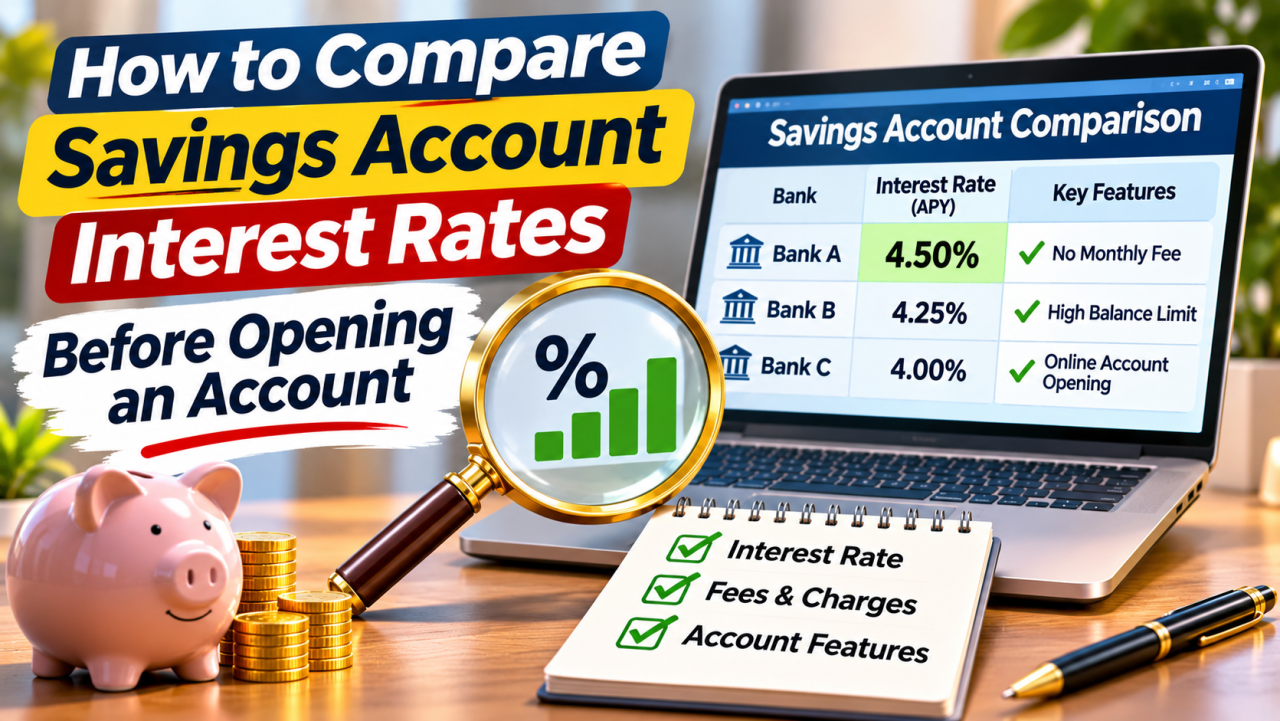
How to Compare Savings Account Interest Rates Before Opening an Account
Choosing a savings account may seem simple, but the interest rate is only one factor that determines how much your money can earn. Some accounts offer competitive annual percentage yields (APYs), while others have monthly fees, minimum balance requirements, or conditions that can affect your returns.
Learning how to compare savings account interest rates can help you make a more informed decision before opening an account. By comparing APY, fees, account requirements, and access to your money, you can find an account that fits your savings goals and financial habits.
For example, an account advertising a higher APY may appear attractive, but monthly maintenance fees could reduce your earnings. Another account with a slightly lower APY might be more suitable if it has no monthly fees, easy access to your funds, and straightforward account requirements.
In this guide, you will learn how savings account interest rates work, why APY matters, what to compare between banks, and how to estimate the interest your savings could earn over time.
All Tools
- All tools
- Budget Calculator
- SIP Calculator
- Take-home Salary Calculator
- Net-worth Calculator
- EMI Calculator
Why Should You Compare Savings Account Interest Rates?
A savings account allows you to set money aside while potentially earning interest. However, the amount you earn depends on the account's APY, your balance, how long your money remains deposited, applicable fees, and whether the bank changes its rate.
Comparing accounts before opening one can help you make a decision based on more than advertising claims.
1. Earn More Interest on Your Savings
A higher APY generally means more interest on the same balance over the same period, assuming comparable account conditions and no offsetting fees.
For example, suppose you deposit $5,000 into two savings accounts with different APYs. If both rates remain unchanged for a year and neither account charges fees, the account with the higher APY will generally earn more.
The difference may seem small initially, but it can become more meaningful as your balance grows or you continue saving over several years.
2. Avoid Fees That Reduce Your Earnings
Some savings accounts charge monthly maintenance fees or impose conditions that you must meet to avoid them.
Other accounts have no monthly maintenance fee but may still include charges for certain services or transactions.
Before opening an account, check its fee schedule. A competitive interest rate is less attractive if recurring charges reduce or eliminate your earnings.
3. Find an Account That Matches Your Savings Goals
Different people use savings accounts for different purposes.
You might be saving for:
- An emergency fund
- A home down payment
- A vacation
- A major purchase
- Future education expenses
- General financial security
If you are building an emergency fund, easy access to your money may be especially important. If you are saving toward a goal you do not expect to reach for several years, you may be more comfortable with an account that has different access conditions, provided those conditions suit your needs.
The best account is not necessarily the one with the highest advertised rate. It is the one that balances potential earnings, costs, accessibility, and your savings habits.
4. Understand the Conditions Behind Promotional Rates
Some banks advertise introductory or promotional interest rates that apply only for a limited period or under specific conditions.
Before opening an account, find out:
- Whether the advertised APY is introductory or ongoing
- Whether a minimum deposit is required
- Whether a minimum balance is needed to earn the stated APY
- Whether the rate applies to your entire balance or only a particular balance range
- Whether the bank can change the rate
Understanding these conditions helps you compare accounts fairly and avoid relying on an advertised rate that may not apply to your situation.
What Is a Savings Account Interest Rate?
A savings account interest rate is the rate a financial institution pays you for keeping money in the account.
When a bank pays interest, it compensates you for depositing money with that institution. The interest is generally calculated according to the account's terms and may be credited monthly, quarterly, or on another schedule.
However, the stated interest rate and the annual percentage yield are not exactly the same.
Understanding the difference is essential when comparing savings accounts.
What Is the Interest Rate?
The interest rate is the stated rate used to calculate interest on your deposit, before accounting for the effect of compounding.
For example, suppose a savings account has a stated annual interest rate of 4.00%.
If you maintain a $1,000 balance for a year, a simple-interest illustration would produce $40 in interest.
Actual earnings may differ because savings accounts can compound interest, and the balance may change during the year.
What Is APY?
APY stands for annual percentage yield. It reflects the effect of compounding over one year, assuming the rate and balance remain unchanged and the interest stays in the account.
Compounding occurs when interest already credited to your account begins earning interest itself.
For example, if an account pays interest monthly and that interest remains deposited, future interest calculations can include the accumulated interest.
For this reason, APY is generally the most useful figure when comparing savings accounts with different compounding schedules.
Interest Rate vs. APY: What's the Difference?
| Feature | Interest rate | APY |
|---|---|---|
| What it represents | The stated rate used to calculate interest | The annual yield reflecting compounding |
| Includes compounding effect | Not necessarily | Yes, for the stated annual period |
| Best use | Understanding the account's stated rate | Comparing potential annual earnings |
| Can change over time? | Yes, for most variable-rate savings accounts | Yes, when the underlying rate changes |
Practical tip: When comparing savings accounts, start with APY rather than comparing the stated interest rates alone. Then check fees, minimum balance requirements, and any other conditions that could affect your actual return.
How Does APY Affect Your Savings?
The effect of APY depends on how much you deposit, how long you leave the money in the account, and whether you make additional deposits or withdrawals.
To illustrate the difference, consider a $5,000 deposit held for one year.
The following figures are hypothetical examples, not current bank offers. They assume each APY remains unchanged for the full year, no additional deposits or withdrawals occur, and no fees apply.
| Starting balance | Illustrative APY | Approximate interest after one year | Approximate ending balance |
|---|---|---|---|
| $5,000 | 1.00% | $50 | $5,050 |
| $5,000 | 2.50% | $125 | $5,125 |
| $5,000 | 4.00% | $200 | $5,200 |
The table shows how the annual yield can affect your potential earnings when the starting balance and holding period are the same.
For instance, the account with a 4.00% APY would earn approximately $150 more than the account with a 1.00% APY on a $5,000 balance over one year, under these assumptions.
Actual results may differ if rates change, fees apply, or you deposit or withdraw money during the year.
Does a Higher APY Always Mean a Better Account?
Not necessarily.
A higher APY is attractive when the other conditions are comparable. However, you should also consider:
- Monthly maintenance fees
- Minimum opening deposits
- Minimum balance requirements
- Withdrawal and transfer access
- Promotional-rate conditions
- Deposit insurance
- Customer service and account management features
For example, a savings account with a slightly lower APY and no monthly fee may be a better fit than one with a higher advertised APY and a fee you are likely to incur.
Compare the total account terms rather than choosing solely on the headline rate.
Key Factors to Compare Before Opening a Savings Account
Once you understand APY, you can evaluate the other details that determine whether an account is suitable for your needs.
1. Annual Percentage Yield (APY)
Start by comparing the APY offered by each account.
Make sure you compare rates for the same balance range and check whether the rate is promotional. For most standard savings accounts, the rate is variable, meaning the bank can change it according to the account terms.
An APY shown today does not guarantee the same earnings next year.
2. Monthly Maintenance Fees
Review whether the account charges a recurring monthly fee.
If a fee applies, check whether you can avoid it by maintaining a certain balance or meeting other requirements.
Even a relatively small monthly fee can reduce the value of a higher APY, particularly if you keep a modest balance.
3. Minimum Opening Deposit
Some banks allow you to open a savings account with no minimum deposit, while others require an initial amount.
Choose an account whose opening requirements fit your available savings.
You should not need to borrow money or compromise your essential expenses just to meet a minimum opening deposit.
4. Minimum Balance Requirements
Check whether you must maintain a certain balance to earn the advertised APY or avoid fees.
An account may offer different rates for different balance tiers. If your balance falls below a threshold, the interest rate or account benefits may change.
Make sure the rate you compare is the one that applies to the amount you expect to keep in the account.
5. Access to Your Money
Consider how quickly and easily you can access your savings.
Review:
- Online and mobile banking features
- Electronic transfers
- ATM access, if available
- Transfer processing times
- Withdrawal conditions
- Any applicable transaction fees or limits
If you are saving for emergencies, accessibility may be just as important as earning a competitive APY.
6. Deposit Insurance
For US consumers, verify whether the bank is insured by the Federal Deposit Insurance Corporation (FDIC) or whether the credit union has applicable federal share insurance through the National Credit Union Administration (NCUA).
Deposit insurance generally protects eligible deposits up to applicable limits if an insured institution fails, subject to the relevant rules.
Check the institution's insurance status and understand the coverage limits before depositing your money.
7. Rate Stability and Account Terms
Most ordinary savings accounts have variable rates, which can change after you open the account.
Check the account agreement to understand whether the rate is variable, whether promotional terms apply, and how the institution communicates changes.
Rather than assuming the current APY will remain available indefinitely, choose an account whose overall features suit your needs even if the rate changes.
How to Compare Savings Account Interest Rates Before Opening an Account — Part 2
How to Compare Savings Account Interest Rates Between Banks
Comparing savings accounts becomes easier when you evaluate them using the same criteria. Rather than choosing the bank with the highest advertised rate, compare the APY, fees, balance requirements, access options, and account conditions side by side.
Follow these steps to make a more informed decision.
Step 1: Compare APYs for Similar Account Types
Start by identifying savings accounts that meet your needs. Compare accounts designed for similar purposes, such as standard savings accounts with other standard savings accounts or high-yield savings accounts with similar alternatives.
Record the advertised APY for each option.
For example, imagine you are comparing three hypothetical accounts:
| Account | Illustrative APY | Monthly maintenance fee | Minimum opening deposit |
|---|---|---|---|
| Account A | 1.00% | $0 | $0 |
| Account B | 3.00% | $0 | $25 |
| Account C | 4.00% | $5 | $100 |
These figures are for illustration only and do not represent current offers from actual banks.
At first glance, Account C appears to be the strongest option because it offers the highest APY. However, its monthly fee could reduce your earnings, especially if you maintain a relatively small balance.
Account B may be worth considering if its requirements fit your circumstances and Account C's fee cannot be avoided.
The lesson: Compare the full account terms, not just the advertised APY.
Step 2: Check Whether the APY Applies to Your Balance
Some savings accounts use balance tiers. The rate you receive may depend on how much money you keep in the account.
For example, an account might offer one APY for balances below a specified threshold and another for higher balances.
Before opening an account, check:
- Whether the advertised APY applies to your expected balance
- Whether different portions of your balance earn different rates
- Whether a minimum balance is required to qualify for the advertised APY
- Whether the rate changes when your balance crosses a threshold
Read the account's rate disclosures carefully. Do not assume the headline APY applies to every dollar you deposit.
Step 3: Identify Fees That Could Reduce Your Earnings
Savings account fees can affect your net financial benefit.
Potential charges include:
- Monthly maintenance fees
- Certain wire transfer fees
- Fees for optional paper statements or special services
- Fees associated with particular transactions or services
Not every account charges these fees, and the exact terms vary by institution.
Suppose an account earns $40 in interest over a year but charges $5 per month in maintenance fees. If you pay the fee for all 12 months, the annual fee total is $60.
Your net result would be a $20 cost relative to your starting balance, before considering taxes or other charges.
This simplified example assumes the interest earned is $40 and the fee remains $5 each month throughout the year.
It demonstrates why a higher interest rate does not automatically translate into a better financial outcome.
Step 4: Review the Bank's Rate Policy
Savings account APYs can change over time, particularly when they are variable.
Before opening an account, look for information about:
- Whether the rate is variable
- Whether a promotional APY applies
- When promotional terms expire
- Whether different balance tiers receive different rates
- How the bank communicates rate changes
- All Tools
- How to manage your salary in India: a no-noise, step-by-step plan
- SIP for beginners in India: how to start, how much, and where (2026 guide)
You generally cannot know in advance exactly what a variable-rate savings account will earn over several years.
A useful approach is to compare the current APY while remembering that it may change. Also consider whether you would still be satisfied with the account's fees, accessibility, and service if its rate fell.
Step 5: Compare Account Access and Convenience
An account should be practical for your daily financial needs.
Consider whether you can transfer money easily between your checking and savings accounts, deposit funds conveniently, and monitor your balance through online or mobile banking.
If you choose an online bank, verify the available deposit methods and how long transfers typically take.
If you prefer in-person assistance, check whether the institution has branches near you.
Convenience matters because a savings account that is difficult to use may not fit your financial habits, even if its APY is competitive.
How Much Interest Can You Earn at Different Savings Account Rates?
One of the easiest ways to compare savings account interest rates is to calculate how much each account could earn on the same starting balance.
The examples below use hypothetical APYs of 3.00% and 4.00%. They are not current bank offers or guaranteed returns.
For simplicity, each example assumes:
- The APY stays unchanged for one full year.
- The starting balance remains in the account for the entire year.
- No additional deposits or withdrawals occur.
- No fees apply.
- Interest is not reduced by taxes.
Because APY already accounts for the effect of compounding over one year, the estimates below use the APY directly rather than compounding it a second time.
Example 1: Comparing Rates on a $1,000 Balance
Suppose you deposit $1,000 into one of two savings accounts.
| Hypothetical APY | Approximate interest after one year | Approximate ending balance |
|---|---|---|
| 3.00% | $30 | $1,030 |
| 4.00% | $40 | $1,040 |
| Difference | $10 | $10 |
With a $1,000 starting balance, the account offering a 4.00% APY would earn approximately $10 more over one year than the account offering a 3.00% APY, assuming all other conditions are equal.
For someone building an initial savings cushion, the difference is modest. However, every dollar earned can contribute to a growing balance.
Example 2: Comparing Rates on a $5,000 Balance
Now suppose you have $5,000 saved.
| Hypothetical APY | Approximate interest after one year | Approximate ending balance |
|---|---|---|
| 3.00% | $150 | $5,150 |
| 4.00% | $200 | $5,200 |
| Difference | $50 | $50 |
On a $5,000 balance, the one-percentage-point difference in APY produces approximately $50 in additional interest over one year.
That difference can help you decide whether switching accounts is worth considering, particularly if the new account has no additional fees or inconvenient requirements.
Example 3: Comparing Rates on a $10,000 Balance
Consider a larger savings balance of $10,000.
| Hypothetical APY | Approximate interest after one year | Approximate ending balance |
|---|---|---|
| 3.00% | $300 | $10,300 |
| 4.00% | $400 | $10,400 |
| Difference | $100 | $100 |
With $10,000 deposited, the account offering a 4.00% APY would earn approximately $100 more over one year than the account offering a 3.00% APY.
This example illustrates why comparing APYs becomes increasingly relevant as your savings balance grows.
Remember that these calculations assume the stated APY remains unchanged for the entire year. Actual earnings may be different if rates change or your balance fluctuates.
Use a Savings Interest Calculator to Compare Your Options
Manually comparing rates is useful for simple examples, but a calculator can help you explore different balances, interest rates, and saving periods.
A savings interest calculator can help you estimate:
- Potential interest earned over a specified period
- Your approximate ending balance
- How different APYs affect earnings
- How regular deposits could contribute to your savings
- How long it might take to reach a savings target
For the most useful comparison, enter the same starting balance and time period for each account. Then compare the results alongside account fees and conditions.
Remember that calculator results are estimates. A calculator that assumes a fixed APY cannot predict future changes to a variable savings rate.
High-Yield Savings Account vs. Traditional Savings Account
When researching savings accounts, you will often encounter two broad categories: traditional savings accounts and high-yield savings accounts.
Both can help you set money aside and earn interest. Their rates, fees, access options, and other conditions can differ by institution.
What Is a Traditional Savings Account?
A traditional savings account is a deposit account offered by a bank or credit union. Depending on the institution, you may be able to open one at a branch, online, or through a mobile app.
Common features can include:
- Access through a branch or digital banking
- Transfers between linked accounts
- Interest on deposited funds
- A minimum opening deposit or balance requirement, depending on the account
- Possible monthly maintenance fees
Traditional savings accounts can be convenient if you already bank with the institution or value in-person service.
However, the interest rate may be less competitive than rates available through some other savings accounts. You should compare actual offers rather than assume all traditional accounts have low rates.
What Is a High-Yield Savings Account?
A high-yield savings account is a savings account marketed for its comparatively competitive interest rate or APY.
These accounts are commonly offered by online banks, although the precise features and availability vary.
Potential advantages include:
- Competitive APYs
- Accounts with no monthly maintenance fees
- Low or no minimum opening deposits on some products
- Online account management
- Electronic transfers between linked accounts
Potential limitations can include fewer in-person services, transfer processing times, or specific account eligibility requirements.
The term “high-yield” does not guarantee that an account will always offer the highest rate available. APYs can change, so it is worth comparing offers periodically.
High-Yield vs. Traditional Savings: Key Differences
| Feature | Traditional savings account | High-yield savings account |
|---|---|---|
| Interest rate | Varies by institution and product | Often marketed with a competitive APY |
| Branch access | May be available | May be limited or unavailable |
| Online banking | Depends on the institution | Usually a central feature |
| Monthly fees | Depends on the account | Some accounts have no monthly fee |
| Minimum balance | Depends on the account | Depends on the account |
| Customer support | May include in-person assistance | Often digital or phone-based, depending on the bank |
| Deposit insurance | Verify the institution's insurance status | Verify the institution's insurance status |
Neither type is automatically the better choice for everyone.
If earning interest is your main priority and you are comfortable managing your money online, a high-yield savings account may be worth considering.
If you value branch access or prefer to keep your accounts with one institution, a traditional savings account may suit you better.
Compare the actual APY and account terms before making a decision.
Online Banks vs. Traditional Banks: Which Should You Choose?
The institution behind the savings account can affect your banking experience.
Online banks generally focus on digital account management, while traditional banks may offer a combination of branches and online services. Some traditional banks also offer competitive digital savings products, so the distinction is not absolute.
Advantages of Online Banks
Online banks may offer:
- Convenient digital account opening
- Mobile and web-based account management
- Competitive savings rates on some products
- Accounts without monthly maintenance fees
- Electronic transfers between accounts
However, you should check how you can deposit cash, contact customer support, and resolve account problems.
Also verify that the bank is appropriately insured. A familiar website or banking app alone does not establish deposit insurance.
Advantages of Traditional Banks
Traditional banks may offer:
- In-person assistance at branches
- Access to a wider range of banking products
- Convenient transfers if you already have a checking account there
- Established digital banking services
- Access to other services under one banking relationship
Some traditional savings accounts may offer less competitive rates than alternatives, but this is not true of every product.
The right choice depends on the actual account terms and the services you value.
How to Decide Between Them
Ask yourself these questions:
- Is earning a competitive APY my main priority?
- Do I need access to physical branches?
- Will I need to deposit cash regularly?
- How quickly can I transfer money when necessary?
- Does the institution offer suitable customer support?
- Is the account eligible for applicable deposit insurance?
- Are there fees or balance conditions that could affect me?
Your answers can help narrow the list of accounts worth comparing.
Common Mistakes to Avoid When Comparing Savings Account Interest Rates
Even when two accounts appear similar, their terms may produce different outcomes. Avoid these common mistakes when reviewing your options.
Mistake 1: Comparing Interest Rates Instead of APYs
The stated interest rate does not necessarily reflect the full effect of compounding.
What to do instead: Compare APYs when evaluating the annual earning potential of different savings accounts. Then review the rest of each account's terms.
Mistake 2: Choosing an Account Based Only on the Highest APY
A high APY can be attractive, but fees and restrictions may reduce its value.
What to do instead: Compare the APY, fees, minimum balance, opening deposit, and access conditions together.
Mistake 3: Ignoring Promotional Rates
An advertised rate may be available only during an introductory period or under particular conditions.
What to do instead: Check whether the APY is promotional and what rate terms apply after the promotion ends.
Mistake 4: Overlooking Minimum Balance Requirements
You might qualify for a particular APY only if you maintain a specified balance.
What to do instead: Confirm which APY applies to your expected balance and whether falling below a threshold could affect your earnings or fees.
Mistake 5: Assuming Today's Rate Will Last Forever
Many savings accounts have variable rates. A competitive APY today is not a promise of the same return next year.
What to do instead: Compare rates periodically and choose an account whose overall terms remain suitable even if its APY changes.
Mistake 6: Forgetting About Fees
A monthly maintenance fee can offset interest earnings, particularly on smaller balances.
What to do instead: Review the account's fee schedule and check whether any charges can be avoided.
Mistake 7: Ignoring Deposit Insurance
A savings account's rate is only one part of evaluating where to keep your money.
What to do instead: Verify the institution's insurance status through the appropriate official source. For US consumers, check FDIC insurance for banks or NCUA share insurance for federally insured credit unions, as applicable.
Mistake 8: Not Considering How You Will Use the Account
An account may offer a competitive APY but be inconvenient for your needs.
What to do instead: Consider how you will deposit money, make transfers, access funds, and contact customer support.
Mistake 9: Treating Estimated Earnings as Guaranteed
A calculator may show how much your savings could earn at a particular APY, but it cannot guarantee that a variable rate will remain unchanged.
What to do instead: Treat estimates as planning tools and check the account's current terms before opening it.
Step-by-Step Checklist for Comparing Savings Accounts
Now that you understand APY, fees, and account types, you can use a simple checklist to compare savings accounts before opening one.
The goal is to find an account that balances potential interest earnings with reasonable costs, convenient access, and suitable account terms.
Step 1: Decide What You Need the Account For
Start by identifying your main savings goal.
Are you building an emergency fund, saving for a large purchase, setting money aside for a vacation, or keeping cash available for unexpected expenses?
Your goal can help determine which account features matter most.
All Tools
- All tools
- EMI Calculator
- Budget Calculator
- SIP Calculator
- Take-home Salary Calculator
- Net-worth Calculator
For example, an emergency fund generally calls for convenient access to your money. If you are saving for a specific purchase, you may prefer an account that helps you keep that money separate from everyday spending.
Step 2: Estimate Your Starting Balance
Determine approximately how much money you plan to deposit when opening the account.
Your starting balance matters because some accounts have minimum deposit requirements or different APYs for different balance ranges.
If you plan to deposit $500, for example, an account requiring a $2,500 opening deposit may not be suitable unless you can comfortably meet that requirement.
Do not use money intended for essential expenses simply to qualify for a particular savings account.
Step 3: Compare APYs Across Several Accounts
Choose a few accounts that meet your basic requirements and compare their advertised APYs.
Use the same balance and time period when estimating potential earnings.
For example, compare what each account could earn on a $5,000 balance over one year, assuming the APYs remain unchanged.
This approach makes the potential difference between accounts easier to understand.
Remember that variable APYs can change, so an estimate is not a guarantee of future earnings.
Step 4: Review Fees and Balance Requirements
Read each account's fee schedule and deposit agreement.
Check:
- Monthly maintenance fees
- Minimum opening deposit
- Minimum balance requirements
- Conditions for earning the advertised APY
- Fees for particular services or transactions
- Any introductory-rate conditions
If an account has a monthly fee, calculate its potential annual cost.
For example, a $5 monthly fee would total $60 over 12 months if charged every month. Compare that cost with the interest you expect to earn.
Step 5: Check Deposit Insurance
Before transferring your savings, verify that the institution is appropriately insured.
In the United States, eligible deposits at FDIC-insured banks are generally protected up to applicable limits. Eligible shares at federally insured credit unions receive coverage through the NCUA's share insurance system, subject to its rules and limits.
Review the official insurance information rather than relying only on a bank's marketing materials.
You can learn more through the official FDIC deposit insurance resources and NCUA share insurance resources.
Step 6: Evaluate Account Access and Customer Support
Consider how you will use the account in everyday life.
Ask yourself:
- Can I transfer money conveniently?
- Are transfer processing times suitable for my needs?
- Can I deposit cash if necessary?
- Is the mobile app easy to use?
- Can I contact customer support when I need help?
- Are branches available if I prefer in-person service?
A competitive APY is valuable, but convenience and access also matter.
Step 7: Estimate Your Potential Interest Earnings
Use a savings interest calculator to compare possible outcomes.
Enter your expected balance, APY, and savings period. If you plan to add money regularly, use a calculator that supports recurring deposits.
Compare the estimated results with any fees or account conditions.
For an accurate comparison, ensure that the calculator's assumptions match the account terms as closely as possible.
Step 8: Read the Terms Before Opening the Account
Before completing your application, review the account's current disclosures.
Confirm the APY, minimum deposit, fees, eligibility requirements, and any promotional conditions.
If something is unclear, ask the financial institution for clarification before depositing your money.
Final checklist: Choose the account that offers a suitable combination of competitive APY, manageable fees, accessible funds, appropriate deposit insurance, and account terms that fit your savings goals.
Should You Switch to a Savings Account With a Higher APY?
If you already have a savings account, you may wonder whether opening a new account with a higher APY is worthwhile.
The answer depends on how much additional interest you could earn and whether switching introduces costs or inconveniences.
Calculate the Potential Difference in Earnings
Suppose you have $10,000 in a savings account earning a hypothetical 2.00% APY. You find another account offering a hypothetical 3.50% APY.
Assuming both APYs remain unchanged for one year, no deposits or withdrawals occur, and no fees apply:
| Account | Hypothetical APY | Approximate interest over one year |
|---|---|---|
| Current account | 2.00% | $200 |
| Alternative account | 3.50% | $350 |
| Potential difference | 1.50 percentage points | $150 |
Under these assumptions, the alternative account would earn approximately $150 more over one year.
These are illustrative rates, not current market offers. Actual earnings will vary if the APYs change or account conditions differ.
Consider the Costs and Effort of Switching
Before switching, check whether the new account has:
- Monthly fees
- Minimum balance requirements
- Different transfer processing times
- Account eligibility restrictions
- Less convenient access to your money
Also consider whether you need to update automatic transfers or change any financial routines linked to your existing account.
If the new account has no meaningful disadvantages, a higher APY may make switching worthwhile. If the difference in potential earnings is small, convenience may be a reasonable reason to stay.
Do You Need to Close Your Existing Savings Account?
Not necessarily.
You may be able to keep your existing account and open another savings account, provided you meet the institutions' eligibility requirements.
Multiple accounts can help you separate savings goals, but they can also make your finances harder to manage. Consider whether maintaining more than one account will help you organize your money or create unnecessary complexity.
If you decide to close an account, first confirm that outstanding transactions have cleared and redirect any automatic transfers.
How Often Should You Compare Savings Account Interest Rates?
There is no single schedule that works for everyone, but reviewing your savings account periodically can help you determine whether it remains suitable.
Consider reviewing your account when:
- You notice a substantial change in its APY.
- Your savings balance increases significantly.
- Your bank introduces new fees or changes account terms.
- You see another account that may offer a better overall fit.
- Your financial goals or access needs change.
You do not need to switch accounts every time another institution advertises a slightly higher rate.
Instead, compare the potential benefit with the practical costs of switching. A suitable account with reasonable fees and convenient access may still be a good choice even if it is not always the highest-rate option available.
Conclusion: Compare More Than Just Savings Account Interest Rates
Learning how to compare savings account interest rates can help you make a more informed decision about where to keep your money.
Start by comparing APYs because they reflect the effect of compounding over a year. Then evaluate fees, minimum deposits, balance requirements, access options, rate conditions, and deposit insurance.
Remember that the highest advertised APY does not automatically make an account the best choice. Fees can reduce earnings, promotional rates may expire, and variable interest rates can change over time.
Before opening an account, compare several options using the same balance and savings period. Estimate the potential interest, read the account disclosures, and make sure the account suits your financial needs.
Ready to Compare Your Savings Options?
Use a savings interest calculator to estimate how much your money could earn at different APYs. Then compare available savings accounts to identify options that fit your balance, savings goals, and access requirements.
A little research before opening an account can help you avoid unnecessary fees and make more informed decisions about your savings.
Financial education disclaimer: This article is for informational and educational purposes only and is not individualized financial advice. Savings account rates, fees, eligibility requirements, and deposit insurance rules may change. Review the institution's current disclosures and official insurance information before opening an account.
Frequently Asked Questions
1. How do I compare savings account interest rates?
Compare the APY, monthly fees, minimum opening deposit, balance requirements, and account access options. Check whether the advertised rate is promotional and whether it applies to your expected balance. Comparing these factors together helps you evaluate the account's overall value.
2. What is a good APY for a savings account?
A good APY is competitive with the rates currently available on comparable accounts and suits your savings needs. Rates change over time, so compare current offers rather than relying on an outdated benchmark. Also consider fees, account conditions, and deposit insurance.
3. Is APY more important than the interest rate?
APY is generally more useful for comparing annual savings earnings because it reflects the effect of compounding. However, APY should not be your only consideration. Fees, minimum balance requirements, and other account terms can affect the overall value of a savings account.
4. How much interest will $10,000 earn in a savings account?
The amount depends on the account's APY, how long the money stays deposited, and any applicable fees or changes in the rate. For example, $10,000 held for one year at a hypothetical 4.00% APY would earn approximately $400 before taxes, assuming the APY remains unchanged and there are no deposits, withdrawals, or fees.
5. Can savings account interest rates change?
Yes. Many savings accounts have variable rates, which can change over time. The APY available when you open an account is not necessarily the APY you will receive in future months or years. Review rate disclosures and check your account periodically.
6. Are high-yield savings accounts better than traditional savings accounts?
Not always. High-yield savings accounts may offer competitive APYs, while traditional savings accounts may provide convenient branch access or other services. Compare the actual rates, fees, minimum balances, deposit insurance, and account features before choosing.
7. Are savings accounts at online banks safe?
An online savings account may be a suitable place to keep money if the institution is legitimate and appropriately insured. In the United States, verify FDIC insurance for a bank or applicable NCUA share insurance for a federally insured credit union. Review the institution's official information before depositing funds.
8. Do savings accounts have minimum balance requirements?
Some savings accounts require a minimum opening deposit or ongoing balance, while others do not. Certain accounts may also use balance tiers to determine the APY or whether fees apply. Read the account disclosures to understand the requirements before opening an account.
9. Do I have to pay taxes on savings account interest?
In the United States, savings account interest is generally taxable income, although individual circumstances and applicable rules can affect tax treatment. Your financial institution may provide a tax form when reporting requirements apply. Consult the IRS or a qualified tax professional for guidance about your situation.
10. Should I switch savings accounts for a higher APY?
Consider switching if the additional interest you could earn justifies any fees, restrictions, or inconvenience. Compare the accounts using the same balance and time period, and check whether the higher APY is promotional. A higher rate may be worthwhile, but the overall account terms matter too.
11. Can I open more than one savings account?
In many cases, yes, although eligibility and account-opening rules vary by institution. Multiple accounts can help you separate goals, such as emergency savings and travel savings. Before opening another account, consider whether managing multiple accounts will be convenient and check applicable deposit insurance limits and ownership categories.