
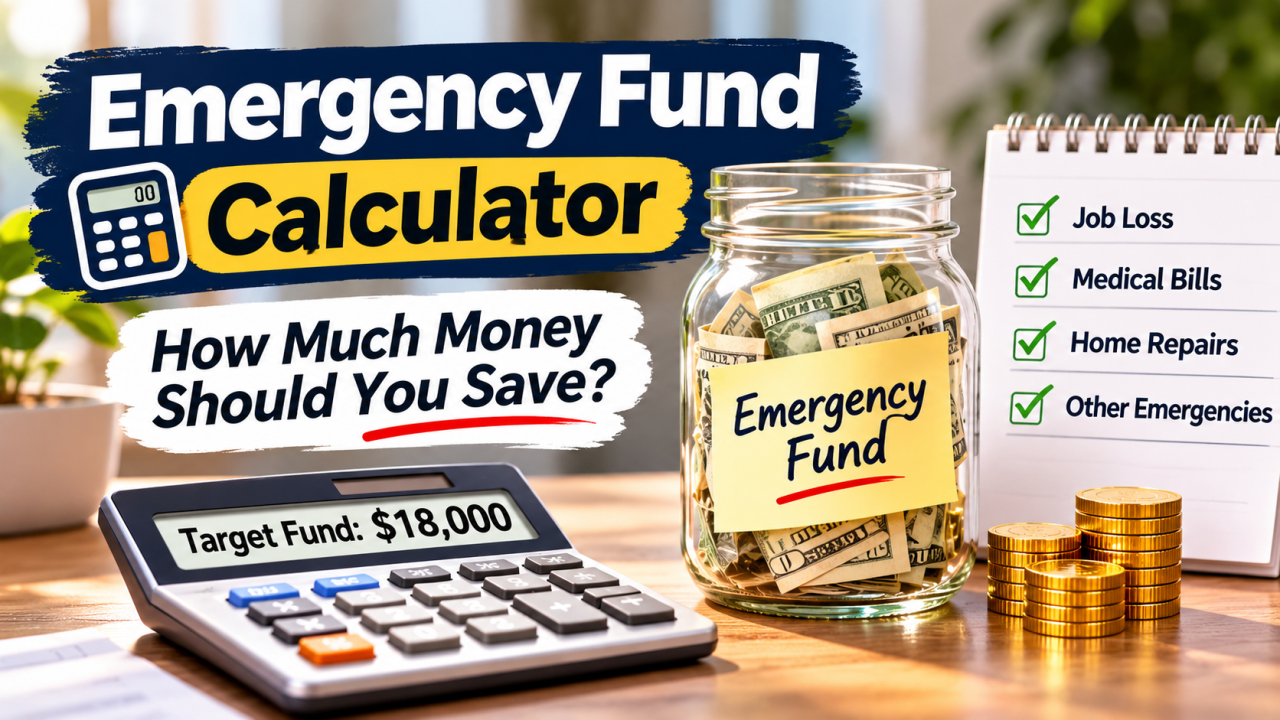
Emergency Fund Calculator: How Much Money Should You Save?
An emergency fund calculator can help you estimate how much money you should save to handle unexpected expenses without relying on credit cards, personal loans, or money intended for other financial goals.
Life can be unpredictable. You might face an unexpected car repair, a medical bill, a temporary loss of income, or an urgent home repair. Without savings set aside for these situations, even a relatively small expense can disrupt your monthly budget.
So, how much should you keep in an emergency fund?
A common starting point is to save enough to cover three to six months of essential living expenses. However, the right target depends on your income stability, household responsibilities, debt obligations, insurance coverage, and access to other financial resources.
For some people, a smaller starter emergency fund is a practical first milestone. Others may benefit from saving enough to cover six to twelve months of essential expenses, particularly if their income varies or they support dependents.
This guide explains how to calculate your emergency fund target, which expenses to include, and how to build your savings gradually.
You'll also learn how to adjust your goal to fit your financial situation instead of following a one-size-fits-all savings rule.
All Tools
- All tools
- SIP Calculator
- EMI Calculator
- Budget Calculator
- Take-home Salary Calculator
- Net-worth Calculator
What Is an Emergency Fund?
An emergency fund is money set aside specifically for unexpected expenses or financial disruptions.
Unlike money saved for a vacation, a new car, or a planned home purchase, emergency savings are intended to help you manage costs you did not anticipate.
For example, an emergency fund may help cover:
- Essential bills during a period of unemployment.
- An unexpected car repair needed to get to work.
- An urgent home repair, such as a broken water heater.
- Necessary medical expenses not covered by insurance.
- Emergency travel for a serious family situation.
- Essential expenses during a temporary interruption in income.
- All Tools
- How to manage your salary in India: a no-noise, step-by-step plan
- SIP for beginners in India: how to start, how much, and where (2026 guide)
The purpose is to provide a financial cushion when something goes wrong.
Without emergency savings, you may need to borrow money, withdraw from long-term investments, or delay paying other bills. Having cash available can give you more flexibility to respond to a problem without disrupting your entire financial plan.
Emergency Fund vs. Regular Savings
An emergency fund and a general savings account can both hold money, but they serve different purposes.
| Feature | Emergency Fund | General Savings |
|---|---|---|
| Main purpose | Cover unexpected essential expenses | Fund planned goals and purchases |
| Examples | Job loss, urgent repairs, unexpected medical costs | Vacation, electronics, home upgrades |
| When to use it | When an eligible, necessary, unexpected expense occurs | According to your savings goal |
| Planning approach | Based on essential expenses and financial risks | Based on the cost and timing of a goal |
| Recommended access | Relatively quick access to cash | Depends on the savings goal |
You can hold your emergency fund and other savings in separate accounts or use clearly defined savings categories within your banking system.
The important thing is to avoid treating your emergency fund as money available for routine discretionary spending.
Why Is an Emergency Fund Important?
Emergency savings can provide financial stability when your regular income or expenses change unexpectedly.
1. It reduces the need for expensive borrowing.
Without cash reserves, you may have to use a credit card or loan to cover an urgent expense. Depending on the terms, borrowing can add interest and fees to an already stressful situation.
2. It helps protect your monthly budget.
A large unexpected bill can make it harder to pay rent, utilities, groceries, or other essential expenses. Emergency savings can help you handle the bill while keeping your regular obligations on track.
3. It provides flexibility during income disruptions.
If you lose your job, experience reduced working hours, or have a temporary decline in self-employment income, emergency savings can help cover essential costs while you look for a solution.
4. It can help protect long-term financial goals.
Having cash available for emergencies may reduce the need to withdraw money from retirement accounts or sell investments at an inconvenient time.
5. It can provide peace of mind.
Knowing you have money reserved for unexpected expenses may make financial uncertainty easier to manage.
An emergency fund cannot prevent every financial problem, but it can give you more options when an unexpected expense occurs.
Emergency Fund Calculator: How Much Money Should You Save?
The amount you need depends primarily on your essential monthly expenses and how many months of expenses you want your fund to cover.
A commonly used guideline is to save three to six months of essential living expenses. People with irregular income, a single household income, dependents, or limited access to other resources may prefer a larger cushion.
You don't necessarily need to reach your final target immediately. Building your fund in stages can make the goal more achievable.
The Basic Emergency Fund Formula
Use this formula to estimate your emergency savings goal:
Emergency Fund Target = Essential Monthly Expenses × Number of Months to Cover
For example, suppose your essential expenses total $3,000 per month.
- Three-month emergency fund: $3,000 × 3 = $9,000
- Six-month emergency fund: $3,000 × 6 = $18,000
- Nine-month emergency fund: $3,000 × 9 = $27,000
- All Tools
- How to manage your salary in India: a no-noise, step-by-step plan
- SIP for beginners in India: how to start, how much, and where (2026 guide)
- Twelve-month emergency fund: $3,000 × 12 = $36,000
These figures represent target balances, not amounts you must save immediately.
If you already have $4,000 in emergency savings and your target is $18,000, you would need another $14,000 to reach that goal.
Your calculator should also account for any savings you have already set aside specifically for emergencies.
Quick Emergency Fund Calculator Table
Use the following table to estimate your savings target based on essential monthly expenses.
| Essential Monthly Expenses | 3 Months | 6 Months | 9 Months | 12 Months |
|---|---|---|---|---|
| $1,500 | $4,500 | $9,000 | $13,500 | $18,000 |
| $2,000 | $6,000 | $12,000 | $18,000 | $24,000 |
| $2,500 | $7,500 | $15,000 | $22,500 | $30,000 |
| $3,000 | $9,000 | $18,000 | $27,000 | $36,000 |
| $4,000 | $12,000 | $24,000 | $36,000 | $48,000 |
| $5,000 | $15,000 | $30,000 | $45,000 | $60,000 |
| $6,000 | $18,000 | $36,000 | $54,000 | $72,000 |
How to use the table: Find your approximate essential monthly expenses in the first column. Then choose the number of months you want your emergency fund to cover.
For instance, if your essential expenses are $2,500 per month and you want six months of coverage, your target would be $15,000.
Your actual target may be higher or lower depending on your circumstances.
Calculate Your Emergency Fund Gap
Your emergency fund gap is the difference between your target and the amount you have already saved.
Use this formula:
Emergency Fund Gap = Emergency Fund Target − Current Emergency Savings
Suppose your target is $15,000 and you already have $5,500 saved.
$15,000 − $5,500 = $9,500 remaining
This tells you how much more you need to save to reach your goal.
If your current emergency savings already meet or exceed your chosen target, you may not need to add more solely to meet that target. You can instead review whether the amount remains appropriate as your expenses and circumstances change.
What Expenses Should You Include in Your Emergency Fund Calculator?
Your emergency fund should generally be based on essential living expenses rather than your entire monthly spending.
This distinction matters because some expenses can be reduced or paused during a financial disruption, while others must continue.
For example, you might temporarily stop restaurant spending or cancel a streaming subscription. You may not be able to avoid paying rent, buying groceries, or maintaining necessary insurance.
Essential Expenses to Include
Consider including the following categories when estimating your monthly costs.
All Tools
- All tools
- EMI Calculator
- Budget Calculator
- SIP Calculator
- Take-home Salary Calculator
- Net-worth Calculator
Housing
- Rent or mortgage payments.
- Property taxes, if paid separately.
- Homeowners or renters insurance.
- Essential home maintenance costs.
Utilities and Communication
- Electricity.
- Heating and water.
- Basic internet service, where needed.
- Essential mobile phone service.
Food and Household Necessities
- Groceries.
- Essential household supplies.
- Basic personal care items.
Transportation
- Necessary car payments.
- Fuel or charging costs.
- Auto insurance.
- Public transportation needed for work or essential activities.
- Essential vehicle maintenance.
Healthcare
- Health insurance premiums.
- Necessary prescription medications.
- Routine medical costs that must continue.
- Essential out-of-pocket healthcare expenses.
Debt Obligations
- Required minimum payments on credit cards.
- Student loan payments.
- Personal loan payments.
- Other contractual debt obligations.
Dependents and Family Responsibilities
- Essential childcare.
- Necessary school-related costs.
- Support for dependent family members.
- Other unavoidable family expenses.
Your own list may include additional items depending on your circumstances.
Expenses You May Not Need to Include in Full
Some spending can potentially be reduced during a financial emergency.
Examples include:
- Restaurant meals and takeout.
- Entertainment subscriptions.
- Nonessential shopping.
- Vacations.
- Optional memberships.
- Hobbies and discretionary purchases.
You don't necessarily have to remove every discretionary expense from your budget. The goal is to estimate a realistic monthly amount you would need to keep your household functioning during a difficult period.
For example, a modest entertainment budget may be reasonable if you expect to maintain it during an income disruption. The key is to distinguish necessary costs from spending you could temporarily reduce.
Should You Include Debt Payments?
Yes, include required minimum debt payments when calculating your essential monthly expenses.
If your income stops, you may still need to make payments on credit cards, student loans, auto loans, or other debts.
However, distinguish between required payments and optional extra payments.
For example, if your required student loan payment is $250 per month but you usually pay an additional $100 toward the balance, your emergency budget might include the required $250 payment rather than the full $350.
You can decide whether to continue making extra payments based on your financial circumstances.
Three Months vs. Six Months vs. Twelve Months of Expenses
How many months should your emergency fund cover?
The answer depends on how much financial uncertainty you face and how quickly you could replace lost income or reduce expenses.
Three-Month Emergency Fund
A three-month emergency fund can be a useful initial target for someone with relatively predictable income, manageable essential expenses, and good employment prospects.
For example, if your essential expenses are $2,000 per month, three months of coverage would require $6,000.
This target may be a reasonable starting point, although it might not provide enough protection for everyone.
Six-Month Emergency Fund
A six-month emergency fund provides a larger cushion.
It may be appropriate for households with dependents, significant fixed expenses, limited flexibility to reduce spending, or concerns about how long it might take to find new employment.
If your essential monthly expenses are $3,500, six months of coverage would equal $21,000.
This can provide more time to adjust your finances if your income is interrupted.
Nine- to Twelve-Month Emergency Fund
A larger emergency fund may be useful if your income varies considerably, your work is seasonal, you are self-employed, or you expect it could take longer to replace your income.
For example, someone with essential expenses of $4,000 per month would need:
- Nine months: $36,000.
- Twelve months: $48,000.
These larger targets may take time to build. You can work toward them gradually rather than delaying all other financial priorities until you reach the full amount.
Which Emergency Fund Target Is Right for You?
Use the following guide as a starting point, not a strict rule.
| Financial Situation | Possible Starting Target |
|---|---|
| Predictable income and relatively low essential expenses | 3 months |
| Dependents or significant recurring obligations | 3–6 months or more |
| Single-income household | Consider 6 months or more |
| Variable or seasonal income | Consider 6–12 months |
| Self-employed or freelance worker | Consider 6–12 months |
| Specialized occupation with a potentially long job search | Consider a larger cushion |
| Limited savings and immediate financial pressure | Start with a smaller, achievable milestone |
Your target should reflect your actual circumstances. A larger fund isn't automatically better if building it would require missing essential bills or taking on expensive debt.
Start with an achievable goal, then increase it as your financial situation improves.
Emergency Fund Calculator Examples for Different Budgets
An emergency fund calculator becomes more useful when you apply it to your actual expenses, savings, and financial circumstances.
Your target should reflect the money you need to cover essential expenses if your income is interrupted or an unexpected cost affects your budget.
Let's look at several examples.
Example 1: Single Adult With $2,000 in Monthly Expenses
Suppose you live alone and spend $2,000 per month on essential expenses.
Your monthly budget includes rent, utilities, groceries, transportation, insurance, and minimum debt payments.
Your emergency fund targets would be:
| Coverage Period | Emergency Fund Target |
|---|---|
| 1 month | $2,000 |
| 3 months | $6,000 |
| 6 months | $12,000 |
| 9 months | $18,000 |
| 12 months | $24,000 |
If your income is predictable and you have relatively low financial obligations, a three-month target might be a reasonable initial goal.
If you want more protection against a prolonged job search or unexpected income disruption, you might work toward six months of expenses.
Example: If you currently have $3,000 saved and choose a $12,000 target, you need another $9,000 to reach your goal.
You don't have to save the entire amount immediately. A consistent monthly contribution can help you build your fund over time.
Example 2: Family With $4,000 in Monthly Essential Expenses
Now imagine a household with two adults and one child.
Its essential monthly expenses total $4,000, including housing, groceries, utilities, childcare, transportation, insurance, and required debt payments.
The potential emergency fund targets are:
| Coverage Period | Emergency Fund Target |
|---|---|
| 1 month | $4,000 |
| 3 months | $12,000 |
| 6 months | $24,000 |
| 9 months | $36,000 |
| 12 months | $48,000 |
A family may have less flexibility to reduce expenses during a financial emergency because childcare, housing, and healthcare costs can be difficult to avoid.
For this household, a six-month target would equal $24,000.
However, the appropriate amount depends on factors such as whether both adults earn income, how stable their jobs are, and whether they have other financial resources.
If the household has only one income, it may consider a larger cushion.
Example 3: Freelancer With Variable Monthly Income
Freelancers, contractors, and self-employed workers may experience irregular income.
One month may be profitable, while the next brings fewer projects or delayed client payments.
Suppose a freelancer has essential monthly expenses of $3,000.
| Coverage Period | Emergency Fund Target |
|---|---|
| 3 months | $9,000 |
| 6 months | $18,000 |
| 9 months | $27,000 |
| 12 months | $36,000 |
A freelancer may prefer to work toward a six- to twelve-month emergency fund, depending on income volatility, client concentration, and the time needed to replace lost work.
This is a planning guideline, not a universal requirement.
Self-employed people should also distinguish personal emergency savings from business cash reserves. Money needed for business expenses, taxes, or payroll may require separate planning.
Example 4: Household With $5,500 in Monthly Essential Expenses
Suppose your household spends $5,500 per month on essential costs.
You have a mortgage, two vehicles, insurance premiums, groceries, utilities, and required loan payments.
Your emergency fund targets would be:
| Coverage Period | Emergency Fund Target |
|---|---|
| 3 months | $16,500 |
| 6 months | $33,000 |
| 9 months | $49,500 |
| 12 months | $66,000 |
These figures may look substantial, but they are based on the amount needed to cover essential expenses over time.
If saving $33,000 feels overwhelming, divide the goal into smaller milestones.
For example:
- First milestone: $1,000.
- Second milestone: One month of essential expenses.
- Third milestone: Three months of essential expenses.
- Fourth milestone: Six months of essential expenses.
The milestones can make the goal feel more manageable while helping you build financial resilience.
How to Calculate How Much You Need to Save Each Month
Once you know your emergency fund target, the next step is to determine how much you need to save regularly.
Use this formula:
Monthly Savings Required = (Emergency Fund Target − Current Emergency Savings) ÷ Number of Months to Reach Your Goal
This formula calculates the amount you need to contribute each month to reach your target within your chosen timeframe.
It does not include interest earned on your savings, so your actual result may vary slightly if your account earns interest.
Example: Build a $10,000 Emergency Fund in 12 Months
Suppose your target is $10,000 and you currently have $2,000 saved.
Your remaining savings gap is:
$10,000 − $2,000 = $8,000
If you want to reach your goal in 12 months:
$8,000 ÷ 12 = $666.67
You would need to save approximately $667 per month.
If that amount is too high for your budget, consider extending your timeline or setting a smaller initial target.
Monthly Savings Targets for Different Timelines
Suppose you need to save $6,000 more to reach your emergency fund goal.
| Time to Reach Goal | Approximate Monthly Savings Required |
|---|---|
| 3 months | $2,000 |
| 6 months | $1,000 |
| 9 months | $666.67 |
| 12 months | $500 |
| 18 months | $333.33 |
| 24 months | $250 |
These amounts exclude interest and assume you make equal monthly contributions.
A longer timeline lowers the amount you need to save each month, although it also means your emergency fund will take longer to reach its target.
Choose a timeline that fits your income and essential obligations.
What If You Can Save Only $100 per Month?
You can still make progress with a modest contribution.
If you save $100 per month:
| Saving Period | Total Contributions |
|---|---|
| 3 months | $300 |
| 6 months | $600 |
| 12 months | $1,200 |
| 18 months | $1,800 |
| 24 months | $2,400 |
| 36 months | $3,600 |
These figures exclude interest and assume you do not withdraw money from the account.
The key is consistency. Saving $100 each month can help you build a starter emergency fund and gradually improve your financial security.
If your income increases or your expenses decrease, you can raise your contribution later.
Remember: A realistic savings plan that you can maintain is generally more useful than an ambitious target that repeatedly forces you to miss essential bills.
How Your Income and Employment Situation Affect Your Emergency Fund
Your monthly expenses provide the starting point for calculating your emergency fund, but they aren't the only factor.
The stability of your income can influence how much protection you need.
Employees With Predictable Income
If you receive a regular paycheck, have stable employment, and can usually find comparable work relatively quickly, a three-month emergency fund may be a reasonable starting point.
You may still prefer a larger fund if you have dependents, significant debt obligations, or limited flexibility to reduce expenses.
Job security is never guaranteed, so consider your industry and household circumstances rather than relying on employment status alone.
Self-Employed People and Freelancers
If your income varies from month to month, consider how long you could manage essential expenses during a period with fewer clients or contracts.
A larger personal emergency fund may be useful if you have irregular revenue or work in a seasonal industry.
You may also need separate reserves for business expenses and tax obligations.
Avoid counting the same dollars toward both your personal emergency fund and your business cash reserve.
Households With One Income
A household that depends on one person's earnings may have fewer immediate options if that income stops.
For this reason, it may be useful to aim for a larger emergency fund, particularly if the household has children, a mortgage, or other substantial fixed expenses.
The goal is to create enough flexibility to cover essential bills while you assess your options.
Dual-Income Households
Two incomes may provide additional flexibility, especially if the earners work in different industries and their incomes are not closely correlated.
However, two incomes do not automatically mean you need a smaller emergency fund.
If both people work in the same industry, face similar employment risks, or support several dependents, a larger reserve may still be appropriate.
Retirees and People With Irregular Income
Retirees, seasonal workers, and people who rely on commissions may need to consider the predictability of their cash flow and the types of expenses they could face.
The appropriate reserve depends on pension or benefit income, essential costs, insurance coverage, and other liquid resources.
For retirees, emergency savings should also be considered alongside the broader retirement income plan. A general three- to six-month guideline may not capture every retirement-specific risk.
How to Adjust Your Emergency Fund Target for Your Situation
A calculator can produce a number, but you should adjust that number to reflect your circumstances.
Consider the following factors before settling on your final target.
Household Size and Dependents
A household with children or other dependents may have essential costs that are difficult to reduce quickly.
Childcare, healthcare, transportation, and educational necessities may increase the amount needed to maintain the household during a financial disruption.
If you support other family members, include their essential costs when estimating your monthly expenses.
Insurance Coverage and Deductibles
Insurance can reduce the financial impact of certain emergencies, but it may not eliminate every expense.
Review relevant deductibles, out-of-pocket limits, coverage exclusions, and premium obligations.
For example, you may need to pay an insurance deductible before coverage applies to a covered claim.
You do not necessarily need to save the maximum possible deductible for every insurance policy in addition to a full emergency fund. Instead, consider the likelihood and potential timing of those expenses when deciding how much accessible cash you want.
Debt Obligations
Required debt payments are usually part of your essential monthly expenses.
If you have a mortgage, auto loan, student loan, or credit card balance, consider how those obligations would affect your budget if your income declined.
It may be appropriate to build a starter emergency fund while paying down expensive debt, then increase your emergency savings as your circumstances allow.
The right balance depends on interest rates, minimum payments, access to credit, and how vulnerable your budget is to unexpected costs.
Access to Other Financial Resources
Consider whether you have reliable alternative resources, such as a partner's stable income or other readily available cash.
Be cautious about treating investments, retirement accounts, or unused credit limits as substitutes for emergency savings.
Investments can lose value, withdrawals may have tax consequences or penalties, and credit must generally be repaid.
A cash emergency fund can provide a more direct source of money when an unexpected expense occurs.
Your Comfort With Financial Risk
Two households with identical monthly expenses may choose different emergency fund targets because their circumstances differ.
One person may feel comfortable with three months of essential expenses, while another may prefer nine months because their income is less predictable.
Use the calculator to establish a starting point, then choose a target that balances financial protection with your other priorities.
Where Should You Keep Your Emergency Fund?
An emergency fund should generally be kept somewhere that provides suitable access to your money while helping you avoid unnecessary risk.
For many people, an interest-bearing savings account at an appropriately insured bank or credit union is a practical option.
High-Yield Savings Accounts
A high-yield savings account can help your emergency savings earn interest while remaining accessible.
When comparing accounts, check:
- Current APY.
- Monthly maintenance fees.
- Minimum balance requirements.
- Transfer processing times.
- Withdrawal conditions.
- Applicable FDIC or NCUA insurance.
A higher APY can be beneficial, but convenience and access also matter.
Money Market Deposit Accounts
A bank or credit union money market account may provide interest along with features such as check-writing privileges or debit card access, depending on the institution.
These features can be useful if you want more ways to access your emergency savings.
Compare the account's fees and minimum balance requirements before opening it.
Checking Accounts
Keeping a portion of your emergency money in a checking account may make sense if you need immediate access to cash for urgent expenses.
However, checking accounts may offer lower interest rates than some savings accounts.
You might choose to keep enough readily accessible for immediate needs and hold the remainder in a suitable savings account, provided transfers are convenient and reliable.
Investments Are Not Always Suitable for Emergency Savings
Stocks, cryptocurrency, and other volatile investments can fluctuate in value.
If you need money during a market downturn, you may have to sell an investment at a loss.
Emergency savings generally serve a different purpose from long-term investments: they provide accessible funds for unexpected expenses rather than seeking maximum investment returns.
A certificate of deposit (CD) may also impose early withdrawal penalties or other restrictions, depending on its terms. That can make it less suitable for money you may need unexpectedly.
Important: Verify that the financial institution is appropriately insured and understand the applicable coverage limits. A money market mutual fund is not the same as a bank money market deposit account and is not FDIC-insured.
How to Build Your Emergency Fund Faster
Building an emergency fund can take time, especially if your budget is already tight.
You don't necessarily need to make dramatic lifestyle changes. A combination of automatic saving, small spending adjustments, and occasional extra contributions can help you make steady progress.
1. Automate Your Savings
Set up an automatic transfer from your checking account to your emergency savings account after payday.
For example, saving $50 per week would produce approximately $2,600 in contributions over a full year, assuming 52 weekly transfers and no withdrawals.
Choose an amount that leaves enough money for your essential bills.
2. Start With a Small, Achievable Milestone
If your ultimate target is $15,000, you may find it easier to focus first on reaching $500 or $1,000.
Once you reach that milestone, work toward one month of essential expenses and then continue building toward your longer-term goal.
Your first milestone should reflect your circumstances. If your essential expenses are high, even a small initial fund can help you prepare for some unexpected costs.
3. Review Recurring Expenses
Look for recurring charges you no longer use or services you can reduce without affecting essential needs.
Potential areas to review include subscriptions, mobile plans, insurance premiums, and other recurring bills.
You do not need to eliminate every discretionary expense. The goal is to identify savings that you can sustain without creating unnecessary hardship.
4. Save Part of Unexpected Income
If you receive a tax refund, cash gift, bonus, or other unexpected payment, consider directing part of it toward your emergency fund.
For example, if you receive a $1,000 bonus, you might save $500 and use the remainder for other priorities.
The right allocation depends on your immediate obligations and financial goals.
5. Increase Contributions When Your Income Rises
If your salary increases or you begin earning more from freelance work, consider raising your automatic savings contribution.
Even a small increase can make a difference over time.
For example, increasing your monthly contribution from $150 to $200 adds another $600 to your savings over a year, assuming you make all 12 contributions.
6. Replenish the Fund After Using It
Emergency savings are meant to be used for legitimate emergencies.
If you withdraw money for an urgent car repair or necessary medical bill, don't view that withdrawal as a failure.
Once your immediate needs are handled, review your budget and create a plan to rebuild the fund.
You can temporarily reduce contributions to other discretionary goals if needed, provided you continue meeting essential obligations.
7. Review Your Target Periodically
Your emergency fund target may change as your life changes.
Recalculate your needs when you:
- Move to a more expensive home.
- Have a child or take on new dependent-care costs.
- Change jobs or become self-employed.
- Take on a mortgage or another major debt obligation.
- Experience a significant change in income.
- Retire or begin relying on a different income source.
A periodic review helps keep your savings target relevant.
Common Emergency Fund Calculation Mistakes
Before finalizing your target, watch out for these common mistakes.
Counting All Spending as Essential
Your regular monthly spending may include entertainment, dining out, shopping, and other discretionary costs.
If you could reduce these expenses during an emergency, you may not need to include all of them in your essential monthly budget.
However, avoid making your budget unrealistically low. Include the costs you would genuinely need to maintain during a financial disruption.
Forgetting Annual and Irregular Bills
Some expenses do not occur every month but may still be necessary.
Examples include certain insurance premiums, vehicle registration, and essential maintenance costs.
You can estimate a monthly equivalent by dividing an annual expense by 12.
For instance, an essential annual bill of $1,200 represents an average of $100 per month.
Include such expenses if they are relevant to your situation, while avoiding double-counting costs already included elsewhere in your budget.
Setting a Target You Cannot Realistically Reach
A $30,000 goal may be appropriate for one household but overwhelming for another.
Instead of abandoning the goal, create smaller milestones and choose a monthly contribution that fits your budget.
Your emergency fund can grow gradually.
Ignoring High-Interest Debt
Emergency savings and debt repayment both matter.
If you have expensive credit card debt, you may need to balance building a starter cash reserve with reducing the debt.
Avoid assuming you must fully fund a six-month emergency fund before addressing every other financial priority. Your plan should reflect interest costs, essential bills, and your exposure to unexpected expenses.
Keeping Emergency Savings Too Difficult to Access
An emergency fund is less useful if you cannot access it when necessary.
Before placing money in an account, check transfer times, withdrawal rules, fees, and any restrictions.
Choose a balance between earning interest and having reliable access to your money.
Emergency Fund Calculator: A Simple Action Plan
You can use this five-step process to turn your calculation into a practical savings plan.
- Calculate essential monthly expenses. Add your housing, utilities, groceries, insurance, healthcare, transportation, minimum debt payments, and other necessary costs.
- Choose a coverage period. Start with three months as one possible milestone, then consider whether your circumstances justify a larger target.
- Subtract current emergency savings. This gives you the remaining amount to save.
- Set a monthly contribution. Divide the remaining amount by the number of months in your target timeline.
- Automate and review. Make regular contributions and revisit the target when your income, expenses, or responsibilities change.
For example, suppose your essential expenses total $2,500 per month and you want a six-month emergency fund.
Your target is:
$2,500 × 6 = $15,000
If you already have $3,000 saved:
$15,000 − $3,000 = $12,000 remaining
If you want to reach your target in 24 months:
$12,000 ÷ 24 = $500 per month
This gives you a clear monthly savings goal.
If $500 per month isn't realistic, extend the timeline or start with a smaller target. The most useful emergency fund plan is one that fits your actual finances.
How to Use an Emergency Fund Calculator to Build Your Savings Plan
An emergency fund calculator can help you turn a general savings goal into a clear, achievable plan. Instead of guessing how much money you need, calculate your target based on essential expenses, your current savings, and the number of months you want to cover.
Follow these steps to create your plan.
Step 1: Calculate Your Essential Monthly Expenses
Add up the expenses you would still need to pay if your income suddenly stopped. Include housing, utilities, groceries, insurance, transportation, minimum debt payments, and necessary medical costs.
For example, if your essential expenses total $3,200 per month, use $3,200 as your starting point.
Step 2: Choose Your Emergency Fund Target
Decide how many months of essential expenses you want to cover.
- Three months: A possible starting target for someone with relatively stable income and a strong backup plan.
- Six months: A useful goal for many households seeking additional financial security.
- Nine to twelve months: A potentially more appropriate target for freelancers, self-employed workers, single-income households, or people with less predictable income.
Your ideal target depends on your circumstances. You do not have to save the full amount immediately.
Step 3: Subtract Your Existing Emergency Savings
Calculate how much more you need to save by subtracting your current emergency savings from your target.
Remaining savings goal = Emergency fund target − Current emergency savings
For example, suppose your six-month target is $19,200 and you already have $4,000 saved.
Your remaining goal is:
$19,200 − $4,000 = $15,200
This is the amount you still need to build toward your target.
Step 4: Decide How Much to Save Each Month
Choose a realistic timeline for reaching your goal.
Monthly savings needed = Remaining savings goal ÷ Number of months
If you need another $15,200 and want to reach your target in 24 months:
$15,200 ÷ 24 = about $634 per month
If that amount does not fit your budget, extend the timeline or begin with a smaller monthly contribution. Consistency matters more than choosing an unrealistic savings amount.
Step 5: Keep Your Emergency Fund Accessible
Your emergency fund should be available when you need it. Consider a dedicated savings account at an insured financial institution, and compare account fees, withdrawal rules, minimum balance requirements, and interest rates.
Avoid putting money you may urgently need into volatile investments or accounts that impose significant withdrawal restrictions.
Step 6: Review Your Goal Regularly
Your essential expenses may change when you move, change jobs, have a child, take on new debt, or experience a major change in household income.
Review your emergency fund target at least once or twice a year and after major life changes. Recalculate the amount needed rather than relying on an old estimate indefinitely.
Final Thoughts: Start With a Goal You Can Reach
An emergency fund provides a financial cushion for unexpected expenses and disruptions to income. It can help you handle an urgent car repair, a medical bill, or a temporary loss of earnings without relying entirely on credit cards or personal loans.
The right amount depends on your essential monthly expenses, income stability, household responsibilities, insurance coverage, and access to other reliable financial support.
For many people, a useful approach is to begin with a small, achievable savings milestone, then work toward covering three to six months of essential expenses. If your income is irregular or your financial responsibilities are higher, consider building a larger reserve over time.
Use an emergency fund calculator to estimate your target, subtract your current savings, and determine a monthly contribution that fits your budget. Automating transfers on payday can make the process easier and help you build the habit gradually.
You do not need to reach your final target in one month. Start with what you can afford, review your progress, and increase your contributions when your financial situation allows.
Ready to take the next step? Calculate your emergency fund target, compare savings account options, and explore related savings guides to create a plan that works for your household.
Financial education disclaimer: This article is for informational and educational purposes only and is not individualized financial advice. Your appropriate emergency savings target depends on your circumstances and financial obligations.
Frequently Asked Questions About Emergency Funds
1. How much money should I have in my emergency fund?
A common guideline is to save three to six months of essential living expenses. You may want a larger reserve if you are self-employed, have an irregular income, support dependents, or face higher financial uncertainty. Start with a manageable goal and increase it over time.
2. How do I calculate my emergency fund?
Add your essential monthly expenses, then multiply that amount by the number of months you want to cover.
Emergency fund target = Essential monthly expenses × Months of coverage
For example, if your essential expenses are $2,500 per month, a three-month target is $7,500, while a six-month target is $15,000.
3. Is a three-month emergency fund enough?
Three months of essential expenses may be a reasonable initial target for someone with stable employment, predictable costs, and a reliable backup plan. However, people with variable income, dependents, or limited access to other resources may benefit from a larger fund.
4. Should I save $1,000 before building a full emergency fund?
A $1,000 starter fund can help cover some unexpected expenses, although it may not be sufficient for a major repair, medical bill, or extended loss of income. Consider it an initial milestone rather than a universal target. Adjust the amount to your circumstances and work toward a larger reserve.
5. What expenses should I include in my emergency fund calculation?
Include necessary housing costs, utilities, basic groceries, essential transportation, insurance premiums, required medical expenses, and minimum debt payments. Depending on your situation, you may also need to account for childcare or other essential family costs.
You generally do not need to include discretionary spending such as entertainment, vacations, or nonessential shopping when estimating the minimum monthly amount needed to get by.
6. Should I build an emergency fund or pay off debt first?
The right balance depends on your debt interest rates, minimum payments, income stability, and current savings. Maintaining at least a modest cash reserve can help prevent an unexpected expense from forcing you to borrow more. After accounting for urgent obligations and minimum payments, you can divide additional money between emergency savings and paying down expensive debt.
7. Where should I keep my emergency fund?
Consider an accessible savings account at an FDIC-insured bank or an NCUA-insured credit union. Compare fees, access, withdrawal conditions, and interest rates. Avoid relying on investments that can lose value just when you need the money.
8. Should I invest my emergency fund?
Generally, money intended for immediate emergencies should prioritize accessibility and stability over investment growth. Stocks, cryptocurrency, and other volatile assets can lose value at the wrong time. Keep your core emergency reserve in an appropriately insured, accessible deposit account, subject to applicable coverage limits and rules.
9. How much should I save each month for my emergency fund?
Subtract your existing emergency savings from your target, then divide the remaining amount by the number of months in your timeline.
For example, if your remaining goal is $6,000 and you want to reach it in 12 months, you would need to save $500 per month, excluding any interest earned.
If that amount is not affordable, choose a longer timeline or a smaller starting contribution.
10. How often should I recalculate my emergency fund?
Review your target at least once or twice a year and whenever your essential expenses, income, household size, or financial responsibilities change significantly. Recalculating helps ensure that your savings goal reflects your current needs.