
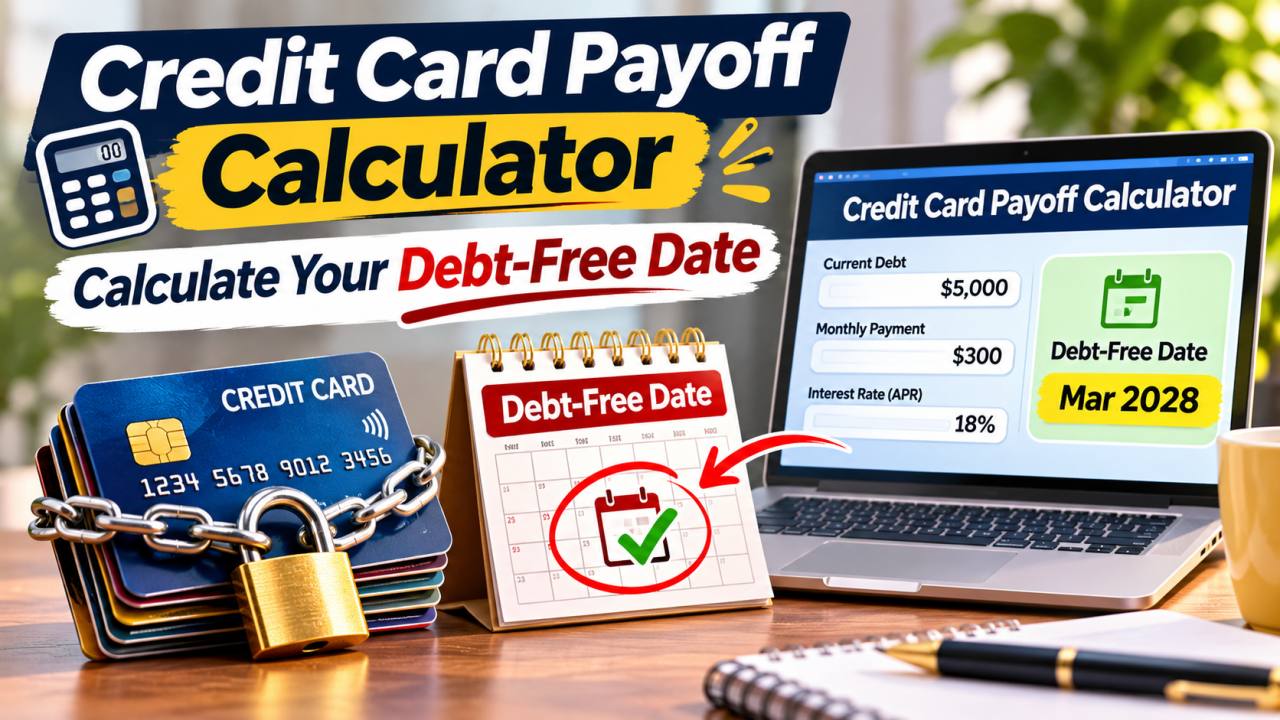
Credit Card Payoff Calculator: Calculate Your Debt-Free Date
Credit card debt can be difficult to manage when interest charges keep adding to your balance every month. Even if you make regular payments, it may take longer than expected to become debt-free—especially when you pay only the minimum amount due.
A credit card payoff calculator helps you estimate how long it may take to pay off your balance based on your current debt, annual percentage rate (APR), and monthly payment. It can also estimate how much interest you may pay before reaching a zero balance.
Whether you owe $1,000, $5,000, or $15,000, understanding your payoff timeline can help you create a more realistic repayment plan. Instead of guessing when your credit card debt will be gone, you can compare different monthly payment amounts and see how increasing your payments may affect your results.
In this guide, you will learn how a credit card payoff calculator works, which numbers you need to enter, how to estimate your debt-free date, and how to use the results to make progress toward becoming debt-free.
All Tools
- All tools
- SIP Calculator
- EMI Calculator
- Budget Calculator
- Take-home Salary Calculator
- Net-worth Calculator
What Is a Credit Card Payoff Calculator?
A credit card payoff calculator is a financial tool that estimates how long it will take to repay credit card debt based on several inputs, including:
- Current credit card balance: The amount you currently owe.
- Annual percentage rate (APR): The annualized rate used to calculate borrowing costs.
- Monthly payment: The amount you plan to pay toward the balance each month.
- Additional payments: Extra money you may contribute to reduce the balance faster.
- Estimated payoff date: The approximate month or date when your balance reaches zero.
- Total interest: The estimated interest charged during repayment.
Some calculators also allow you to enter multiple credit card balances, different interest rates, and separate monthly payments.
The main purpose is to show the relationship between your payment amount, interest costs, and repayment timeline.
For example, paying $300 per month toward a credit card balance will generally result in a faster payoff than paying $150 per month, assuming the same starting balance and interest rate and no additional charges. The higher payment also generally reduces the amount of interest that accumulates over the repayment period.
A calculator makes these differences easier to understand before you change your monthly budget.
Why Should You Calculate Your Credit Card Payoff Date?
Knowing your estimated debt-free date can help you turn a general goal into a specific financial plan.
1. Understand How Long Repayment May Take
A credit card balance can feel manageable when you focus only on the monthly minimum payment. However, that payment may not reduce the principal very quickly when the interest rate is high.
A payoff calculator estimates how many months you may need to repay your debt at a particular payment amount.
This gives you a clearer timeline and helps you decide whether your current payment strategy is realistic.
2. Estimate Your Total Interest Costs
Interest is an important part of the cost of borrowing. The longer a balance remains unpaid, the more opportunities there are for interest to accumulate.
A calculator can help estimate the total interest you may pay under different repayment plans.
For example, you can compare a plan that pays $200 per month with one that pays $350 per month. The results may show that the higher payment reduces both the repayment period and the estimated interest cost.
Actual results depend on your card's APR, billing cycle, payment timing, fees, and how the issuer calculates interest.
3. Set a Realistic Monthly Payment
A payment that is too low may keep you in debt longer than you expect. On the other hand, committing to an amount that is too high may leave you without enough money for essential expenses or unexpected bills.
A payoff calculator helps you compare payment options so you can choose a monthly amount that fits your budget.
Your goal should be to make consistent progress without missing essential bills or relying on additional borrowing to cover everyday expenses.
4. Compare Different Debt Repayment Strategies
If you have more than one credit card, you may need to decide which balance to pay first.
Two common strategies are:
- Debt avalanche: Direct extra payments toward the debt with the highest interest rate while maintaining required minimum payments on other accounts.
- Debt snowball: Direct extra payments toward the smallest balance while maintaining required minimum payments on other accounts.
The avalanche method can reduce interest costs when applied consistently, while the snowball method may help some people stay motivated by paying off smaller balances sooner.
A calculator can help you compare repayment scenarios and understand how your choices may affect your debt-free timeline.
5. Track Your Progress Toward Becoming Debt-Free
A payoff estimate gives you a starting point. As your balance decreases, you can update the calculator to see how your progress compares with your original plan.
If your income increases, you receive a bonus, or your expenses decrease, you may be able to make additional payments.
Regularly reviewing your plan can help you stay focused and adjust your payment amount when your financial situation changes.
How Does a Credit Card Payoff Calculator Work?
A credit card payoff calculator uses your balance, interest rate, and planned payments to estimate how your debt may decline over time.
The calculation generally follows these steps:
- Start with your current credit card balance.
- Estimate the interest added during the period.
- Subtract the payment applied to the balance.
- Calculate the remaining balance.
- Repeat the process until the balance reaches zero.
A simplified monthly calculation looks like this:
Estimated ending balance = Starting balance + Monthly interest − Monthly payment
For example, suppose you have a $5,000 balance and an illustrative APR of 24%.
For a simplified estimate, divide the APR by 12:
24% ÷ 12 = 2% per month.
If the starting balance were $5,000, the estimated interest for the first month would be:
$5,000 × 2% = $100.
If you then made a $250 payment, a simplified calculation would produce:
$5,000 + $100 − $250 = $4,850.
Under these assumptions, the balance would decline by $150 during that month.
This is an illustrative calculation, not an exact statement of how every credit card issuer calculates interest. Many issuers calculate interest using daily balances and a daily periodic rate, so actual charges can differ from this simplified monthly estimate.
The calculation also assumes no new purchases, fees, promotional-rate changes, or other adjustments.
What Happens If Your Monthly Payment Is Too Low?
Your payment must be sufficient to cover the interest and other charges being added to the balance if you want the debt to decrease.
For example, if your estimated monthly interest is $100 and your payment is only $80, the payment would not cover the interest in this simplified example. Your balance could increase rather than decrease.
Actual credit card minimum payments are determined by your card issuer's terms, and minimum payment formulas vary.
If you are struggling to make the required minimum payment, contact your card issuer promptly to discuss possible assistance rather than simply paying less than the amount due.
The Four Main Inputs You Need
Before using a credit card payoff calculator, gather the following information.
1. Current Credit Card Balance
Your balance is the amount you currently owe on the card.
You can usually find it on your latest statement or through your card issuer's online account. If you have made purchases or payments since the statement date, your current balance may be different.
Use the most recent available figure and remember that new purchases can change the payoff estimate.
2. Annual Percentage Rate (APR)
Your APR represents the annualized cost of borrowing under the card's terms. The rate used for purchases may differ from the rates for balance transfers or cash advances.
Check your statement or card agreement to identify the applicable APR for the balance you want to repay.
For planning purposes, a calculator may convert the APR into an estimated monthly rate or daily periodic rate. The precise calculation method matters when estimating actual interest charges.
If your APR is variable, the future rate may change, which can affect your payoff date.
3. Monthly Payment Amount
Enter the amount you realistically expect to pay each month.
You should make at least the required minimum payment by the due date. If your goal is to become debt-free sooner, consider paying more than the minimum when your budget allows.
Choose a payment amount that you can maintain while still covering essential expenses and meeting other important financial obligations.
4. Additional Payments or New Charges
Some calculators let you include extra payments. These may represent occasional contributions from a tax refund, bonus, or other available money.
Extra payments can help reduce your balance faster, provided they are applied to the debt and you avoid replacing the amount paid off with new charges.
Also consider whether you will continue using the card. New purchases and fees can extend your repayment timeline and increase your total cost.
For the clearest estimate, calculate your plan without new purchases first. You can then run another scenario if you expect to keep using the card.
How to Calculate Your Credit Card Payoff Date
Your credit card payoff date depends on three primary factors: your outstanding balance, your interest rate, and how much you pay each month.
Generally, a higher monthly payment helps you repay the balance faster and reduces the time interest can accumulate. A lower payment usually extends the repayment period.
To estimate your debt-free date, you can use a credit card payoff calculator or work through a simplified calculation.
Step 1: Identify Your Outstanding Balance
Start with your current credit card balance.
For example, suppose you owe $4,000 on a credit card. This is your starting balance before adding future interest or subtracting future payments.
Step 2: Find Your APR
Next, identify the annual percentage rate applicable to your balance.
For this example, assume an APR of 22%. This is an illustrative rate, not a statement of current market rates or a prediction of your card's future rate.
For a simplified monthly estimate, divide the APR by 12:
22% ÷ 12 = approximately 1.833% per month.
Actual credit card issuers may calculate interest using daily balances and a daily periodic rate, so the final result may differ.
Step 3: Choose Your Monthly Payment
Decide how much you can consistently pay each month.
For example, you might compare payments of $150, $250, and $350 to see how each amount changes your repayment timeline.
Make sure your chosen payment is at least the required minimum and is affordable alongside your other financial obligations.
Step 4: Estimate the Repayment Period
A calculator estimates the interest added during each period, subtracts the payment, and repeats the process until the remaining balance reaches zero.
It can then estimate:
- The number of months required to repay the debt
- The approximate date of your final payment
- The total interest paid
- The total amount paid, including principal and interest
- How to manage your salary in India: a no-noise, step-by-step plan
- SIP for beginners in India: how to start, how much, and where (2026 guide)
The estimate is most useful when you understand its assumptions. If you continue making new purchases, incur fees, or experience an APR change, your actual payoff date may be later than projected.
Credit Card Payoff Calculator Examples
The following examples demonstrate how a payoff calculator can help you compare repayment plans.
All rates and results are illustrative estimates based on a simplified monthly interest model. They assume a fixed APR, no new purchases or fees, and a fixed payment at the end of each monthly period. Actual issuer calculations may differ.
Example 1: Paying Off a $2,000 Credit Card Balance
Suppose you have a $2,000 balance with an illustrative APR of 24%.
You want to compare three possible monthly payments.
| Monthly payment | Approximate payoff time | Estimated total interest |
|---|---|---|
| $75 | 38 months | $850 |
| $100 | 25 months | $490 |
| $150 | 16 months | $300 |
These rounded figures illustrate how increasing your monthly payment can reduce both the repayment period and total interest.
For instance, paying $150 per month could help you clear the balance considerably sooner than paying $75 per month, assuming your circumstances and interest rate remain unchanged.
Key takeaway: If your budget allows, paying more than the minimum can make a meaningful difference. Choose a payment that is sustainable rather than one that leaves you unable to cover essential expenses.
Example 2: Paying Off a $5,000 Credit Card Balance
Now suppose your balance is $5,000 and your illustrative APR is 22%.
You are comparing two fixed monthly payment amounts.
| Monthly payment | Approximate payoff time | Estimated total interest |
|---|---|---|
| $200 | 32 months | $1,350 |
| $300 | 21 months | $850 |
These figures are rounded estimates from a simplified monthly model.
In this example, increasing the payment from $200 to $300 per month reduces the estimated repayment period and interest cost.
The larger payment directs more money toward reducing the principal after accounting for interest. As the balance falls, the interest calculated on that balance generally falls too.
Key takeaway: Even a moderate increase in your monthly payment can improve your repayment timeline.
Example 3: Paying Off a $10,000 Credit Card Balance
Suppose you owe $10,000 and your illustrative APR is 24%.
You want to understand how a more aggressive payment plan could affect your debt-free date.
| Monthly payment | Approximate payoff time | Estimated total interest |
|---|---|---|
| $300 | 49 months | $4,600 |
| $400 | 34 months | $3,300 |
| $500 | 26 months | $2,500 |
These are rounded planning estimates, not guaranteed outcomes.
With a $10,000 balance, interest can account for a substantial part of the total repayment cost. Increasing your monthly payment can shorten the time your balance remains outstanding.
However, you should not assume that the largest payment is automatically the best choice. Consider your full budget, emergency savings, other debts, and the possibility of unexpected expenses before committing to an aggressive repayment schedule.
Key takeaway: Use the calculator to compare realistic payment amounts and select a plan you can maintain.
How Extra Payments Can Help You Become Debt-Free Faster
An extra payment reduces the amount of debt that remains outstanding, provided it is applied to your balance. This can reduce future interest charges and shorten your payoff period.
Extra payments do not have to be large to be useful. The important consideration is how much additional money you can contribute without undermining your financial stability.
Make an Extra Payment When You Can Afford It
You might consider an additional payment when you receive:
- A work bonus
- Overtime income
- Money from selling unused belongings
- A tax refund
- Income left over after covering necessary expenses
Before making a large additional payment, consider upcoming bills and whether you have enough accessible savings to manage an unexpected expense.
Example: Making an Additional $50 Payment
Suppose you owe $3,000 on a credit card and pay a fixed amount each month.
You decide to increase your monthly payment by $50.
That additional $50 may help reduce the principal more quickly. A smaller balance generally means less interest accrues in later periods, assuming the rate and other conditions remain unchanged.
The exact time and interest savings depend on your APR, original payment, billing cycle, and payment timing.
To see the potential difference, run the calculator twice:
- Enter your original monthly payment.
- Record the estimated payoff date and total interest.
- Increase your monthly payment by $50.
- Compare the new payoff date and interest estimate.
This side-by-side comparison makes the potential benefit of extra payments easier to understand.
Should You Make One Large Payment or Smaller Extra Payments?
If you have money available after covering essential expenses and maintaining an appropriate cash reserve, paying down high-interest credit card debt sooner may reduce interest costs.
However, timing matters. Credit card issuers may calculate interest using daily balances, so paying earlier can affect the interest charged. Your specific card terms determine how payments are applied.
Before using savings to make a large payment, consider whether doing so would leave you without enough money for rent, utilities, insurance, or urgent expenses.
Minimum Credit Card Payments vs. Fixed Monthly Payments
One of the most important things to understand about credit card debt is the difference between making the required minimum payment and paying a consistent amount above the minimum.
What Is a Minimum Credit Card Payment?
The minimum payment is the amount your card issuer requires you to pay by the due date to keep the account current, subject to your card agreement.
The amount and calculation method vary by issuer. Your minimum may depend on your balance, interest charges, fees, and the terms of your account.
Paying the minimum can help you avoid being late on your payment, but it may result in a long repayment period.
If the minimum payment declines as your balance falls, your repayment progress may slow unless you voluntarily continue paying more.
Why Minimum Payments Can Keep You in Debt Longer
When a credit card balance carries a high interest rate, part of each payment goes toward interest rather than reducing the principal.
For example, if interest charges account for a substantial portion of your payment, the balance may decline slowly.
If you also continue making purchases, the amount you owe may remain high or even increase.
Your statement may include a minimum-payment warning or an estimate of how long repayment could take under certain assumptions. Review that information alongside your own calculator results.
Why a Fixed Monthly Payment Can Help
A fixed monthly payment means you aim to pay the same planned amount each month, even if the issuer's required minimum decreases.
For example, suppose your required minimum begins at $180. Instead of reducing your payment when the required minimum falls, you continue paying $250, provided that amount remains affordable.
As the required interest portion generally declines with the balance, a consistent payment can direct more money toward reducing principal over time.
Important: Always pay at least the required minimum by the due date. If you cannot afford it, contact your card issuer as soon as possible to ask about available hardship options.
Debt Avalanche vs. Debt Snowball: Which Strategy Should You Choose?
If you have multiple credit cards, choosing which balance to pay first can make your repayment plan more organized.
Two widely used approaches are the debt avalanche and debt snowball methods.
Both approaches generally involve making the required minimum payments on all accounts while directing extra money toward one target balance.
All Tools
- All tools
- EMI Calculator
- Budget Calculator
- SIP Calculator
- Take-home Salary Calculator
- Net-worth Calculator
Debt Avalanche Method
The debt avalanche method prioritizes the debt with the highest interest rate.
You continue paying the required minimum on each card and direct extra money toward the card with the highest APR. After paying it off, you redirect the money you were paying toward that card to the next-highest-rate balance.
Advantages:
- Can reduce total interest costs when consistently applied.
- Prioritizes the most expensive debt.
- Provides a clear order for repayment.
Potential drawback: If the highest-rate card also has a large balance, it may take time before you completely pay off an account.
This can make progress feel slower for people who are motivated by quick wins.
Debt Snowball Method
The debt snowball method prioritizes the smallest outstanding balance, regardless of interest rate.
You pay the required minimums on all cards and direct extra money toward the card with the smallest balance. After clearing that balance, you move to the next-smallest one.
Advantages:
- Can help you eliminate individual balances sooner.
- Creates visible milestones.
- May make the process feel more manageable.
Potential drawback: You may pay more interest than with the avalanche method if you prioritize a low-rate balance while a higher-rate balance remains unpaid.
Which Method Is Better?
The best approach depends on your interest rates, balances, budget, and ability to stick with the plan.
If reducing interest costs is your main priority, the avalanche method is often a sensible starting point. If clearing smaller balances helps you stay motivated and consistent, the snowball method may be easier to maintain.
You can use a calculator to compare different payment allocations and estimate the impact on your total repayment timeline.
Whichever method you choose, continue making at least the required minimum payments on every account.
Common Credit Card Payoff Calculator Mistakes to Avoid
A calculator is only as useful as the information entered into it. Avoid these common mistakes when estimating your debt-free date.
1. Entering the Wrong APR
Check the APR that applies to the balance you are repaying. Purchase balances, balance transfers, and cash advances may have different rates.
Entering the wrong rate can significantly affect the estimate.
2. Forgetting About New Purchases
If you continue using your credit card, new charges can offset your repayment progress.
For a clearer estimate, first calculate a scenario in which you stop adding new purchases. Then create a separate scenario if you expect to continue using the card.
3. Assuming the Interest Rate Will Never Change
Some credit cards have variable APRs. A rate change can affect your interest charges and payoff date.
Treat your result as a projection rather than a guarantee.
4. Choosing an Unrealistically High Payment
An aggressive payment plan may look appealing in a calculator, but it will not help if you cannot sustain it.
Make room in your budget for essential expenses, minimum payments on other debts, and unexpected costs.
5. Ignoring Fees and Promotional Offers
Annual fees, late fees, balance-transfer fees, and promotional APR periods can change the total cost of repayment.
Read your card agreement and check the terms of any promotional offer before relying on a calculator estimate.
6. Treating the Estimated Date as Guaranteed
Your payoff date is based on assumptions about future payments, interest rates, and account activity.
Update the calculator whenever your balance, payment amount, or APR changes materially.
A Simple Action Plan for Paying Off Credit Card Debt
Use the following steps to turn your calculator result into a practical repayment plan.
Step 1: List your credit card balances. Record each balance, applicable APR, minimum payment, and payment due date.
Step 2: Calculate your repayment timeline. Enter your balance, APR, and planned monthly payment into a credit card payoff calculator.
Step 3: Choose a realistic payment amount. Make sure your plan fits your budget and does not force you to rely on additional borrowing for essential expenses.
Step 4: Select a repayment strategy. Consider the debt avalanche method if interest savings are your main goal, or the debt snowball method if smaller milestones help you stay motivated.
Step 5: Automate payments where appropriate. Automatic payments or reminders can help you avoid missed due dates. Confirm that the amount and timing meet your card issuer's requirements.
Step 6: Stop adding unnecessary charges. Where practical, avoid new purchases on the balances you are trying to pay off.
Step 7: Review your progress monthly. Update your balance and calculator estimates, then adjust your plan if your financial situation changes.
Step 8: Celebrate milestones responsibly. Paying off one balance or reaching a lower total debt amount is progress. Recognize the achievement without taking on new debt.
The objective is not simply to calculate a date. It is to develop a repayment strategy that you can follow consistently until your credit card debt is paid off.
How to Stay on Track Until Your Credit Card Debt Is Paid Off
Calculating your debt-free date is an important first step, but following your repayment plan is what helps you reach that goal.
Your financial situation may change during repayment. An unexpected bill, a change in income, or a new expense can affect how much you can afford to pay each month. A practical plan should account for these possibilities.
Here are several ways to stay consistent while paying off credit card debt.
Create a Monthly Debt Repayment Budget
Start by reviewing your monthly income and necessary expenses. Include housing, groceries, utilities, transportation, insurance, and minimum payments on all debts.
Then determine how much money you can reasonably allocate toward your credit card repayment goal.
Avoid choosing a payment amount simply because it produces an attractive payoff date in a calculator. Your plan should be sustainable, even during months when expenses are higher than expected.
Set a Specific Debt-Free Goal
Instead of saying, "I want to pay off my credit card," establish a measurable goal.
For example:
- Reduce your credit card balance by $1,000 over the next six months.
- Pay an additional $75 per month toward your highest-interest balance.
- Pay off one small credit card balance before the end of the year.
Use your calculator to determine whether your target is realistic. If it is not, adjust your payment amount or timeline.
Avoid Adding New Credit Card Debt
It can be difficult to make progress when new purchases keep replacing the balance you have paid off.
Where practical, use money already available in your budget for everyday expenses rather than adding new charges to the card you are trying to repay.
If you need the card for essential purchases, account for those charges in your budget and calculator estimates. Otherwise, your actual debt-free date may differ from your original projection.
Build a Small Financial Buffer
Unexpected expenses can disrupt a debt repayment plan. If every available dollar goes toward credit card debt, an urgent car repair or medical expense could force you to borrow again.
Consider maintaining an accessible cash reserve appropriate to your circumstances while continuing to make required debt payments.
The right balance between saving and repayment depends on your interest rates, financial obligations, income stability, and access to other resources.
Review Your Payoff Date Every Month
At the end of each billing cycle, review your current balance, payment amount, and interest charges.
Update your credit card payoff calculator when your balance or circumstances change significantly. This helps you see whether you are progressing as expected and whether you need to adjust your plan.
If your income increases or you reduce other expenses, you may be able to increase your payment. If your budget becomes tighter, revise your plan rather than committing to a payment you cannot afford.
What If You Cannot Afford Your Credit Card Payments?
If you are struggling to make even the minimum payment, take action as early as possible.
Contact your card issuer and explain your situation. Ask whether it offers hardship programs, temporary payment arrangements, or other assistance. Review any proposed terms carefully, including possible fees, interest changes, and effects on your account.
You may also consider speaking with a reputable nonprofit credit counseling organization to understand your options. Be cautious of companies that promise to eliminate debt quickly, guarantee results, or ask you to stop communicating with your creditors without clearly explaining the consequences.
If you are already behind on payments, a calculator can help you understand possible repayment scenarios, but it cannot replace advice tailored to your circumstances.
Final Thoughts: Use a Credit Card Payoff Calculator to Take Control of Your Debt
Credit card debt can feel overwhelming when you do not know how long repayment will take or how much interest you may pay.
A credit card payoff calculator gives you a practical way to estimate your debt-free date, compare monthly payment amounts, and understand how your repayment choices may affect total interest costs.
Start by gathering your current balance, applicable APR, and required minimum payment. Then compare realistic payment scenarios to identify a plan that fits your budget.
If you have multiple credit cards, consider whether the debt avalanche or debt snowball method better suits your financial goals and motivation. Make at least the required minimum payment on every account, and direct additional payments according to your chosen strategy.
Remember that a calculator provides an estimate, not a guarantee. Interest calculation methods, billing cycles, fees, new purchases, and changes in your APR can affect your actual payoff timeline.
The most important step is to begin with an achievable plan and review it regularly.
Ready to get started? Use a credit card payoff calculator to estimate your debt-free date, compare repayment options, and create a realistic plan for becoming debt-free. Explore related budgeting and debt-management guides to help you make informed financial decisions.
Financial education disclaimer: This article is for informational and educational purposes only and does not constitute individualized financial, legal, or tax advice. Calculator results are estimates and may differ from your credit card issuer's calculations.
Frequently Asked Questions About Credit Card Payoff Calculators
1. How do I calculate when my credit card will be paid off?
Enter your current balance, APR, and planned monthly payment into a credit card payoff calculator. The calculator estimates how much interest will accrue and how much your balance will decline with each payment. It then estimates the number of months until your balance reaches zero.
2. How much should I pay monthly to pay off my credit card faster?
The right amount depends on your balance, interest rate, budget, and desired payoff timeline. Generally, paying more than the required minimum reduces the balance faster, provided you do not add new charges that offset your progress. Use a calculator to compare different monthly payment amounts.
3. How long does it take to pay off a $5,000 credit card balance?
The repayment period depends on your APR and monthly payment. A higher payment generally shortens the payoff period and reduces total interest. Enter your $5,000 balance, applicable APR, and planned payment into a calculator for an estimate tailored to your situation.
4. Does paying more than the minimum reduce credit card interest?
Generally, yes. Paying more than the required minimum can reduce your outstanding principal faster, which can lower the interest charged over time. The amount saved depends on your APR, payment timing, billing cycle, fees, and whether you continue making new purchases.
5. What is the difference between the debt avalanche and debt snowball methods?
The debt avalanche method directs extra payments toward the debt with the highest interest rate first, which can reduce total interest costs. The debt snowball method targets the smallest balance first, regardless of interest rate, to create quicker account-payoff milestones. Both approaches generally require minimum payments on all other accounts.
6. Can a credit card payoff calculator show my total interest?
Yes. Many calculators estimate total interest based on your balance, APR, monthly payment, and repayment schedule. The result is an estimate because your issuer may calculate interest daily, and fees, new purchases, and changing rates can affect the actual amount.
7. What happens if my monthly payment is too low?
If your payment does not cover the interest and other charges being added to your balance, your debt may not decrease and could grow. Credit card minimum-payment rules vary by issuer. Always check your required minimum and contact your card issuer if you cannot afford it.
8. Should I pay off credit card debt or save money first?
The right balance depends on your financial circumstances, debt interest rates, essential expenses, and access to emergency funds. Maintaining some accessible savings can help prevent an unexpected expense from creating more debt. At the same time, paying down high-interest credit card debt can reduce borrowing costs. Consider your overall situation before choosing how to divide available money.
9. Will paying off my credit card improve my credit score?
Paying down credit card balances can improve credit utilization, which is an important factor in many credit scoring models. However, the effect on your score depends on your complete credit profile, the scoring model, and when your card issuer reports account information. Paying off debt does not guarantee a specific score increase.
10. Are credit card payoff calculator results exact?
No. Results are estimates based on the information and assumptions entered. Actual results may differ because of daily interest calculations, payment dates, fees, new purchases, variable APRs, and the issuer's payment-allocation rules. Check your card agreement and statements for account-specific details.