
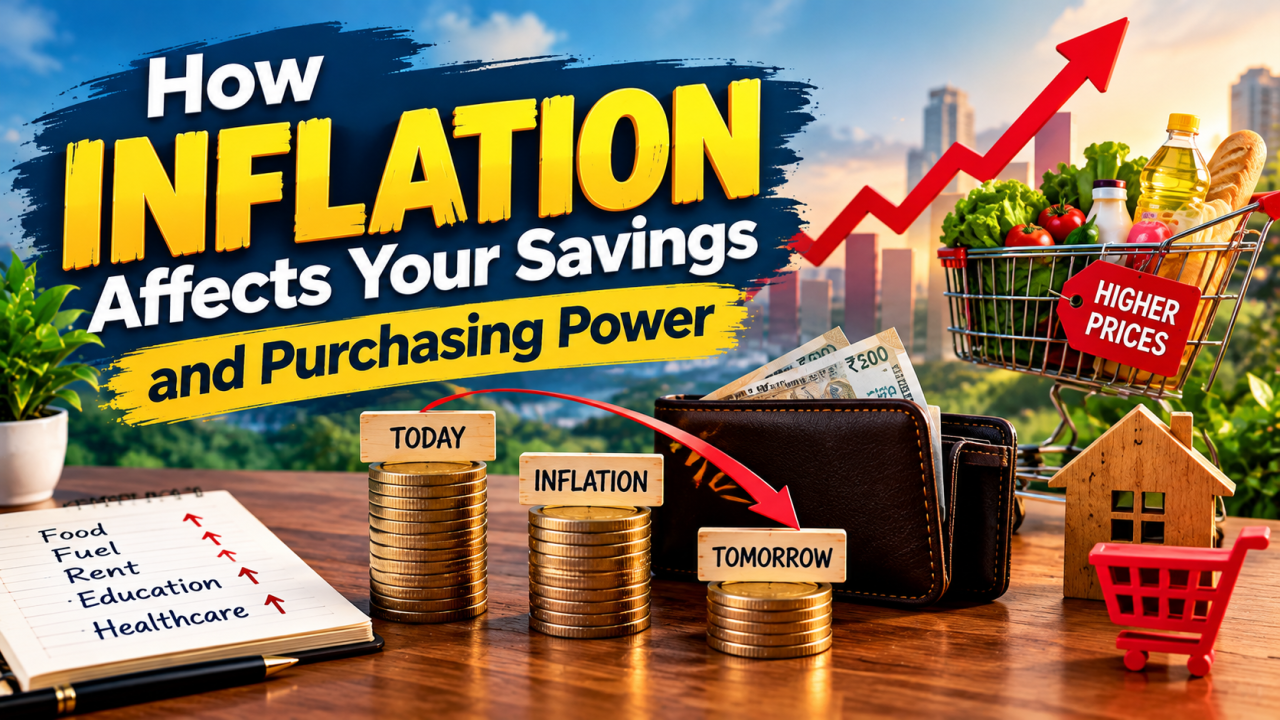
How Inflation Affects Your Savings and Purchasing Power
Have you noticed that the same amount of money buys fewer groceries, pays for fewer services, or covers fewer household expenses than it did a few years ago? This is one of the most common ways people experience inflation in everyday life.
Inflation reduces the purchasing power of money by increasing the general price level over time. When prices rise, the money you save today may not buy the same quantity of goods and services in the future.
For example, suppose your monthly grocery budget is ₹5,000 today. If the prices of the items you regularly buy increase over the next few years, you may need a larger budget to purchase the same basket of groceries. Your money has not disappeared, but its purchasing power has declined.
Understanding how inflation affects your savings is important for anyone who wants to build an emergency fund, save for a home, pay for education, or prepare for retirement.
In India, where households manage expenses such as groceries, rent, transport, healthcare, education, and electricity, inflation can influence both everyday spending and long-term financial planning.
The good news is that you can take practical steps to manage its effects. By understanding inflation, comparing savings options, considering investment risks, and planning for future expenses, you can make better financial decisions.
In this guide, you will learn what inflation means, how it affects your savings and purchasing power, how to calculate its impact, and what you can do to help protect your financial future.
What Is Inflation?
Inflation is the increase in the general price level of goods and services over time. When inflation occurs, money generally buys less than it did previously.
Inflation is commonly measured using price indices that track changes in the cost of a representative basket of goods and services.
In India, the Consumer Price Index (CPI) is an important measure of retail inflation. It tracks price changes across categories that consumers spend money on, although the exact effect on an individual household depends on its spending patterns.
For example, a household that spends a large share of its income on rent and education may experience a different cost increase from a household that spends more on transport or groceries.
A Simple Example of Inflation
Imagine that a family spends ₹10,000 per month on a particular basket of goods and services.
If the prices of that basket rise by 5% over a year, buying the same basket would cost approximately ₹10,500.
| Item | Amount |
|---|---|
| Original monthly cost | ₹10,000 |
| Illustrative annual price increase | 5% |
| New monthly cost | ₹10,500 |
| Additional amount needed each month | ₹500 |
This example assumes that the same basket experiences a 5% price increase. It is an illustration, not a claim about the actual inflation rate in India.
The important point is that if your income or savings do not keep pace with rising expenses, you may have less money available for other financial goals.
What Causes Inflation?
Inflation can occur for several reasons. Often, multiple factors influence prices at the same time.
1. Demand increases
When demand for goods and services grows faster than supply, businesses may increase prices.
For example, a sudden increase in demand for housing in a particular area can put upward pressure on rents and property-related costs.
2. Production costs rise
Businesses may face higher costs for raw materials, wages, transport, electricity, or packaging. Some of these costs may be passed on to consumers through higher prices.
3. Supply disruptions occur
Poor harvests, extreme weather, transport disruptions, or international supply problems can reduce the availability of certain products.
This can be particularly relevant for food prices, which influence household budgets.
4. Imported goods become more expensive
India imports certain commodities and other products from abroad. Changes in international prices and exchange rates can affect the domestic cost of imported goods.
The impact depends on the product, the exchange rate, taxes, supply conditions, and how much of the cost businesses pass on to consumers.
5. Expectations influence pricing
If businesses expect their costs to rise, they may adjust prices in advance. Workers and businesses may also make decisions based on expectations about future inflation.
Inflation is therefore not caused by one factor alone. Understanding its different causes helps explain why some categories become more expensive faster than others.
What Is Purchasing Power?
Purchasing power is the amount of goods and services your money can buy.
When prices increase while the amount of money you have stays the same, your purchasing power decreases.
For example, suppose you have ₹1,000 to spend at a supermarket. At today's prices, it may cover a particular set of groceries. If those groceries become more expensive, the same ₹1,000 may no longer cover the entire basket.
Your bank balance may remain unchanged, but the real value of the money has fallen.
Inflation and Purchasing Power: A Simple Comparison
Consider a product that costs ₹100 today.
| Annual price increase | Approximate price after one year |
|---|---|
| 2% | ₹102 |
| 4% | ₹104 |
| 6% | ₹106 |
| 8% | ₹108 |
These are hypothetical scenarios showing how different inflation rates affect a single price over one year.
If your money does not grow at all, the amount of that product you can buy with the same balance will decline as its price increases.
However, inflation does not affect every product equally. Food, fuel, housing, healthcare, and education can experience different price changes over the same period.
Inflation vs Purchasing Power
Inflation and purchasing power are closely connected, but they describe different things.
- Inflation measures how the general price level changes over time.
- Purchasing power describes what your money can buy at a particular price level.
When general prices rise, the purchasing power of a fixed amount of money usually falls.
This relationship matters when you set financial goals. If you plan to save a fixed amount for a future expense, you should consider how much that expense may cost when you actually need to pay for it.
How Inflation Affects Your Savings
Inflation can affect your savings even when the amount in your bank account does not decrease.
The key issue is that the future buying power of your money depends on both changes in prices and the return you earn on your savings.
1. Your Savings May Buy Less in the Future
Suppose you keep ₹1 lakh in a savings account and the balance remains ₹1 lakh.
If the prices of the goods and services you need rise over time, the same ₹1 lakh will cover fewer of those expenses.
This does not mean your bank balance has fallen in nominal terms. It means its purchasing power has declined.
For people saving for goals that are many years away, this difference can be significant.
2. Low Returns May Not Keep Up With Inflation
Savings accounts and some deposits provide interest, but the rate you earn may be lower than the inflation rate.
For example, suppose your savings earn 3% interest over a year while the prices relevant to your spending increase by 5%.
Your balance may increase, but its purchasing power can still decline.
This is why comparing the interest rate with inflation is important when evaluating savings options.
Remember that the interest rates offered by banks vary and may change. Tax on interest can also reduce the return you actually keep.
3. Long-Term Savings Goals May Become More Expensive
Inflation can increase the amount you need to save for goals such as:
- Children's education.
- Buying a home.
- Marriage expenses.
- Healthcare.
- Starting a business.
- Retirement.
Suppose you estimate that a future education expense will cost ₹10 lakh based on today's prices. If the relevant costs rise steadily, you may need substantially more money when the expense becomes due.
A financial plan based only on today's prices could therefore leave you short of your target.
4. Your Emergency Fund May Lose Purchasing Power
An emergency fund is designed to help cover essential expenses when unexpected events occur.
However, the cost of food, rent, medicines, transport, and other necessities can rise over time.
An emergency fund that covered six months of essential expenses several years ago may no longer cover the same period today if your costs have increased.
Review your emergency fund regularly and adjust it as your essential expenses change.
5. Retirement Savings May Not Stretch as Far
Retirement can last for decades, making inflation an important consideration.
If your retirement income stays fixed while living costs rise, you may gradually find it more difficult to maintain the same lifestyle.
Healthcare expenses and other essential costs may also change at different rates from general inflation.
When planning for retirement, consider future expenses, potential investment returns, taxes, and the length of time your savings may need to support you.
How Inflation Reduces the Real Value of Money
To understand inflation's effect more clearly, it helps to distinguish between the nominal value of money and its real purchasing power.
Nominal value is the amount shown in your bank account or investment statement.
Real value describes what that amount can buy after accounting for price changes.
Suppose you have ₹5 lakh saved. The nominal balance is ₹5 lakh. But if prices rise over the next several years, that balance will buy fewer goods and services than it does today unless its growth compensates for the price increases.
Example: The Future Purchasing Power of ₹1 Lakh
Assume inflation averages 5% per year. The following table shows the approximate purchasing power of ₹1 lakh in today's rupees if the money earns no return.
| Time period | Approximate purchasing power in today's rupees |
|---|---|
| Today | ₹1,00,000 |
| After 5 years | ₹78,350 |
| After 10 years | ₹61,390 |
| After 20 years | ₹37,690 |
These figures are illustrative calculations based on a constant 5% annual inflation assumption. Actual inflation varies, and individual expenses may rise faster or slower than the assumed rate.
The table does not mean that ₹1 lakh will disappear from your bank account. It means that after 20 years of 5% annual inflation, ₹1 lakh would buy roughly what ₹37,690 buys today.
This is why long-term financial planning should focus on purchasing power, not only the amount of money accumulated.
How to Calculate Inflation's Effect on Your Savings
You can estimate the future cost of an expense using a simple formula.
Future cost = Current cost × (1 + inflation rate)ⁿ
Here:
- Current cost is the price today.
- Inflation rate is the assumed annual rate expressed as a decimal.
- (n) is the number of years until you need the money.
For example, suppose a course costs ₹5 lakh today and you expect its cost to rise by an illustrative 6% annually over the next 10 years.
The calculation is:
₹5,00,000 × (1.06)¹⁰
The estimated future cost would be approximately ₹8.95 lakh.
This is a planning estimate, not a prediction of actual education costs. Education expenses may rise at a different rate from general inflation.
You can use the same approach for retirement expenses, healthcare costs, housing-related expenses, and other long-term financial goals.
The most important step is to choose assumptions carefully and revisit them periodically.
In Part 2, we will look at how inflation affects different savings options, how to calculate real returns, and practical strategies that can help you manage inflation's impact on your finances.
All Tools
- All tools
- SIP Calculator
- EMI Calculator
- Budget Calculator
- Freelancer GST Calculator
- Goal Countdown Calculator
7. Inflation vs Savings Interest: Why the Difference Matters
One of the most important concepts in personal finance is the relationship between inflation and the interest you earn on your savings.
Your bank balance may increase because you receive interest, but that does not automatically mean your purchasing power has increased.
To understand why, compare the return on your savings with the rate at which prices rise.
For example, suppose you deposit ₹1 lakh in a savings product that earns 4% interest over one year.
Your balance before taxes would become ₹1,04,000, assuming the rate applies for the full year and interest is credited accordingly.
If inflation over the same period is 6%, the general price level has risen faster than your savings balance. Your money has grown in rupee terms but lost some purchasing power.
Example: Savings Interest vs Inflation
| Financial measure | Illustrative rate |
|---|---|
| Annual savings return | 4% |
| Annual inflation | 6% |
| Difference between the rates | -2 percentage points |
| Approximate real return before tax | -1.89% |
The real return is slightly different from the simple difference between the two rates because the exact calculation accounts for compounding.
The formula is:
[ \text{Real return}=\frac{1+\text{nominal return}}{1+\text{inflation}}-1 ]
Using the example above:
[ \frac{1.04}{1.06}-1\approx -1.89% ]
This means your savings would have lost approximately 1.89% of their purchasing power over the year, before considering tax and any other costs.
The example uses hypothetical rates. Actual savings interest rates and inflation can change over time.
Key lesson: Do not judge savings only by the interest rate. Consider how much purchasing power your money retains after inflation and tax.
8. How Inflation Affects Different Savings and Investment Options
Inflation does not affect every financial product in the same way. Some options provide predictable interest, while others have returns that fluctuate with the market.
Understanding these differences can help you choose options that suit your financial goals and time horizon.
1. Savings Accounts
Savings accounts provide convenient access to money and are useful for routine expenses and emergency reserves.
However, the interest earned may not keep pace with inflation.
For example, if your savings account earns 3% while inflation averages 5%, your money's purchasing power may decline, even though your balance increases.
Savings accounts are generally more suitable for liquidity and short-term needs than for maximising long-term growth.
Consider the interest rate, account conditions, and applicable deposit protection rules when choosing a bank.
2. Fixed Deposits (FDs)
Fixed deposits offer an interest rate for a specified period, subject to the deposit terms. They can help people plan around known dates and expected cash flows.
However, an FD's purchasing power depends on its interest rate relative to inflation and tax.
Consider this example:
| Measure | Amount |
|---|---|
| Initial deposit | ₹1,00,000 |
| Illustrative annual interest rate | 6% |
| Balance after one year, before tax | ₹1,06,000 |
| Illustrative inflation rate | 5% |
Before tax, the real return is approximately 0.95%.
If interest income is taxable at your applicable rate, your after-tax return may be lower. If inflation exceeds the interest rate, your purchasing power may decline.
Practical tip: Compare the FD's effective return after tax with your expected inflation rate. Also check premature withdrawal rules and whether the maturity date matches your financial goal.
3. Recurring Deposits (RDs)
Recurring deposits allow you to contribute a fixed amount regularly for a chosen period.
They can be useful for building savings through disciplined monthly contributions. However, the final value depends on the interest rate, contribution schedule, tenure, and applicable tax.
If the return on an RD is lower than inflation after tax, the money accumulated may not maintain its purchasing power.
RDs can be appropriate for planned short-term goals, but compare their terms with other suitable savings options before deciding.
4. Public Provident Fund (PPF)
The Public Provident Fund is a long-term savings scheme with government-defined rules and a long maturity period.
PPF may be useful for people building long-term savings, including retirement savings. However, its interest rate is notified under the applicable rules and can change over time.
Its future real return depends on the interest credited, inflation, tax treatment, and the scheme's applicable conditions.
Because PPF has specific contribution, maturity, and withdrawal rules, it may not be suitable for money you need to access immediately.
5. Employee Provident Fund (EPF)
For eligible employees, the Employee Provident Fund can form an important part of retirement savings.
Contributions accumulate under the scheme's applicable rules, and the declared interest rate may change over time.
Inflation still matters because the purchasing power of the accumulated balance depends on how the savings grow relative to future prices.
Review your EPF balance as part of your overall retirement plan, but also consider your other investments, expected retirement expenses, and access requirements.
6. Equity Mutual Funds
Equity mutual funds invest primarily in shares. They may offer long-term growth potential, but their value can fluctuate significantly.
Over long periods, equity investments may help some investors pursue returns that outpace inflation. However, this outcome is not guaranteed, and markets can underperform for extended periods.
Equity funds are generally unsuitable for money that must be available on a fixed date in the near future if a market decline would prevent you from meeting the goal.
Before investing, consider your risk tolerance, investment horizon, diversification, fees, and the fund's investment strategy.
7. Index Funds
Index funds aim to track the performance of a particular market index, before applicable costs and tracking differences.
They can offer diversified exposure to the securities included in that index, but they still carry market risk.
An index fund may be useful within a long-term investment plan, but it should not be treated as a guaranteed inflation hedge. Its performance depends on the underlying market, investment period, and costs.
8. Gold
Some investors hold gold as part of a diversified portfolio or for personal and cultural reasons.
Gold prices can rise or fall and do not always move in line with inflation. It also does not generate interest or dividends simply by being held.
The outcome depends on the purchase price, selling price, product costs, applicable taxes, and the investment method used.
Gold may play a role in some portfolios, but relying on it alone to protect all savings from inflation creates concentration risk.
9. Real Estate
Property may generate rental income and may appreciate over time, but neither outcome is guaranteed.
Property owners need to consider maintenance, vacancies, taxes, transaction expenses, insurance, and other costs. Real estate can also be difficult to sell quickly without accepting a lower price.
Property values and rents do not necessarily rise at the same rate as consumer prices.
Before buying property as an inflation-related investment, assess affordability, financing costs, rental demand, and the role it would play in your overall financial plan.
Comparing Common Savings and Investment Options
| Option | Main purpose | Key inflation consideration |
|---|---|---|
| Savings account | Liquidity and everyday banking | Interest may not keep pace with inflation |
| Fixed deposit | Predictable interest for a defined term | Tax and inflation can reduce real returns |
| Recurring deposit | Regular savings habit | Final return depends on rate, tenure, and tax |
| PPF | Long-term savings | Rate changes, access rules, and inflation matter |
| EPF | Retirement savings for eligible employees | Long-term purchasing power depends on credited returns and inflation |
| Equity mutual funds | Long-term market-linked growth | Potentially higher growth, but significant market risk |
| Index funds | Market-index exposure | Market returns are uncertain and costs matter |
| Gold | Portfolio diversification or other personal goals | Prices fluctuate and do not always track inflation |
| Real estate | Housing or potential rental and capital growth | Costs, liquidity, and property-market risk matter |
There is no single best product for everyone. Your choice should depend on when you need the money, how much risk you can accept, and whether the investment suits your goal.
9. How to Protect Your Savings From Inflation
You cannot control the general price level, but you can take practical steps to reduce inflation's effect on your finances.
Step 1: Set Financial Goals in Future Rupees
A common planning mistake is to set a long-term target using today's prices.
For example, if you want to save for a future education expense, estimate what that expense might cost when the payment is due.
Use the future-cost formula:
[ \text{Future cost}=\text{Current cost}\times(1+\text{assumed inflation})^n ]
Suppose a goal costs ₹5 lakh today and you assume a 6% annual increase for 10 years.
The estimated future cost is:
[ ₹5,00,000\times(1.06)^{10}\approx ₹8.95\text{ lakh} ]
This is an illustration, not a forecast. The actual cost may rise faster or slower.
For major goals, consider using a range of inflation assumptions rather than relying on one figure.
Step 2: Keep Emergency Savings Accessible
Your emergency fund serves a different purpose from your long-term investments.
It should help cover unexpected expenses without forcing you to sell volatile assets during a market downturn.
Calculate your target using your current essential expenses. Review it periodically as rent, food, healthcare, transport, and other costs change.
Keep the money in suitable, relatively stable, accessible options. Avoid chasing higher returns with funds that you may need immediately.
Step 3: Compare After-Tax Returns
The interest rate or advertised return is only part of the picture.
For taxable investments, the return you keep after tax may be lower than the stated return. Inflation can reduce purchasing power further.
For example, a deposit that earns 6% before tax will not deliver the same net return to every investor because the tax outcome depends on individual circumstances and applicable rules.
When comparing options, consider:
- Expected return after fees and applicable taxes.
- Inflation assumptions.
- Investment duration.
- Withdrawal restrictions.
- Risk of loss.
- Liquidity requirements.
For tax-sensitive decisions, check current rules or consult a qualified tax professional.
Step 4: Invest According to Your Time Horizon
Money required soon and money intended for a goal decades away should not automatically be invested in the same way.
For short-term goals, protecting the principal and maintaining access may matter more than seeking higher returns.
For long-term goals, an appropriately diversified investment portfolio may help you pursue growth. However, higher potential returns usually come with risks, and no investment mix guarantees that inflation will be beaten.
Choose investments based on when you need the money, how much loss you can tolerate, and whether you could delay the goal if markets perform poorly.
Step 5: Diversify Your Investments
Diversification means spreading your money across suitable assets rather than relying on one company, product, or asset class.
Depending on your needs, your financial plan might combine cash reserves, deposits, retirement savings, and market-linked investments.
The exact mix should reflect your goals, time horizon, risk tolerance, and existing financial position.
Diversification cannot eliminate all risks, but it can reduce the danger of relying entirely on a single investment.
Step 6: Increase Your Savings as Income Grows
If your income increases but your expenses remain almost unchanged, you may be able to save more.
For example, suppose your monthly income rises from ₹50,000 to ₹60,000. If you direct part of the additional ₹10,000 toward savings or investments, you can build your financial reserves more quickly.
You do not have to save the entire increase. Allocate some money to improving your lifestyle if that is important to you, while also increasing contributions toward long-term goals.
Step 7: Review Your Budget Regularly
Inflation can affect different spending categories differently.
Review your expenses every few months and identify where prices have increased the most. Compare prices where practical, plan purchases, reduce waste, and look for better-value alternatives.
Useful strategies may include:
- Planning grocery purchases and meals.
- Comparing utility plans where alternatives exist.
- Reviewing recurring subscriptions.
- Shopping around for suitable insurance renewals.
- Avoiding unnecessary borrowing for everyday expenses.
- Planning for annual fees and predictable large bills.
The objective is to manage spending intelligently, not to sacrifice essential healthcare or other important needs just to save a small amount.
Step 8: Improve Your Earning Potential
Inflation can put pressure on a household if income does not grow alongside essential expenses.
Improving your skills, seeking suitable career opportunities, negotiating pay, or developing a side business may help increase your earning capacity.
Additional income does not guarantee financial security, but it can give you more flexibility to cover rising costs and save toward long-term goals.
Evaluate side projects realistically, including the time, expenses, and risks involved.
10. How Inflation Affects Different Income Groups
Inflation can affect households differently depending on income, spending patterns, savings, and the types of goods and services they purchase.
Low-Income Households
Households with limited income may spend a large share of their budget on essentials such as food, transport, utilities, and housing.
If these costs rise, there may be little room to reduce spending without affecting basic needs.
Maintaining an emergency reserve can be difficult when income is already stretched. Access to suitable public benefits, careful budgeting, and support where available may therefore be important.
Middle-Income Households
Middle-income households may need to balance daily expenses with home loans, school fees, insurance, and savings goals.
Rising prices can make it harder to maintain contributions toward investments or retirement.
A useful approach is to review the budget regularly, maintain an appropriate emergency fund, avoid expensive debt, and adjust financial goals when necessary.
High-Income Households
Higher-income households may have more room to adjust spending, but inflation can still affect education costs, travel, property maintenance, healthcare, and other large expenses.
A high income does not automatically protect purchasing power if spending rises just as quickly.
Maintaining a sensible savings rate and a diversified financial plan remains important.
Retirees
Retirees may be especially sensitive to inflation if they rely on a fixed pension or planned withdrawals from their savings.
Rising costs can reduce the amount of goods and services that a fixed income can cover.
Retirement plans should account for changing expenses, healthcare needs, taxes, investment risk, and how long the money may need to last. A suitable mix of accessible savings and longer-term assets can help balance liquidity and growth needs.
11. Common Mistakes to Avoid When Planning for Inflation
Ignoring Inflation in Long-Term Goals
A target based only on today's expenses may be too low when the money is eventually needed.
What to do instead: Estimate future costs and review the assumptions periodically.
Keeping All Long-Term Savings in Cash
Cash is useful for liquidity, but holding all long-term savings in low-return options may expose your purchasing power to inflation.
What to do instead: Separate emergency money from long-term investments and choose appropriate options for each purpose.
Taking Excessive Investment Risk
Trying to beat inflation by chasing unusually high returns can expose you to losses you may not be able to recover from.
What to do instead: Match your investments to your time horizon, risk tolerance, and financial goals.
Comparing Returns Before Tax Only
An investment may look attractive based on its stated return but deliver a lower net result after taxes and costs.
What to do instead: Compare realistic after-tax returns where applicable.
Assuming All Prices Rise at the Same Rate
Your household's personal inflation experience may differ from the headline rate because you buy a different mix of goods and services.
What to do instead: Track the expenses that matter most to your household and use appropriate assumptions for major goals.
Failing to Review Your Financial Plan
Income, expenses, family responsibilities, and investment conditions can change.
What to do instead: Review your budget, emergency fund, savings goals, and investment allocation regularly.
12. A Practical Inflation-Protection Plan for Beginners
If you are unsure where to begin, follow this simple sequence.
During the first month:
- List your income and essential expenses.
- Review your savings accounts and deposits.
- Identify your main short-term and long-term financial goals.
- Calculate your current emergency fund target.
During the next three months:
- Build or strengthen your emergency savings.
- Compare the interest rates and conditions of your savings products.
- Identify any high-interest debt that needs attention.
- Estimate future costs for your major financial goals.
During the next 12 months:
- Review your savings rate and adjust it where possible.
- Learn about suitable investment options and their risks.
- Consider whether your long-term investments match your time horizon.
- Recalculate future goals using reasonable inflation assumptions.
- Review your plan whenever your income or family circumstances change.
You do not need to predict inflation perfectly. The aim is to make your finances more resilient if prices rise faster than expected.
Final Thoughts
Inflation is an important part of personal financial planning because the value of money depends on what it can buy, not only on the number shown in your account.
A savings balance can grow while losing purchasing power if prices rise faster than the money earns. This is why it is important to understand real returns, account for future expenses, and choose suitable savings and investment options.
At the same time, trying to avoid inflation by taking excessive investment risks can create new problems. Your strategy should balance safety, liquidity, growth, and your ability to tolerate losses.
Start by reviewing your current savings, calculating the future cost of your major goals, and choosing a realistic plan to manage rising expenses. Small, consistent financial decisions can help you prepare for an uncertain future.
Conclusion: Protect Your Savings From Inflation
Inflation is a part of everyday financial life, and its impact goes beyond rising prices at the supermarket. It can reduce the purchasing power of your savings, increase the cost of long-term goals, and make retirement planning more challenging.
The key is to look beyond the balance in your bank account and understand what your money may be worth in the future.
Start by tracking your expenses, maintaining an appropriate emergency fund, comparing savings returns with inflation, and estimating the future cost of your financial goals. For long-term goals, consider suitable investments based on your time horizon, financial situation, and risk tolerance.
Remember that no investment guarantees protection against inflation. Every financial product has its own risks, costs, tax implications, and liquidity conditions.
You do not need to predict inflation perfectly to prepare for it. Regularly reviewing your budget, increasing your savings when possible, and making informed financial decisions can help you manage rising costs more effectively.
Your money should not only grow in numbers—it should also help you maintain your purchasing power and achieve your financial goals.
Key Takeaways
- Inflation is the increase in the general price level of goods and services over time.
- Purchasing power describes how much your money can buy.
- When prices rise faster than your savings grow, your money's purchasing power declines.
- The real return on savings accounts for inflation and can also be affected by taxes and fees.
- Fixed deposits and recurring deposits can provide predictable interest, but their after-tax returns may not keep pace with inflation.
- Equity mutual funds and index funds may offer long-term growth potential, but they carry market risk and do not guarantee inflation-beating returns.
- PPF and EPF can form part of long-term savings plans, subject to their respective rules and conditions.
- Estimate future expenses when planning for education, housing, healthcare, and retirement.
- Review your emergency fund regularly as essential expenses change.
- Diversify investments according to your financial goals, time horizon, and risk tolerance.
- Avoid chasing unusually high returns simply to beat inflation.
- Review your budget and financial plan regularly to adapt to changing prices and personal circumstances.
Take Control of Your Savings Today
Are rising prices affecting your monthly budget? Start by reviewing your essential expenses, checking the returns on your savings, and calculating how much your future financial goals may cost.
A few simple changes today can help you prepare for tomorrow's expenses.
Take the first step: review your savings plan, set a realistic financial goal, and make your money work toward your future needs.
For more practical personal finance tips, savings strategies, and investment education, explore our other financial planning guides.
Frequently Asked Questions About Inflation and Savings
1. How does inflation affect your savings?
Inflation reduces the purchasing power of your savings when the prices of goods and services rise faster than your money grows. Your bank balance may increase, but you may still be able to buy fewer goods and services with it.
2. What is the relationship between inflation and purchasing power?
Inflation measures the increase in the general price level, while purchasing power describes what your money can buy. When prices rise, the purchasing power of a fixed amount of money generally falls.
3. How can I protect my savings from inflation in India?
You can prepare by maintaining an emergency fund, comparing after-tax savings returns with inflation, investing according to your financial goals, diversifying appropriately, and reviewing your budget regularly. No strategy guarantees complete protection against inflation.
4. Can inflation make my savings lose value even if I earn interest?
Yes. If your savings earn less than the inflation rate, their purchasing power can decline even though the account balance increases. Taxes and fees can reduce your effective return further.
5. Is a fixed deposit a good option during inflation?
A fixed deposit may be useful for predictable interest and planned expenses, but its real return depends on the interest rate, inflation, and applicable taxes. Compare the after-tax return with your needs and the expected time horizon.
6. What is a real rate of return?
The real rate of return measures investment growth after accounting for inflation. A useful formula is: real return = (1 + nominal return) ÷ (1 + inflation rate) − 1. Taxes and fees may further reduce the return you keep.
7. How does inflation affect retirement savings?
Inflation increases the future cost of living, so a retirement corpus that appears sufficient today may not support the same lifestyle in the future. Retirement planning should account for future expenses, healthcare needs, investment risk, taxes, and the length of retirement.
8. Does investing in mutual funds protect against inflation?
Some mutual funds, particularly diversified equity funds held over suitable long-term periods, may help investors pursue growth that outpaces inflation. However, returns are uncertain, losses are possible, and no mutual fund guarantees inflation protection.
9. How do I calculate the future cost of an expense?
Use this formula: Future cost = Current cost × (1 + assumed annual inflation rate)^number of years. For example, an expense of ₹1 lakh growing at an illustrative 5% annually for 10 years would cost approximately ₹1.63 lakh.
10. What happens if inflation is higher than my savings interest rate?
Your savings may lose purchasing power because prices rise faster than your balance grows. The effect depends on the difference between your effective savings return and inflation, including applicable taxes and fees.