
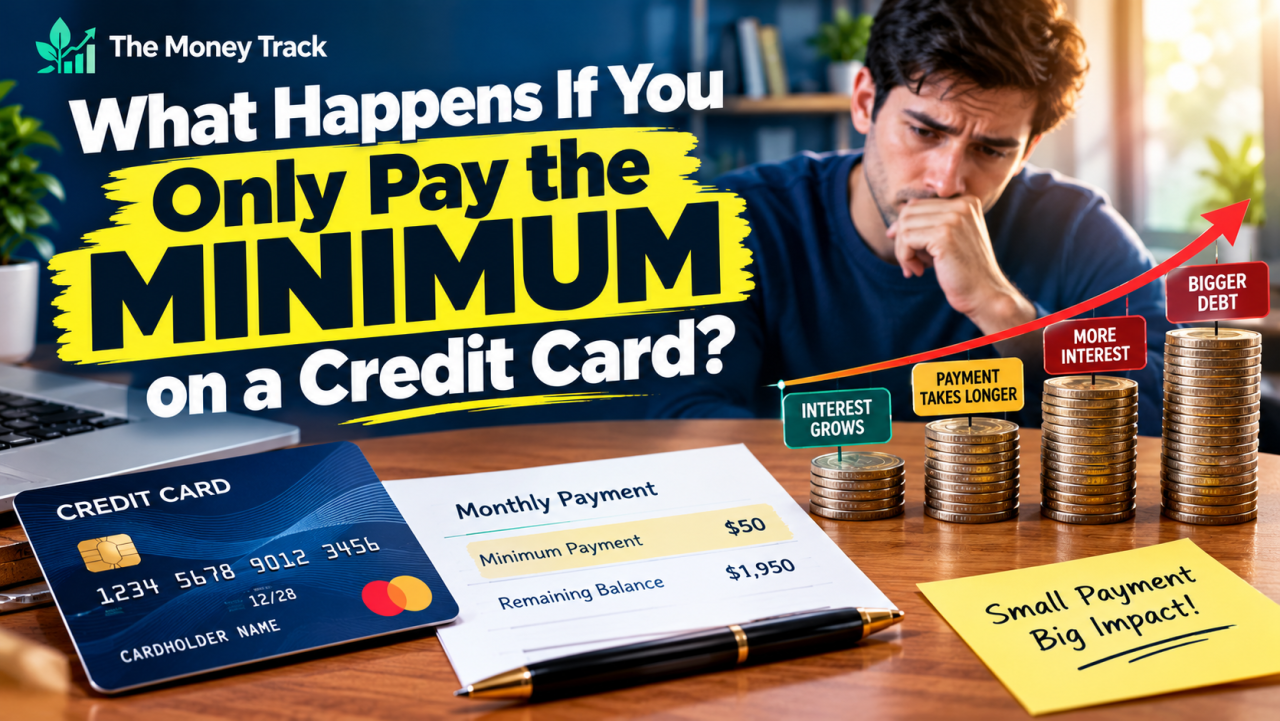
What Happens If You Only Pay the Minimum on a Credit Card?
When your credit card bill arrives, you may notice two different amounts: the total amount due and the minimum amount due. If money is tight, paying the smaller amount can seem like an easy way to avoid missing a payment.
But what happens if you only pay the minimum on a credit card every month?
Although paying at least the minimum by the due date can help you avoid being classified as late on that payment, it does not mean your outstanding balance is interest-free. If you carry a balance, interest and other applicable charges can increase your debt, and repayment may take much longer than you expect.
For example, imagine that your credit card balance is ₹50,000. You pay the minimum amount requested by your card issuer, but continue carrying the remaining balance. Depending on your card's interest rate, payment rules, new purchases, and fees, you could pay substantially more than the original amount borrowed.
The good news is that understanding how minimum payments work can help you make better decisions, reduce interest costs, and avoid getting trapped in long-term credit card debt.
In this guide, we will explain what a minimum credit card payment means, how interest affects your outstanding balance, what it may mean for your credit score, and how to repay your credit card debt more efficiently.
All Tools
- All tools
- SIP Calculator
- EMI Calculator
- Budget Calculator
- Take-home Salary Calculator
- Net-worth Calculator
What Is the Minimum Amount Due on a Credit Card?
The minimum amount due is the smallest payment your credit card issuer requires you to make by the payment due date to keep that bill from being treated as unpaid or late, subject to the issuer's terms and applicable rules.
In India, the minimum amount due is generally shown on your monthly credit card statement alongside the total amount due and the payment due date.
The exact calculation varies by card issuer and may depend on factors such as your outstanding balance, applicable charges, instalments, and previous unpaid amounts.
Example of a Credit Card Bill
Suppose your monthly statement shows the following amounts:
| Statement detail | Amount |
|---|---|
| Total amount due | ₹30,000 |
| Minimum amount due | ₹1,500 |
| Payment due date | 20 October |
In this example, paying ₹1,500 by the due date meets the stated minimum payment requirement, assuming no other payment-related complications.
However, you would still have most of the original bill unpaid. Interest may apply to the remaining balance under your card's terms, and new transactions may also attract interest depending on how your issuer calculates charges and whether you have lost the interest-free period.
Important: The minimum amount due is not the recommended amount to pay every month. It is the minimum required payment, not a guarantee that the remaining balance will be free of interest.
What Happens If You Only Pay the Minimum on a Credit Card?
Paying only the minimum can have several financial consequences. The exact impact depends on your card agreement, interest rate, payment history, and spending habits.
1. Interest Can Accumulate on Your Outstanding Balance
One of the biggest disadvantages of minimum payments is the potential interest cost.
Credit cards often charge relatively high interest on unpaid balances. If you pay only the minimum, the remaining amount may continue to attract interest according to your card's terms.
For example, suppose you have an outstanding balance of ₹40,000 and your card charges interest at an illustrative rate of 3% per month.
A simple one-month illustration would be:
₹40,000 × 3% = ₹1,200
That ₹1,200 is an illustrative interest amount before considering payment timing, daily balance calculations, fees, taxes, and other issuer-specific rules. It is not necessarily the exact charge that will appear on your statement.
If you make only a small payment and continue carrying the balance, interest can consume a significant portion of what you pay.
2. Your Debt May Take Much Longer to Repay
Minimum payments are designed to meet a minimum repayment requirement, not necessarily to clear your debt quickly.
When your payment is small relative to your balance and interest charges, only a limited amount may reduce the principal—the amount you originally owe.
Consider a simplified example:
- Outstanding balance: ₹40,000
- Payment made: ₹2,000
- Interest and other applicable charges: calculated according to your card terms
Your outstanding balance will not necessarily fall by the full ₹2,000. Part of the payment may cover interest, fees, taxes, or other amounts first, depending on the issuer's payment-allocation rules.
This means a balance can remain outstanding for months or years if you consistently make small payments and do not stop adding new purchases.
3. You May Lose the Interest-Free Period
Many credit cards offer an interest-free period on eligible purchases when you meet the card's payment conditions. However, this benefit generally depends on paying the applicable total outstanding amount in full by the due date.
If you carry a balance by paying only the minimum, you may lose the interest-free benefit on new purchases under your issuer's terms.
As a result, new transactions may begin attracting interest sooner than you expect. The rules for restoring the interest-free period can also vary by issuer.
Before continuing to use your card while carrying debt, check the interest-free-period and interest-calculation sections of your card agreement.
4. Your Available Credit Limit May Shrink
Your credit card has a credit limit, which is the maximum amount you can generally borrow using that card.
If you carry a large outstanding balance, a significant portion of that limit remains occupied.
For example:
| Credit card detail | Amount |
|---|---|
| Total credit limit | ₹1,00,000 |
| Outstanding balance | ₹60,000 |
| Remaining available limit | ₹40,000 |
In this simplified example, you have used 60% of your credit limit.
A high balance can make it harder to handle an unexpected expense using the same card. It can also affect credit utilisation, a factor that may influence your credit score.
5. Your Debt Can Become Harder to Manage
Minimum payments may create a false sense of progress because your account shows that you have made the required payment.
However, if you continue adding new purchases while making only small payments, your balance may remain high or even increase.
For example, if you make a payment of ₹2,000 but add ₹3,000 in new purchases, your balance could grow before accounting for interest and fees.
The result is a cycle in which you keep paying the card every month without making meaningful progress toward becoming debt-free.
The safest approach is to stop unnecessary new spending on a card with a carried balance and focus on reducing the existing debt.
How Does Paying Only the Minimum Affect Your Credit Score?
Paying only the minimum amount due on your credit card can help you avoid being treated as late on that payment, provided you pay the required amount by the due date. However, it does not necessarily protect your credit score from other negative effects.
Your credit profile can be influenced by several factors, including your repayment history, outstanding balances, credit utilisation and the information reported by your card issuer.
1. Your payment history may remain current
If you pay at least the minimum amount due by the payment deadline, your account may be treated as paid on time for that billing cycle, subject to your card issuer's terms and reporting practices.
This is generally better than missing the payment altogether. A late or missed payment can have a more serious effect on your credit history.
However, paying the minimum does not mean your entire bill has been cleared. The unpaid balance remains outstanding and may attract interest.
2. High credit utilisation can affect your credit profile
Credit utilisation is the proportion of your available credit limit that you are currently using.
For example, suppose your credit card has a limit of ₹1,00,000 and your outstanding balance is ₹70,000.
- Credit limit: ₹1,00,000
- Outstanding balance: ₹70,000
- Credit utilisation: 70%
A high outstanding balance relative to your limit can be a concern when lenders assess your credit profile. Paying only the minimum may keep your utilisation high for longer.
As you repay the balance, your utilisation can decrease, assuming you do not continue adding new purchases.
Practical tip: If possible, aim to pay more than the minimum and keep your outstanding balance manageable relative to your credit limit. There is no single utilisation threshold that guarantees a particular credit score.
3. Your credit score may not improve quickly
Making minimum payments on time is preferable to missing payments, but it does not automatically improve your credit score.
If your balance remains high month after month, the potential benefit of maintaining a timely payment record may be offset by other aspects of your credit profile.
Your score also depends on factors beyond one credit card, so no one can accurately predict the exact score change from minimum payments alone.
Example: What Happens When You Pay Only the Minimum?
Imagine that you have a credit card balance of ₹50,000. Your card issuer calculates a minimum amount due of ₹2,500 for the billing cycle.
You pay ₹2,500 by the due date.
That payment reduces the amount owed, but the remaining balance is not automatically interest-free. Depending on your card terms, interest may accrue on the unpaid balance, and other charges or applicable taxes may also appear on your statement.
If you continue making new purchases while paying only the minimum, your balance could stay high or even increase.
The important distinction is this:
- Minimum payment: Helps you meet the minimum payment requirement for the billing cycle.
- Full payment: Clears the statement balance when paid in full by the due date, subject to the issuer's terms and any existing interest or other outstanding charges.
Whenever possible, paying the full statement balance by the due date is generally the more cost-effective approach.
How to Pay Off Credit Card Debt Faster
If you have been paying only the minimum, you can take practical steps to reduce the outstanding balance without relying on unrealistic repayment targets.
1. Pay more than the minimum amount due
Start by increasing your payment to an amount you can afford consistently.
For example, if your minimum due is ₹2,500, you might choose to pay ₹5,000 or ₹7,500, provided you can still cover essential expenses and other financial obligations.
A larger payment generally reduces the outstanding principal faster, which can help limit future interest charges. The actual savings depend on your interest rate, billing cycle, payment timing and card terms.
2. Stop adding avoidable purchases to the card
If you are struggling with an existing balance, consider temporarily using a debit card or cash for discretionary spending.
Continuing to use a card while trying to repay it can make progress difficult to measure. New transactions may also attract interest depending on whether you have retained the interest-free period.
Focus first on stabilising your balance before using the card for non-essential purchases again.
3. Make a realistic monthly repayment plan
Review your income, essential expenses, existing loan payments and savings needs. Then decide how much you can safely allocate to your credit card each month.
For example:
| Monthly budget item | Illustrative amount |
|---|---|
| Take-home income | ₹45,000 |
| Essential expenses | ₹25,000 |
| Other financial commitments | ₹8,000 |
| Amount left before savings and discretionary spending | ₹12,000 |
This ₹12,000 is not automatically available for debt repayment. You may still need to account for emergency savings, irregular bills and personal spending.
The goal is to choose a repayment amount you can sustain rather than setting a target that forces you to borrow again.
4. Prioritise high-interest debt
If you have balances on multiple credit cards or loans, list each outstanding balance, interest rate and minimum payment.
Continue meeting the minimum payment requirements on all debts. If your budget allows extra repayments, directing them towards the debt with the highest interest rate can reduce the total interest you pay, assuming other terms and fees are comparable.
Avoid neglecting one account to make an extra payment on another, as missed payments can create additional charges and credit-reporting consequences.
5. Contact your card issuer if repayment is becoming difficult
If you cannot afford more than the minimum—or are struggling to pay even that amount—contact your card issuer before missing a payment.
Ask about available repayment arrangements, the applicable interest rate, fees and the total amount you would need to repay. Review any proposed terms carefully before agreeing.
Do not assume that converting a balance into instalments will always make it cheaper. Compare the total cost, including interest and processing fees, with your current arrangement.
Conclusion: Is Paying Only the Minimum on a Credit Card a Good Idea?
Paying only the minimum on a credit card can help you meet the minimum payment requirement, but it is usually not the best long-term repayment strategy.
The biggest risk is that interest can accumulate on your unpaid balance, making your credit card debt more expensive and slower to repay. A high outstanding balance may also affect your credit utilisation, while missing payments can create additional charges and harm your credit history.
If you can afford it, pay your full statement balance by the due date to avoid interest on eligible purchases under your card's terms. If that is not possible, pay at least the minimum on time and put a realistic plan in place to reduce the remaining balance.
Start by checking your latest credit card statement, understanding the applicable interest rate, and choosing a repayment amount that fits your budget.
Take Control of Your Credit Card Debt
Do not wait until your balance becomes difficult to manage. Review your spending, limit unnecessary purchases and increase your repayment amount whenever your budget allows.
Remember: The minimum amount due is a payment requirement, not a debt repayment strategy. Paying more than the minimum can help you regain control of your finances and reduce the time and cost involved in clearing your balance.
Call to action (CTA)
Want to manage your credit card debt more effectively? Review your outstanding balance, interest rate and monthly budget today. Make a repayment plan that works for your finances, and pay more than the minimum whenever you can afford to do so.
Suggested External Links
-
Reserve Bank of India (RBI)
URL: https://www.rbi.org.in/
Use for relevant official guidance, circulars and consumer information about credit cards and banking. -
TransUnion CIBIL
URL: https://www.cibil.com/
Use for educational information about credit reports, credit scores and credit behaviour. -
Your card issuer's official website
Link to the specific card's terms and conditions, interest-rate schedule or most recent MITC (Most Important Terms and Conditions), where available. These documents help readers verify the applicable interest rates, charges and repayment rules.
Editorial tip: Link directly to the relevant official page or document wherever possible rather than sending readers to a broad homepage. Verify the destination and its current content before publishing.
FAQs: What Happens If You Only Pay the Minimum on a Credit Card?
1. What happens if you only pay the minimum on a credit card?
Your payment may be considered on time if you pay at least the required minimum by the due date. However, the unpaid balance remains outstanding and may attract interest, making the debt more expensive to repay.
2. Is it bad to pay only the minimum on a credit card?
It can be costly if you do it regularly. Although paying the minimum on time is generally better than missing a payment, interest charges and a high outstanding balance can make it harder to repay your debt.
3. Will paying the minimum amount due affect my credit score?
Paying the minimum on time can help you avoid the consequences associated with a missed payment. However, a high credit utilisation ratio or other negative information on your credit report may still affect your score.
4. Does paying the minimum amount due avoid interest?
No. Paying the minimum amount due does not normally make the remaining statement balance interest-free. Interest may apply according to your card's terms, including rules concerning the interest-free period and new transactions.
5. What happens if I pay only the minimum amount due every month?
Your outstanding balance may take a long time to clear because a portion of your payments goes towards interest and charges. New purchases can extend the repayment period further.
6. Is it better to pay the minimum or miss a credit card payment?
If you cannot pay the full bill, paying at least the minimum by the due date is generally better than missing the payment. If you cannot afford even the minimum, contact your card issuer promptly to discuss your options.
7. Can I use my credit card after paying only the minimum?
You may be able to use the card if your available credit permits it, but new purchases can increase your debt. You may also lose the interest-free period, depending on your card's terms. Check your card agreement before making additional purchases.
8. How can I reduce credit card interest charges?
Where possible, pay the full statement balance by the due date. If you already have an outstanding balance, stop unnecessary spending and pay more than the minimum. Contact your issuer if you need help understanding your repayment options.
9. Does paying more than the minimum improve my credit score?
Paying more can reduce your outstanding balance and potentially lower your credit utilisation. These changes may benefit your credit profile, but no specific score improvement is guaranteed.
10. What should I do if I cannot repay my credit card debt?
Review your income and essential expenses, stop avoidable new spending, and contact your card issuer before missing a payment. Ask about repayment arrangements and compare the total cost, fees and terms before accepting an offer.