
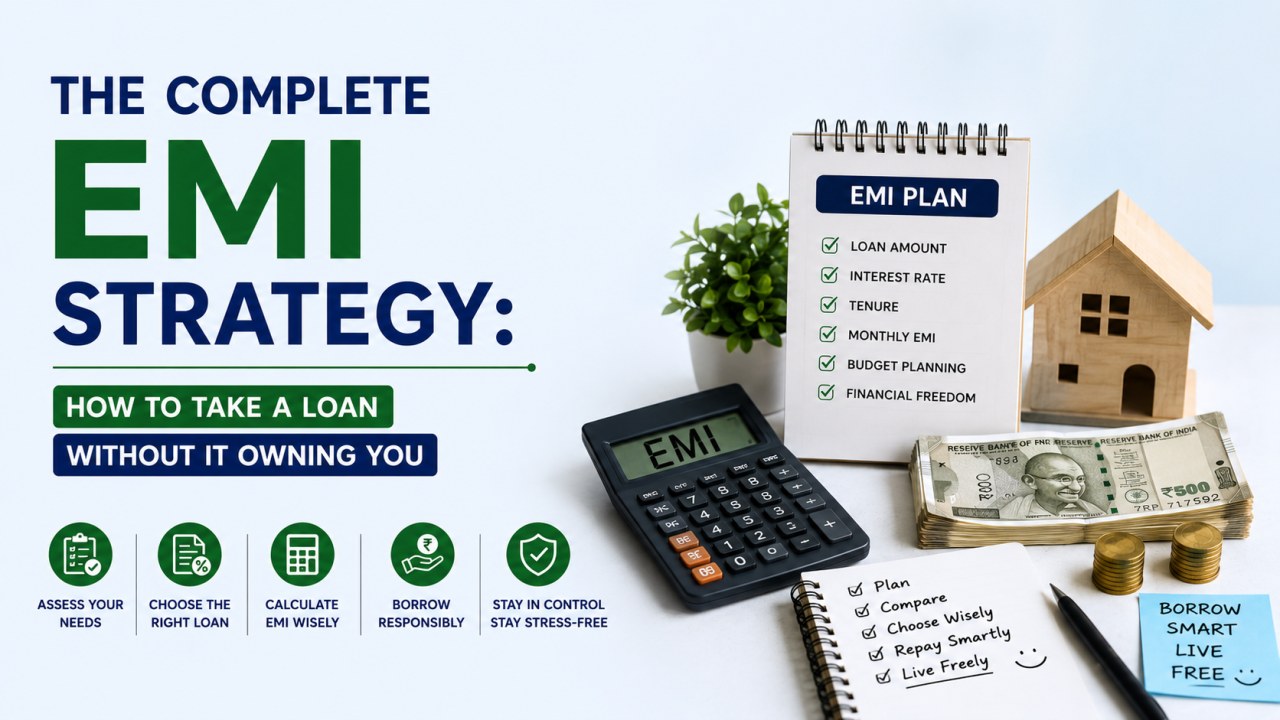
EMIs are not evil. A 30-year home loan at 8.5% can make sense; a 24-month "no cost EMI" on a ₹1.2 L smartphone often doesn't. The difference is what the loan funds and how the math compounds.
This guide is the lens through which to look at every loan offer Indian banks throw at you.
Rule 1 — The 40% rule (your EMI-to-income red line)
Add up every monthly EMI you currently pay (home, car, personal, credit card minimum) plus any new EMI you're considering. Divide by your take-home (not CTC).
If the answer is above 40%, banks won't approve more loans — and they're right not to. Above 40%, a single bad month (medical bill, job change, illness) cascades into late EMIs, which destroy credit score and trigger collection calls.
A safer line for emotional sanity, not just credit eligibility, is 30%. Live below that for a calmer life.
Rule 2 — Not all loans are equal
| Loan type | Typical rate | Verdict |
|---|---|---|
| Home loan (housing) | 8.5% – 10% | Often worth it — builds asset, tax benefits, longest tenure |
| Top-up home loan | 9% – 11% | OK if for genuine needs; treat as part of total home EMI |
| Education loan | 9% – 13% | Worth it for upgrade-of-earning education only |
| Car loan (new) | 9% – 11% | Acceptable for genuine need; the car is depreciating, plan carefully |
| Personal loan | 11% – 18% | Last resort. Use only when nothing else works. |
| Credit card revolve | 36% – 42% | Never. Pay full statement, always. |
| BNPL (Buy Now Pay Later) | 0% – 36% | Avoid. Tiny convenience, scary debt accumulation |
| Pay-later / wallet credit | 24% – 36% | Avoid |
The pattern: secured, long-term, asset-building loans = OK. Unsecured, short-term, consumption loans = trap.
Rule 3 — Calculate before you commit
Indian banks are notoriously opaque about effective EMI cost. The official "9% interest rate" can become an effective 9.8% once you add processing fee (1% of loan), GST on charges (18% of fee), and insurance bundling.
Always run the loan offer through an EMI Calculator before signing. The total interest figure is more honest than the monthly EMI. On a 20-year ₹50 lakh home loan at 9%, you pay roughly ₹58 lakh in total interest — more than the loan itself.
Rule 4 — Pre-payment is the single biggest interest saver
Most Indian home loans are floating-rate. By RBI rule, there is no pre-payment penalty on floating-rate home loans for individual borrowers. Use this.
A single ₹1 lakh pre-payment in year 2 of a 20-year ₹50 L loan at 9% saves approximately:
- ₹3.5 — ₹4 lakh in total interest
- Or shortens tenure by 8–10 months
Strategy: every year, take any bonus / windfall / increment and pre-pay 10–20% of the original loan amount. The math compounds dramatically. A 30-year loan with disciplined pre-payment often closes in 12–15 years.
Rule 5 — Balance transfer (when, and when not)
A balance transfer means moving your loan to another bank offering a lower rate. It can save you lakhs — but only when:
- The rate difference is at least 0.75% (anything less is eaten by processing fee + insurance + legal charges)
- You're in the first half of the loan tenure (interest is front-loaded in EMIs)
- The new bank's processing fee is negotiable or waived
What banks won't tell you: internal rate switch is often cheaper than balance transfer. Walk into your current bank, ask for a rate revision. They'd rather charge ₹1,000 conversion fee than lose you to a competitor. Banks have done this since the RBI external-benchmark linking rules of 2019.
Rule 6 — The "no-cost EMI" almost always has cost
When you see "₹50,000 phone on 12-month no-cost EMI", here's what's usually happening:
- The phone's list price is silently increased by the EMI's hidden interest
- A processing fee (₹199 — ₹999) is charged on every order
- Cash discount of ~5% disappears when EMI is selected
- GST is calculated on the marked-up price, not original
True interest-free EMIs do exist (Amazon Pay Later, some Bajaj Finserv card offers) — but check three things: the phone's all-cash price elsewhere, processing fee, and whether your card statement shows the full GST.
Rule 7 — Personal loans are emergency-only
A personal loan at 14% on a ₹5 L emergency makes sense if it pays for: critical medical, urgent home repair, a one-time family event you genuinely can't postpone.
Personal loans don't make sense for: wedding upgrades, holidays, gadgets, debt consolidation into a bigger debt, "investment opportunities" your friend is excited about.
If you have an existing personal loan at 14%+:
- Pay the minimum on everything else
- Throw every spare rupee at this loan
- It's the highest-return "investment" you can make right now — a 14% guaranteed return is better than any equity SIP
Rule 8 — Never use credit card revolve
A credit card is a 50-day free loan if you pay full statement. The moment you pay "minimum due", you're paying 36–42% annual interest on the remaining balance — plus interest from the transaction date, not the bill date.
If you've fallen into revolve, the cleanest exits in order of cost:
- Personal loan at 12–14% to clear the card (saves ~22% per year)
- Loan against PPF / FD / gold (lower rate, slower processing)
- Family loan documented properly
Then close that card, or treat it as debit-only.
Rule 9 — Track loans alongside everything else
The reason most Indian borrowers don't pre-pay is forgetting how much loan they have. EMIs are auto-debit, balances scroll off statements, mental tracking fades.
Money Track's Subscriptions module treats EMIs as recurring outflows. Each loan shows monthly impact + next debit date + total annual outflow. Once you see all your EMIs in one row, the desire to clear at least one of them becomes hard to ignore.
The short summary
- EMI ≤ 40% of take-home, ideally ≤ 30%.
- Long-term, secured, asset-building loans only.
- Run every offer through an EMI calculator — look at total interest, not monthly EMI.
- Pre-pay home loans aggressively — no penalty on floating rate.
- Balance transfer only if rate difference > 0.75%.
- Avoid "no-cost EMI" on lifestyle purchases.
- Personal loans = genuine emergencies only.
- Never revolve on credit cards.
- Track every loan in one place.
EMIs become dangerous when you lose track. Track them, and they become a tool — not a trap.