
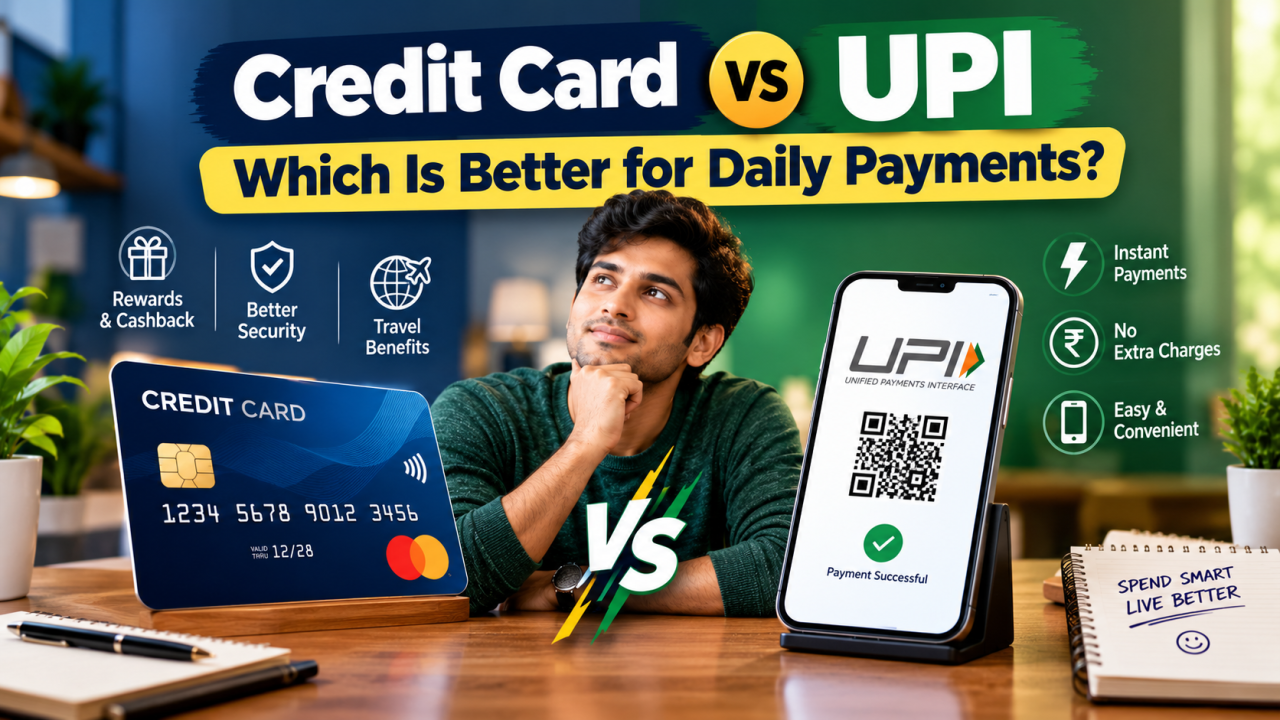
Credit Card vs UPI: Which Is Better for Daily Payments?
Digital payments have become a regular part of everyday life in India. Whether you are buying groceries, ordering food, paying electricity bills, or shopping online, you can complete many transactions without carrying cash.
Two popular payment options are credit cards and Unified Payments Interface (UPI).
But when it comes to Credit Card vs UPI, which payment method is better for daily payments?
The answer depends on how you spend, whether you want rewards, how you manage your money, and the type of transaction you are making.
UPI allows you to transfer money directly from your linked bank account or use an eligible linked credit facility. A credit card lets you make purchases using a credit limit and repay the amount later according to the card's billing terms.
Both methods offer convenience, but they work differently.
In this guide, we will compare credit cards and UPI based on convenience, rewards, security, spending control, fees, and everyday use. You will also learn when each payment method may be suitable for your financial needs.
What Is UPI?
UPI stands for Unified Payments Interface.
It is a real-time payment system that allows users to transfer money between participating bank accounts through supported payment apps.
In India, UPI is commonly used for everyday transactions such as:
- SIP Calculator
- EMI Calculator
- Budget Calculator
- All tools
- Paying at grocery stores.
- Sending money to friends and family.
- Paying restaurant bills.
- Shopping at local stores.
- Paying utility bills.
- Making online purchases.
- Transferring money using a UPI ID or QR code.
UPI is operated by the National Payments Corporation of India (NPCI) and is supported by participating banks and payment applications.
How Does UPI Work?
UPI connects your bank account to a supported payment application.
Once your account is set up, you can make payments using different methods, depending on the app and bank.
These may include:
- Scanning a merchant's QR code.
- Entering a UPI ID.
- Selecting a saved contact.
- Choosing a supported bank account.
- Approving the payment using the required authentication method.
For a standard bank-account-based UPI payment, the money is generally transferred directly from your linked bank account.
This means you do not need to enter your bank account number and IFSC code every time you make a payment.
Example of a UPI Payment
Suppose you purchase groceries worth ₹650.
The shopkeeper displays a UPI QR code.
You open your payment app, scan the code, enter ₹650, and approve the transaction.
The amount is debited from your selected bank account, and the merchant receives the payment through the UPI system.
The exact process may vary depending on the payment app and transaction type.
What Is a Credit Card?
A credit card is a payment card issued by a bank or financial institution that allows you to make purchases using a pre-approved credit limit.
Instead of immediately deducting the purchase amount from your bank account, the card issuer provides credit for eligible transactions.
You receive a statement showing your transactions and the amount due.
You must repay the amount according to the card's billing terms.
How Does a Credit Card Work?
A typical credit card transaction follows these steps:
- You use your card to pay for a purchase.
- The transaction is authorized by the card issuer.
- The purchase amount is added to your card account.
- The transaction appears on your credit card statement.
- You repay the amount by the payment due date.
If you pay the full statement balance by the due date, you can generally avoid interest on eligible purchases, subject to the card's terms and conditions.
If you carry an unpaid balance, interest and other charges may apply.
Cash advances and certain transactions may have different fees and interest rules.
Example of a Credit Card Payment
Suppose you purchase a smartphone accessory worth ₹2,000 using your credit card.
The amount is added to your credit card account.
You receive a statement at the end of the billing cycle.
If you pay the full amount by the due date, you can generally avoid interest on eligible purchases.
However, if you pay only the minimum amount due, the remaining balance may attract interest.
This is why understanding your credit card's billing cycle and repayment rules is important.
Credit Card vs UPI: Quick Comparison
Credit cards and UPI are both useful for digital payments, but they differ in how transactions are funded and managed.
Here is a quick comparison of their main features.
| Feature | Credit Card | UPI |
|---|---|---|
| Payment source | Credit provided by the card issuer | Usually a linked bank account; eligible credit-linked options are also available |
| Payment timing | Repayment is made later according to billing terms | Bank-account payments are generally deducted immediately |
| Spending limit | Based on the approved credit limit | Usually depends on available account balance and applicable transaction limits |
| Rewards | Some cards offer cashback, points, or other benefits | Rewards depend on the app, bank, or specific offer |
| Interest | May apply if the balance is not repaid according to the terms | Standard bank-account-based UPI payments generally do not involve borrowing interest |
| Payment method | Card swipe, chip, contactless, or online card details | QR code, UPI ID, supported app, or other available methods |
| Merchant acceptance | Depends on card network and merchant acceptance | Depends on whether the merchant accepts UPI |
| Spending control | Requires tracking card usage and repayment | Direct bank-account payments can make spending easier to track against available funds |
| Credit history | Responsible use may help build a credit history | Standard bank-account-based UPI payments do not directly build a credit history |
| Common uses | Shopping, travel, subscriptions, and eligible purchases | Daily shopping, peer-to-peer transfers, and merchant payments |
Important: UPI is a payment system, while a credit card is a borrowing and payment product. They are not exactly the same type of financial service.
Also, UPI can support certain credit-linked payment options, so not every UPI transaction necessarily draws money directly from a bank account.
Credit Card vs UPI: Key Differences Explained
Understanding the basic differences can help you decide which method to use for different purchases.
1. Payment Source
The most important difference is where the money comes from.
With a standard bank-account-based UPI payment, the money is deducted from your linked bank account.
With a credit card, the card issuer provides a credit facility that you repay later.
This difference affects how you manage your cash flow.
For example, if you have ₹5,000 in your bank account and make a ₹1,000 UPI payment, your available bank balance generally decreases by ₹1,000.
If you make the same purchase using a credit card, your bank balance generally remains unchanged at the time of purchase, but your outstanding credit card balance increases.
2. Payment Timing
UPI bank-account payments are generally completed in real time.
Credit card purchases are recorded against your credit limit and repaid later according to the billing cycle.
This makes the two methods different in terms of payment timing.
However, delayed repayment should not be confused with free money.
A credit card is a form of borrowing, and unpaid balances may attract interest and other charges.
3. Spending Limits
Credit cards come with a credit limit determined by the issuer.
The available limit decreases as you make purchases and is restored as you repay the outstanding balance, subject to the issuer's rules.
UPI transaction limits depend on the type of transaction, the bank, the payment app, and applicable rules.
For regular bank-account-based UPI payments, your available account balance also matters.
Some transactions may have lower limits, while certain eligible payment categories may have different limits.
4. Rewards and Benefits
Some credit cards offer rewards such as:
- Cashback.
- Reward points.
- Discounts on eligible purchases.
- Travel-related benefits.
- Special offers on selected merchants.
However, these benefits vary by card and may come with conditions.
UPI payment apps and banks may also offer promotional rewards or cashback from time to time.
These offers are not necessarily available on every transaction.
When comparing rewards, consider the actual benefit after accounting for annual fees, joining fees, exclusions, and spending conditions.
Is UPI Better for Everyday Payments?
UPI can be convenient for many everyday purchases, particularly when you want to pay directly from your bank account.
It is widely used for transactions such as buying vegetables, paying at local stores, splitting bills, and transferring money.
Benefits of Using UPI for Daily Payments
1. Quick Payments
UPI allows users to make payments through supported apps without needing to carry cash.
Scanning a QR code can make small transactions straightforward.
2. Direct Bank Account Payments
For standard bank-account-based UPI transactions, the amount is deducted from your linked bank account.
This can help you keep track of how much money is available for spending.
3. Convenient Money Transfers
UPI supports eligible person-to-person transfers.
This can be useful when splitting restaurant bills, sharing household expenses, or sending money to family members.
4. No Need to Carry a Physical Card
You can make payments through a supported mobile app.
This can be convenient when you do not have your wallet with you.
5. Useful for Small Purchases
UPI is commonly accepted by many local merchants and small businesses.
However, acceptance depends on the merchant and the payment setup.
Limitations of UPI
UPI also has certain limitations.
- Transactions may fail because of bank, network, or technical issues.
- Payment limits may apply.
- You need access to a supported app and payment setup.
- Fraudulent payment requests can lead to financial loss.
- Some merchants may not accept UPI.
- Standard bank-account-based UPI payments do not provide a credit card's billing cycle.
UPI is convenient, but users still need to verify payment details and protect their authentication credentials.
Is a Credit Card Better for Everyday Payments?
Credit cards can be useful for people who want to make eligible purchases using a credit facility and repay the amount later.
They may also provide rewards or benefits, depending on the card.
However, credit cards require careful spending and repayment management.
Benefits of Using a Credit Card for Daily Payments
1. Billing Cycle Flexibility
A credit card allows you to make purchases during the billing cycle and repay the outstanding amount by the due date.
This can help with short-term cash-flow management.
However, the benefit depends on paying the bill on time and understanding the card's terms.
2. Rewards and Cashback
Some cards offer rewards on eligible purchases.
For example, a card may provide cashback or reward points on selected spending categories.
The actual benefit depends on the card's reward structure and applicable conditions.
3. Purchase Convenience
Credit cards are accepted by many online platforms, retail stores, hotels, and travel providers.
Acceptance varies by merchant and card network.
4. Credit History
Responsible use of a credit card may help build a credit history.
Making payments on time and managing outstanding balances can be important for maintaining a healthy credit profile.
However, a credit card is not necessary for every person, and opening one solely to build credit should involve considering its costs and repayment requirements.
5. Transaction Records
Credit card statements provide a record of purchases.
This can help you review your spending and identify recurring expenses.
Limitations of Credit Cards
Credit cards also come with risks and costs.
- Interest may apply if you do not repay the full amount as required.
- Annual or joining fees may apply.
- Late payment charges may apply.
- Overspending can lead to debt.
- Cash advances may involve additional charges and interest.
- Rewards may have exclusions and conditions.
- High outstanding balances can affect your credit profile.
A credit card can be useful when managed responsibly, but it should not be treated as additional income.
Key Takeaways From Part 1
- UPI and credit cards are different payment methods with different funding mechanisms.
- Standard UPI payments usually draw money directly from a linked bank account.
- Credit cards allow purchases using a credit facility that must be repaid later.
- UPI can be convenient for everyday payments and money transfers.
- Credit cards may offer rewards, a billing cycle, and other benefits depending on the card.
- Both payment methods have risks, limitations, and security considerations.
- The right payment method depends on your spending habits, financial needs, and ability to manage payments responsibly.
Credit Card vs UPI: Which Is Better for Daily Payments?
Credit Card vs UPI for Different Daily Expenses
The best payment method can vary depending on what you are buying.
For example, UPI may be convenient for small purchases at local shops, while a credit card may be useful for eligible online purchases or transactions where you want to earn rewards.
Let's compare both payment methods for common daily expenses.
1. Grocery Shopping
Grocery shopping is one of the most frequent household expenses.
You can use either UPI or a credit card, depending on the store's payment options.
UPI for groceries:
- Convenient for quick payments at local shops.
- Payments are generally deducted directly from your bank account.
- Useful for tracking spending against your available balance.
Credit card for groceries:
- Some cards offer rewards or cashback on eligible grocery purchases.
- You can pay the bill later according to the billing cycle.
- You need to track your spending and repay the full bill on time.
Which should you use?
UPI may suit people who prefer paying directly from their bank account. A credit card may suit people who have a card with relevant benefits and can manage repayments responsibly.
2. Online Shopping
Online shopping platforms may accept UPI, credit cards, and other payment methods.
UPI:
- Allows payments through supported apps.
- Can be convenient for direct bank-account payments.
- May be available as a payment option on many shopping platforms.
Credit card:
- May offer cashback, reward points, or discounts on eligible purchases.
- Can provide a billing cycle for repayment.
- May include purchase-related benefits depending on the card's terms.
Which should you use?
Compare the final payable amount, available offers, payment terms, and your ability to repay the credit card bill.
Do not make unnecessary purchases simply to earn rewards.
3. Restaurant and Food Delivery Payments
Both UPI and credit cards can be used for eligible restaurant and food delivery transactions.
UPI:
- Convenient for paying at restaurants using QR codes.
- Useful for splitting bills and making direct payments.
- Generally deducts money from the linked bank account for standard UPI transactions.
Credit card:
- May offer rewards on eligible dining or food delivery purchases.
- Allows payment through the card's billing cycle.
- May have special offers on selected platforms.
Which should you use?
Choose based on merchant acceptance, available benefits, and your spending preferences.
4. Electricity, Mobile, and Other Utility Bills
Utility payments can often be made using UPI or a credit card through supported payment platforms.
UPI:
- Can be convenient for paying bills directly from your bank account.
- Helps you avoid carrying a separate payment balance.
- May be available through bill-payment apps and service providers.
Credit card:
- Some cards offer benefits on eligible utility payments.
- Can help consolidate certain expenses into one statement.
- May have transaction limits, fees, or reward exclusions.
Which should you use?
Check whether your card offers meaningful benefits on the specific bill payment and whether any convenience fee applies.
If a fee is higher than the reward, using the card may not provide a financial advantage.
5. Fuel Payments
Fuel purchases may be eligible for certain credit card benefits, depending on the card and merchant.
UPI may also be accepted at fuel stations.
UPI:
- Can provide a convenient way to pay directly from your bank account.
- May be available through QR codes or supported payment systems.
Credit card:
- Some cards offer fuel-related benefits.
- Certain transactions may involve fuel surcharges or specific conditions.
- Rewards may be limited by transaction type or monthly caps.
Which should you use?
Compare the total cost after considering any surcharge, fee waiver, reward limits, and applicable terms.
6. Small Purchases at Local Shops
For small purchases such as tea, snacks, vegetables, or other everyday items, UPI is commonly used at participating merchants.
UPI:
- Often convenient for QR-based payments.
- Allows direct payments from a linked bank account.
- Can be used without carrying a physical card.
Credit card:
- May be accepted at some local stores.
- Can offer rewards if the transaction qualifies.
- May not be accepted by every small merchant.
Which should you use?
Choose the method the merchant accepts and that fits your spending habits.
Credit Card vs UPI: Rewards and Cashback Comparison
Rewards are one reason some people choose credit cards for eligible purchases.
However, not every credit card offers rewards on every transaction.
UPI apps and banks may also provide promotional offers, but these can change over time.
Credit Card Rewards
Depending on the card, rewards may include:
- Cashback on eligible purchases.
- Reward points that can be redeemed under the card's rules.
- Discounts on selected shopping platforms.
- Travel-related benefits.
- Offers on dining, groceries, or other spending categories.
The value of these benefits depends on the card's reward structure.
Some cards have annual fees, spending requirements, reward caps, or exclusions.
UPI Rewards
UPI payment apps or banks may occasionally provide:
- Promotional cashback.
- Merchant-specific discounts.
- Rewards under limited-time campaigns.
- Offers linked to particular transactions.
These benefits are not guaranteed and may not apply to every payment.
Example: Comparing Cashback
Suppose you spend ₹10,000 on eligible purchases in a month.
Imagine that your credit card offers 1% cashback on those transactions.
Your potential cashback would be:
₹10,000 × 1% = ₹100
Now suppose a payment app offers a promotional cashback of ₹20 on a qualifying UPI transaction.
The actual benefit depends on the terms of the offer.
This example is only an illustration. Actual reward rates, eligibility rules, and promotional offers vary.
How to Compare Rewards Properly
Before choosing a payment method, check:
- The reward rate.
- Eligible spending categories.
- Monthly or annual reward caps.
- Minimum transaction requirements.
- Annual and joining fees.
- Convenience fees or surcharges.
- Redemption conditions.
- Whether the reward is worth the extra cost.
The most useful reward is one you earn on spending you were already planning to do.
Credit Card vs UPI: Fees and Hidden Charges
The cost of a payment method depends on the transaction type, the payment provider, and the applicable terms.
UPI Charges
Standard bank-account-based UPI payments are generally offered without a direct charge to ordinary users.
However, charges may vary for certain payment products, services, or transaction types.
For example, some merchant-side payment arrangements or credit-linked payment products may have different commercial terms.
Users should check the terms of the specific payment service.
Credit Card Charges
Credit cards may involve several types of charges.
| Charge | What It Means |
|---|---|
| Annual fee | A yearly fee for holding the card, if applicable |
| Joining fee | A one-time fee charged when the card is issued, if applicable |
| Interest | A charge that may apply to unpaid balances |
| Late payment fee | A charge for missing the required payment deadline |
| Cash advance fee | A fee for withdrawing cash using the card |
| Foreign transaction fee | A charge that may apply to eligible international transactions |
| Convenience fee | A fee that may apply to certain bill payments or transactions |
| Fuel surcharge | A surcharge that may apply to eligible fuel transactions |
The exact charges depend on the card issuer and its terms.
Example: When a Credit Card Reward May Not Be Worth It
Suppose you make a purchase worth ₹5,000.
Your card offers 1% cashback, which equals ₹50.
If the transaction also involves a fee of ₹75, the reward would not cover the fee.
This is a simplified example. Actual fees and reward eligibility depend on the card and transaction.
Always compare the net benefit after fees rather than looking only at the reward rate.
Credit Card vs UPI: Security and Fraud Prevention
Both credit cards and UPI offer digital payment convenience, but users need to protect themselves from fraud.
The risks and protections may differ depending on the payment method, transaction type, bank, payment provider, and applicable rules.
UPI Security
UPI payments commonly require authentication through a supported payment app and the relevant payment credentials.
Users should follow basic security practices.
UPI Safety Tips
- Never share your UPI PIN with anyone.
- Enter your PIN only when you are authorizing a payment.
- Verify the recipient's name and payment details before approving a transaction.
- Do not approve unexpected payment requests.
- Avoid scanning unfamiliar QR codes without checking the purpose.
- Never install remote-access apps at the request of an unknown caller.
- Use your bank's official channels to report suspicious transactions.
Important: Receiving money through a standard UPI transaction does not require you to enter your UPI PIN.
Be cautious if someone asks you to enter your PIN to receive a payment.
Credit Card Security
Credit cards have security features that may include transaction alerts, card controls, and options to block or replace a card.
The exact features depend on the issuer.
Credit Card Safety Tips
- Never share your PIN, OTP, or card security code with unknown people.
- Enable transaction alerts.
- Use official bank apps or websites to manage your card.
- Review your statements regularly.
- Report unauthorized transactions promptly.
- Block your card if it is lost or stolen.
- Avoid entering card details on suspicious websites.
- Use secure payment pages when shopping online.
What Should You Do If You Notice an Unauthorized Transaction?
If you notice a suspicious transaction:
- Contact your bank or payment provider immediately.
- Report the transaction through the official channel.
- Block or secure the affected payment method if necessary.
- Save transaction details and relevant messages.
- Follow the provider's instructions for raising a dispute or complaint.
Prompt reporting is important because applicable protections and dispute procedures may depend on the circumstances and the time taken to report the transaction.
Credit Card vs UPI: Spending Control and Budgeting
The way you manage spending can influence which payment method suits you.
UPI and Spending Control
For standard bank-account-based UPI payments, money is generally deducted directly from your bank account.
This can make it easier to see how much money remains available.
However, convenient payments can still lead to overspending if you do not follow a budget.
Credit Cards and Spending Control
Credit cards allow you to spend within an approved credit limit.
This can provide payment flexibility, but it may also make spending less noticeable if you do not track transactions.
The amount you can borrow should not be confused with the amount you can comfortably afford to repay.
Example: Monthly Spending
Suppose your monthly budget for discretionary spending is ₹8,000.
You make purchases using a credit card throughout the month.
If your total spending reaches ₹10,000, you have exceeded your planned budget even if your card still has an available credit limit.
The same issue can occur with UPI if you continue making payments without tracking your expenses.
Practical Budgeting Tips
- Set a monthly spending limit.
- Track purchases regularly.
- Review bank statements and credit card statements.
- Separate essential expenses from discretionary spending.
- Avoid borrowing to pay for non-essential purchases.
- Pay your credit card bill in full by the due date when possible.
A payment method can support budgeting, but it cannot replace a spending plan.
Credit Card vs UPI: Impact on Credit Score
Credit cards and standard bank-account-based UPI payments affect credit history differently.
Credit Card and Credit History
Credit card activity may be reported to credit information companies, depending on the issuer and applicable reporting rules.
Responsible use can help establish a credit history.
Factors that may matter include:
- Payment history.
- Outstanding balances.
- Credit utilization.
- Length of credit history.
- Other information included in the credit scoring model.
Missing payments or maintaining high outstanding balances may negatively affect your credit profile.
UPI and Credit History
Standard bank-account-based UPI transactions generally do not directly build a credit history.
They are payment transactions rather than borrowing activity.
However, certain credit-linked payment products may have different reporting and repayment implications.
Should You Use a Credit Card Just to Build a Credit Score?
A credit card may help establish a credit history when used responsibly.
However, you should consider the card's fees, repayment requirements, and your ability to manage credit.
You do not need to take on debt simply to make everyday payments.
Common Mistakes to Avoid When Choosing Between Credit Card and UPI
Mistake 1: Choosing a Credit Card Only for Rewards
Rewards may look attractive, but they do not justify spending more than planned.
What to do: Use rewards as a secondary benefit, not as a reason to make unnecessary purchases.
Mistake 2: Assuming Every UPI Payment Is Free
Many standard bank-account-based UPI payments are free to ordinary users, but not every payment-related service has identical terms.
What to do: Check the applicable terms for the specific transaction or product.
Mistake 3: Paying Only the Minimum Credit Card Amount
Paying only the minimum amount due may leave a balance that attracts interest.
What to do: Understand your billing statement and aim to pay the full amount due by the payment deadline.
Mistake 4: Ignoring Transaction Fees
A payment method may involve a fee that reduces its financial benefit.
What to do: Check for convenience fees, surcharges, and other applicable costs.
Mistake 5: Sharing Payment Credentials
Sharing your UPI PIN, OTP, card PIN, or other sensitive credentials can expose you to fraud.
What to do: Keep authentication details private and use official support channels.
Mistake 6: Treating a Credit Limit as Extra Income
A credit limit is borrowed money, not additional income.
What to do: Keep your spending within an amount you can repay comfortably.
Practical Tips for Choosing the Right Payment Method
Before making a payment, consider these questions:
1. Do You Want to Pay Directly From Your Bank Account?
If you prefer immediate bank-account-based payments, UPI may be convenient for eligible transactions.
2. Are You Able to Repay Your Credit Card Bill in Full?
If you use a credit card, make sure you understand the billing cycle and can manage the repayment.
3. Does Your Credit Card Offer a Relevant Benefit?
Check whether the transaction qualifies for cashback, rewards, or another benefit.
4. Are There Any Additional Fees?
Compare the final amount payable after accounting for applicable charges.
5. Does the Merchant Accept Your Preferred Method?
Payment acceptance varies by merchant and transaction type.
6. Does the Payment Method Fit Your Budget?
Choose a method that helps you manage your expenses without creating unnecessary financial pressure.
Key Takeaways From Part 2
- UPI can be convenient for daily purchases and direct bank-account payments.
- Credit cards may offer rewards and payment flexibility, depending on the card's terms.
- Reward benefits should be compared against fees and eligibility conditions.
- Both payment methods require careful attention to security.
- Credit card borrowing should be managed responsibly.
- Standard bank-account-based UPI transactions generally do not directly build a credit history.
- The right payment method depends on your spending habits, merchant acceptance, and financial situation.
Credit Card vs UPI: Which Is Better for Daily Payments?
Credit Card vs UPI: Which Payment Method Should You Choose?
Choosing between a credit card and UPI depends on your spending habits, financial goals, and payment preferences.
Both methods offer convenience, but they serve different purposes.
UPI is commonly used for direct bank-account payments, quick money transfers, and everyday purchases.
Credit cards allow you to make purchases using a credit facility and repay the amount later. Some cards also offer cashback, reward points, and other benefits.
When Should You Use UPI?
UPI may be suitable when:
- You want to pay directly from your linked bank account.
- You are making small purchases at local shops.
- You need to transfer money to friends or family.
- You prefer not to use borrowed money for everyday expenses.
- You want a convenient way to make eligible digital payments.
When Should You Use a Credit Card?
A credit card may be suitable when:
- You can comfortably repay the full bill by the due date.
- Your card offers useful rewards on eligible purchases.
- You want to manage purchases through a billing cycle.
- You need to make a transaction at a merchant that accepts credit cards.
- You want to build a credit history through responsible credit use.
Can You Use Both Credit Card and UPI?
Yes. You can use both payment methods for different types of transactions.
For example, you might use UPI for small daily purchases and a credit card for eligible online shopping or purchases that offer useful benefits.
The important thing is to track your spending and avoid unnecessary borrowing.
Credit Card vs UPI: Final Comparison
| Category | Credit Card | UPI |
|---|---|---|
| Payment source | Credit facility | Usually a linked bank account |
| Payment timing | Paid later according to billing terms | Generally immediate for bank-account payments |
| Rewards | May offer cashback or points | Offers may be available through specific campaigns |
| Interest | May apply to unpaid balances | No borrowing interest on standard bank-account payments |
| Daily shopping | Useful where cards are accepted | Convenient at participating merchants |
| Credit history | Responsible use may help build credit history | Standard bank-account transactions generally do not build credit history |
| Spending control | Requires monitoring outstanding balances | Direct bank-account payments can help track available funds |
| Main risk | Overspending and unpaid debt | Fraudulent payment requests and unauthorized transactions |
The table provides a general comparison. Features, charges, and transaction conditions depend on the specific payment service and financial product.
Conclusion: Credit Card vs UPI for Daily Payments
The choice between a credit card and UPI depends on how you manage your money and what you need from a payment method.
UPI can be convenient for everyday purchases, quick transfers, and direct bank-account payments.
Credit cards may offer rewards, a billing cycle, and other benefits when used responsibly.
However, a credit card also creates a repayment obligation. Interest and other charges may apply if you do not follow the card's terms.
For many people, using both methods for different purposes can be practical.
The most important thing is to choose a payment method that fits your budget, understand the applicable charges, and protect your payment credentials.
A good payment habit is not about choosing one method for every transaction. It is about making informed decisions and managing your money responsibly.
Call to Action (CTA)
Want to manage your daily payments more effectively?
Compare the features, fees, and benefits of your available payment options before choosing one.
Use UPI for convenient bank-account payments and consider a credit card only when its benefits and repayment terms suit your financial situation.
Start tracking your daily expenses today and choose the payment method that fits your budget.
Frequently Asked Questions (FAQs)
1. Which is better for daily payments: Credit Card or UPI?
Both can be useful for daily payments. UPI is convenient for direct bank-account payments, while credit cards may offer rewards and a billing cycle. The suitable option depends on your spending habits and financial needs.
2. Is UPI safer than a credit card?
Both payment methods have security features and potential risks. Safety depends on how you use them, the protections provided by your bank or payment provider, and whether you follow security practices.
3. Can I earn cashback using UPI?
Some UPI apps, banks, and merchants may offer cashback or promotional rewards. These offers vary and may have specific eligibility conditions.
4. Do credit cards offer rewards on daily purchases?
Some credit cards offer cashback or reward points on eligible daily purchases. Reward rates, spending categories, and limits depend on the card's terms and conditions.
5. Does using UPI improve my credit score?
Standard bank-account-based UPI payments generally do not directly build a credit history. Credit-linked products may have different reporting and repayment rules.
6. Can I use a credit card through UPI?
Certain eligible credit cards, such as supported RuPay credit cards, can be linked to UPI for permitted merchant payments. Availability depends on the bank, payment app, card type, and transaction eligibility.
7. Are UPI payments free?
Standard bank-account-based UPI payments are generally free for ordinary users. Charges may differ for certain payment products or services, so check the applicable terms.
8. What happens if I do not pay my credit card bill on time?
You may face interest charges, late payment fees, and other consequences under the card's terms. Late payments may also affect your credit history.
9. Can I use both UPI and a credit card for daily expenses?
Yes. You can use both methods for different transactions, depending on merchant acceptance, available features, and your financial preferences.
10. Should I use a credit card for small purchases?
You can use a credit card for small purchases if the merchant accepts it and you can repay the bill responsibly. Consider any fees and rewards before choosing the payment method.