
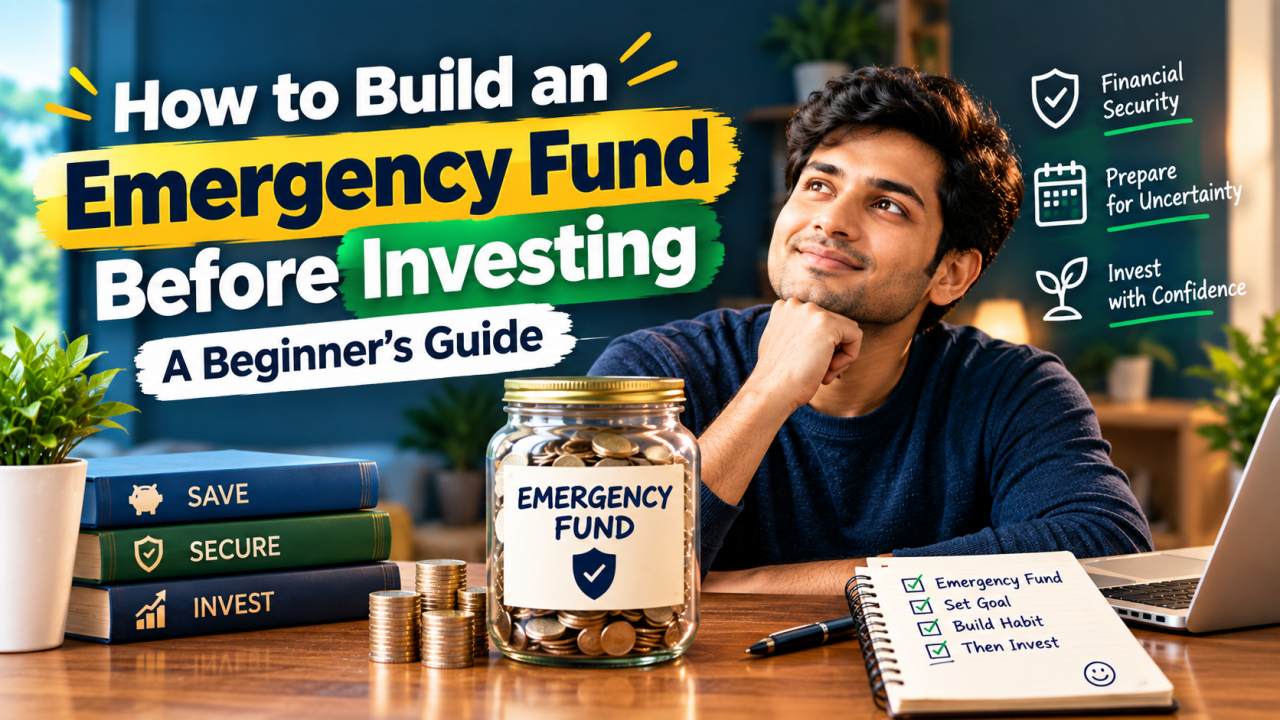
How to Build an Emergency Fund Before Investing
Imagine you suddenly lose your job, face an unexpected medical expense, or need to repair your vehicle urgently.
Would you have enough money to handle the situation without borrowing or selling your investments?
This is where an emergency fund becomes important.
An emergency fund is money set aside specifically for unexpected expenses and financial emergencies. It can help you manage sudden costs without disturbing your long-term financial goals.
Many beginners want to start investing in mutual funds, stocks, or other financial products as soon as they begin earning. However, building an emergency fund before investing can provide a financial safety net and help reduce the need to withdraw investments at an inconvenient time.
In this guide, you will learn how to build an emergency fund before investing, how much money you may need, where to keep your savings, and how to create a realistic savings plan based on your income and expenses in India.
Let's begin.
What Is an Emergency Fund?
An emergency fund is a dedicated savings reserve that you can use to cover unexpected and essential expenses.
It is designed to help you handle financial disruptions without relying heavily on loans, credit cards, or long-term investments.
For example, an emergency fund may help you pay for:
- Unexpected medical expenses
- A sudden job loss
- Essential home repairs
- Urgent vehicle repairs
- Temporary loss of income
- Emergency travel due to a family situation
- Other necessary and unplanned expenses
The purpose of an emergency fund is not to generate high investment returns.
Instead, its main purpose is to provide financial stability, accessibility, and peace of mind when an unexpected expense arises.
Example of an Emergency Fund
Suppose your monthly essential expenses are ₹20,000.
If you want to save enough money to cover three months of essential expenses, your emergency fund target would be:
₹20,000 × 3 = ₹60,000
This means you would aim to build an emergency fund of ₹60,000.
If you experience a temporary loss of income, this reserve could help cover essential expenses while you work toward restoring your regular income.
The actual amount you need depends on your income stability, family responsibilities, existing insurance coverage, and financial obligations.
Why Should You Build an Emergency Fund Before Investing?
Investing can help you work toward long-term financial goals, but unexpected expenses can arise at any time.
Without emergency savings, you may have to withdraw investments, take on debt, or delay important financial commitments.
Building an emergency fund first can help you prepare for these situations.
Here are some reasons why emergency savings are important.
1. It Helps You Handle Unexpected Expenses
Life is unpredictable.
You may face an unexpected medical bill, an urgent home repair, or an emergency family expense.
An emergency fund gives you money that is specifically reserved for these situations.
Instead of relying entirely on borrowed money, you can use your savings to cover eligible expenses.
2. It Reduces Dependence on Loans and Credit Cards
When you do not have emergency savings, even a relatively small unexpected expense can create financial pressure.
You may have to use a credit card, take a personal loan, or borrow money from someone else.
These options can create additional financial obligations.
An emergency fund can help reduce the need to borrow when an unexpected expense occurs.
3. It Protects Your Long-Term Investments
Suppose you have invested money in equity mutual funds for a long-term goal.
A few months later, you face an unexpected expense.
If you do not have emergency savings, you may need to sell some of your investments.
If the market is down at that time, selling could result in a loss.
An emergency fund can help reduce the likelihood of having to sell long-term investments to meet short-term financial needs.
However, it cannot eliminate all investment risks.
4. It Provides Financial Support During Job Loss
A sudden loss of income can affect your ability to pay rent, utility bills, groceries, and other essential expenses.
An emergency fund can provide temporary financial support while you search for another job or rebuild your income.
This can be particularly important for people with limited savings or significant monthly obligations.
5. It Helps You Avoid Financial Stress
Unexpected expenses can create uncertainty and pressure.
Having money set aside for emergencies may make it easier to manage such situations.
An emergency fund cannot prevent every financial problem, but it can provide a financial cushion when something unexpected happens.
6. It Helps You Invest With Greater Confidence
When your essential expenses are covered by a financial reserve, you may feel more comfortable committing money toward long-term goals.
You can focus on your investment plan without relying on those investments for every unexpected expense.
This is one reason why emergency savings are often considered an important part of financial planning.
How Much Emergency Fund Should You Build?
One of the most common questions beginners ask is:
How much money should I keep in my emergency fund?
A common starting point is to save enough to cover three to six months of essential living expenses.
However, this is a general guideline rather than a fixed rule.
Your ideal emergency fund depends on your income stability, family responsibilities, monthly expenses, and access to other financial resources.
1. Emergency Fund for Salaried Employees
If you have a stable monthly salary and relatively predictable expenses, you may begin by targeting three to six months of essential expenses.
For example:
| Monthly Essential Expenses | 3-Month Fund | 6-Month Fund |
|---|---|---|
| ₹15,000 | ₹45,000 | ₹90,000 |
| ₹20,000 | ₹60,000 | ₹1,20,000 |
| ₹25,000 | ₹75,000 | ₹1,50,000 |
| ₹30,000 | ₹90,000 | ₹1,80,000 |
| ₹40,000 | ₹1,20,000 | ₹2,40,000 |
| ₹50,000 | ₹1,50,000 | ₹3,00,000 |
These figures are based on essential monthly expenses, not total salary.
2. Emergency Fund for Freelancers and Self-Employed People
Freelancers, business owners, and self-employed individuals may experience irregular income.
For them, a larger emergency fund may be useful because payments can be delayed or income can fluctuate.
Depending on their circumstances, they may consider building a reserve covering six to twelve months of essential expenses.
For example, if your essential monthly expenses are ₹30,000:
- Six months of expenses = ₹1,80,000
- Nine months of expenses = ₹2,70,000
- Twelve months of expenses = ₹3,60,000
The appropriate target depends on how predictable your income is and how quickly you could replace it.
3. Emergency Fund for Families With Dependents
If you financially support children, parents, or other family members, your emergency fund may need to be larger.
This is because an unexpected loss of income can affect several people.
Consider your household's essential expenses, including:
- Rent or home loan payments
- Groceries
- Electricity and other utility bills
- School fees
- Essential medical expenses
- Insurance premiums
- Transportation
- Other necessary household obligations
A larger reserve may provide additional flexibility if your household depends heavily on a single income.
4. Emergency Fund for People With Existing Loans
If you have a home loan, personal loan, or other regular financial obligations, include the essential payments you would need to continue making during an emergency.
For example, if your monthly expenses include a home loan EMI, that payment may need to be included in your emergency fund calculation.
Review your financial commitments before deciding on a savings target.
How to Calculate Your Emergency Fund Target
Calculating your emergency fund target is simple.
You only need to estimate your essential monthly expenses and decide how many months of expenses you want to cover.
Emergency Fund Formula
Emergency Fund Target = Essential Monthly Expenses × Number of Months
For example:
- Essential monthly expenses: ₹25,000
- Target coverage: 6 months
Calculation:
₹25,000 × 6 = ₹1,50,000
Your emergency fund target would be ₹1,50,000.
Step 1: Calculate Your Essential Monthly Expenses
Start by identifying the expenses you would need to pay even if your income stopped temporarily.
These may include:
- Rent or home loan EMI
- Groceries
- Electricity and water bills
- Essential transportation
- School fees
- Necessary insurance premiums
- Essential healthcare costs
- Minimum required loan payments
Avoid including optional expenses such as entertainment, luxury shopping, or non-essential subscriptions.
Step 2: Choose Your Coverage Period
Decide how many months of essential expenses you want to cover.
A common starting point is three to six months.
If your income is irregular or your financial responsibilities are higher, you may consider a longer coverage period.
Step 3: Multiply Expenses by the Coverage Period
Multiply your essential monthly expenses by the number of months you want your fund to cover.
For example:
₹35,000 × 6 = ₹2,10,000
Your six-month emergency fund target would be ₹2,10,000.
Step 4: Subtract Your Existing Emergency Savings
If you already have money set aside for emergencies, subtract that amount from your target.
For example:
- Target emergency fund: ₹1,50,000
- Existing emergency savings: ₹30,000
Remaining amount:
₹1,50,000 − ₹30,000 = ₹1,20,000
You would need to save another ₹1,20,000 to reach your target.
Step 5: Set a Monthly Savings Goal
Divide the remaining amount by the number of months in which you want to complete your emergency fund.
For example:
- Remaining target: ₹1,20,000
- Savings timeline: 12 months
Monthly savings required:
₹1,20,000 ÷ 12 = ₹10,000
You would need to save ₹10,000 per month to reach your target in one year, assuming no withdrawals or interest earnings.
Emergency Fund vs Investment: What's the Difference?
An emergency fund and an investment portfolio serve different financial purposes.
An emergency fund is designed to provide accessible money for unexpected expenses.
Investments are generally intended to help you work toward financial goals over a specific time horizon.
Here is a comparison:
| Feature | Emergency Fund | Investment Portfolio |
|---|---|---|
| Main purpose | Cover unexpected expenses | Work toward financial goals |
| Primary priority | Accessibility and financial stability | Growth or income, depending on the investment |
| Risk preference | Generally low risk | Depends on the chosen asset |
| Time horizon | Available when needed | Often aligned with specific goals |
| Typical options | Savings accounts and suitable liquid savings products | Mutual funds, stocks, bonds, and other investments |
| Return expectation | Usually secondary to accessibility | Depends on the investment and risk level |
| Withdrawal needs | May be required unexpectedly | Depends on the financial goal and product rules |
The main difference is that emergency savings are meant to be available when needed, while investments are usually intended for planned financial goals.
You do not necessarily need to wait until every long-term savings goal is fully funded before investing.
However, building a basic emergency reserve before committing significant money to long-term investments can help you manage unexpected expenses more effectively.
What Should You Include in Your Emergency Fund?
Your emergency fund should focus on expenses that are necessary and difficult to avoid during a financial disruption.
The exact expenses depend on your personal situation.
Essential Expenses to Include
Housing
- Rent
- Home loan EMI
- Essential home maintenance
Food and Household Needs
- Groceries
- Basic household supplies
- Necessary cooking expenses
Utilities
- Electricity
- Water
- Mobile and internet services needed for work or essential communication
Healthcare
- Essential medicines
- Necessary medical expenses not covered by insurance
- Health-related costs that must be paid out of pocket
Transportation
- Essential commuting expenses
- Necessary vehicle maintenance
Family Responsibilities
- Essential school fees
- Necessary support for dependents
- Other unavoidable household expenses
Expenses You May Exclude
Depending on your circumstances, you may exclude:
- Dining out
- Vacations
- Luxury shopping
- Entertainment subscriptions
- Non-essential gadgets
- Optional lifestyle upgrades
The goal is to estimate how much money you would need to maintain essential living conditions during a financial emergency.
How to Build an Emergency Fund With a Low Salary
Building an emergency fund can feel difficult when your income is limited.
However, you do not need to save the entire target amount immediately.
You can start with a small amount and increase your savings gradually.
The key is to create a realistic plan that fits your income and essential expenses.
1. Start With a Small Initial Target
Instead of focusing immediately on a large emergency fund, set a smaller milestone.
For example, you could begin with a target of ₹5,000 or ₹10,000.
Once you reach that amount, gradually work toward covering one month of essential expenses.
After that, continue building toward a three-month or six-month reserve.
The exact milestones should reflect your financial circumstances.
2. Save a Fixed Amount Every Month
Choose an amount you can consistently set aside.
For example:
| Monthly Savings | Savings After 6 Months | Savings After 12 Months |
|---|---|---|
| ₹500 | ₹3,000 | ₹6,000 |
| ₹1,000 | ₹6,000 | ₹12,000 |
| ₹2,000 | ₹12,000 | ₹24,000 |
| ₹3,000 | ₹18,000 | ₹36,000 |
| ₹5,000 | ₹30,000 | ₹60,000 |
These calculations assume that you make every contribution and do not withdraw any money.
Even small contributions can help you build a financial reserve over time.
3. Automate Your Savings
Consider setting up an automatic transfer from your salary account to a separate savings account after payday.
This can help you save consistently without having to remember to transfer money manually.
Choose an amount that does not prevent you from paying essential bills.
4. Reduce One or Two Non-Essential Expenses
Review your spending and identify expenses you can reduce without affecting your essential needs.
For example, you might reduce unnecessary subscriptions, frequent food delivery, or impulse purchases.
Redirect the money you save toward your emergency fund.
You do not need to eliminate every enjoyable expense to build a sustainable savings habit.
5. Use Extra Income to Build Your Fund
If you receive a bonus, incentive, freelance payment, or other additional income, consider directing a portion toward your emergency savings.
This may help you reach your target sooner.
6. Increase Your Savings Gradually
Whenever your salary increases or your expenses decrease, consider increasing your monthly emergency fund contribution.
Even a modest increase can help you build your savings faster.
7. Avoid Comparing Your Savings With Others
Your emergency fund should be based on your own expenses, income stability, and financial responsibilities.
A person with lower expenses may need a smaller reserve than someone supporting a family or managing irregular income.
Focus on building a fund that suits your circumstances.
Emergency Fund Example: Building ₹1 Lakh in 12 Months
Suppose you want to build an emergency fund of ₹1,00,000 over one year.
You can divide your target into monthly savings.
Calculation:
₹1,00,000 ÷ 12 = ₹8,333.33
You would need to save approximately ₹8,334 per month to reach ₹1 lakh in 12 months, assuming no interest earnings or withdrawals.
Here is an illustrative savings schedule:
| Month | Monthly Savings | Total Savings |
|---|---|---|
| 1 | ₹8,334 | ₹8,334 |
| 2 | ₹8,334 | ₹16,668 |
| 3 | ₹8,334 | ₹25,002 |
| 4 | ₹8,334 | ₹33,336 |
| 5 | ₹8,334 | ₹41,670 |
| 6 | ₹8,334 | ₹50,004 |
| 7 | ₹8,334 | ₹58,338 |
| 8 | ₹8,334 | ₹66,672 |
| 9 | ₹8,334 | ₹75,006 |
| 10 | ₹8,334 | ₹83,340 |
| 11 | ₹8,334 | ₹91,674 |
| 12 | ₹8,326 | ₹1,00,000 |
This example shows how a clear monthly savings target can make a larger financial goal easier to manage.
If ₹8,334 per month is too much for your budget, you can extend the timeline or begin with a smaller target.
All Tools
How to Build an Emergency Fund Before Investing
Where Should You Keep Your Emergency Fund?
Once you know how much money you need, the next question is where to keep your emergency savings.
An emergency fund should be easily accessible, relatively safe, and separate from your regular spending money.
Unlike long-term investments, emergency savings are not primarily intended to generate high returns.
The main objective is to ensure that you can access your money when an unexpected expense arises.
Here are some common options to consider.
1. Savings Account
A savings account is one of the simplest places to keep emergency savings.
It allows you to deposit money, withdraw funds when needed, and access your balance through banking services.
Benefits of a Savings Account
- Easy access to money.
- Suitable for short-term savings.
- Simple to manage.
- Can help keep emergency savings separate from daily spending.
- May earn interest on the account balance.
Things to Consider
- Interest rates vary between banks and account types.
- Some accounts may have minimum balance requirements.
- Withdrawal limits or banking conditions may apply to certain accounts.
- Savings account interest may be taxable depending on applicable rules.
A savings account can be a practical starting point for building an emergency fund.
2. Fixed Deposits (FDs)
A fixed deposit allows you to deposit money for a specified period at an agreed interest rate, subject to the product's terms.
Some investors use suitable short-term or flexible fixed deposits as part of their emergency savings strategy.
However, not every fixed deposit is equally convenient for emergencies.
Benefits of Fixed Deposits
- Interest terms are generally defined when the deposit is opened.
- Can provide a predictable return if held according to the applicable terms.
- May offer options for premature withdrawal.
- Can help separate savings from regular spending.
Things to Consider
- Premature withdrawal may involve a penalty or reduced interest.
- Some deposits may have restrictions on early withdrawal.
- Funds may not be available instantly in every situation.
- Interest income may be taxable.
Before using a fixed deposit for emergency savings, check its withdrawal conditions and how quickly you can access the money.
3. Sweep-In Fixed Deposits
Some banks offer sweep-in facilities that link a savings account with a fixed deposit.
When the savings account balance falls below a specified level, the bank may automatically transfer or break part of the linked deposit to meet a withdrawal, depending on the account's terms.
Benefits of Sweep-In Facilities
- May provide a combination of savings account access and fixed deposit interest.
- Can reduce the need to manage multiple deposits manually.
- May help keep part of your emergency savings accessible.
Things to Consider
- Availability and features depend on the bank.
- Minimum balance and deposit conditions may apply.
- Premature withdrawal rules can vary.
- The facility may not operate identically across banks.
Review the terms carefully before relying on a sweep-in facility for emergency expenses.
4. Liquid Mutual Funds
Liquid mutual funds invest primarily in short-term money market and debt instruments within the scheme's permitted maturity limits.
They are designed for short-term cash management, but they are not the same as bank savings accounts.
Potential Benefits
- May provide an option for managing short-term surplus money.
- Offer market-linked returns.
- Some schemes allow relatively quick redemption, subject to applicable rules.
Risks and Limitations
- Returns are not guaranteed.
- The value of investments can fluctuate.
- Redemption timing and settlement conditions may apply.
- Exit loads or other scheme-specific conditions may apply.
- Mutual fund investments are not covered by bank deposit insurance.
Liquid mutual funds may be considered for a portion of emergency savings if you understand the risks and redemption conditions.
However, money needed immediately may be better kept in an easily accessible bank account.
Savings Account vs Fixed Deposit vs Liquid Mutual Fund
Here is a general comparison of common emergency savings options.
| Feature | Savings Account | Fixed Deposit | Liquid Mutual Fund |
|---|---|---|---|
| Main purpose | Accessible savings | Deposit for a defined period | Short-term market-linked investment |
| Access to money | Generally convenient | Depends on premature withdrawal terms | Subject to redemption and settlement rules |
| Return structure | Bank-determined interest | Interest terms defined at deposit opening | Market-linked returns |
| Capital risk | Eligible bank deposits have applicable deposit protection | Eligible bank deposits have applicable deposit protection | Investment value can fluctuate |
| Early withdrawal conditions | Account-specific terms | May involve penalties or restrictions | Scheme-specific rules may apply |
| Suitable for immediate expenses | Often practical | Depends on access conditions | Depends on redemption timing |
| Return guarantee | Interest terms depend on the account | Subject to deposit terms | Not guaranteed |
Important Note About Deposit Insurance
In India, eligible bank deposits are insured by the Deposit Insurance and Credit Guarantee Corporation (DICGC) up to ₹5 lakh per depositor per bank, including principal and interest, subject to applicable rules.
Mutual fund investments do not receive this bank deposit insurance.
Always check the relevant product terms before choosing where to keep your emergency fund.
Should You Invest Before Completing Your Emergency Fund?
This is one of the most common questions people ask when starting their financial journey.
The answer depends on your income, expenses, financial obligations, and existing savings.
Building an emergency fund before investing can reduce the likelihood of having to sell investments or borrow money when unexpected expenses arise.
However, you do not necessarily need to wait until you have saved six months of expenses before beginning every type of investment.
A practical approach is to build a basic financial safety net first and then gradually balance emergency savings with long-term investments.
A Practical Approach for Beginners
You can consider the following sequence:
Step 1: Cover essential expenses.
Make sure you can pay for basic necessities such as rent, groceries, utilities, and essential medical needs.
Step 2: Build a starter emergency fund.
Begin with a manageable savings milestone, such as ₹5,000, ₹10,000, or one month's essential expenses.
Choose a target that reflects your situation.
Step 3: Review high-cost debt.
If you have expensive outstanding debt, consider how repayment fits into your financial plan.
Step 4: Continue building your emergency fund.
Work toward a reserve covering several months of essential expenses.
Step 5: Start or increase long-term investments.
Once you have a basic safety net, consider investing according to your financial goals and risk tolerance.
This is a general framework, not a universal rule. Your circumstances may require a different order.
Emergency Fund vs Debt Repayment: What Should You Prioritize?
If you have outstanding debt, deciding whether to save or repay it can be challenging.
The right approach depends on the type of debt, interest rate, repayment obligations, and your current financial stability.
Why a Starter Emergency Fund Can Help
Without any emergency savings, an unexpected expense may force you to borrow more money.
A small emergency reserve can help reduce the need to rely on credit for every unexpected cost.
Why High-Interest Debt Matters
Debt with high interest rates can become expensive over time.
Paying it down may reduce future interest costs, depending on the loan terms.
However, using every available rupee to repay debt may leave you without money for essential unexpected expenses.
A Balanced Approach
Depending on your situation, you might:
- Make required minimum payments on your debts.
- Build a small emergency reserve.
- Direct additional money toward expensive debt.
- Continue growing your emergency fund.
- Begin or expand long-term investments when your financial position allows.
If you have overdue payments or serious financial difficulties, prioritize essential needs and review your repayment obligations carefully.
Common Emergency Fund Mistakes to Avoid
Building an emergency fund is not just about saving money.
It is also about making sure the money is available and used for the right purpose.
Here are some mistakes to avoid.
1. Setting an Unrealistic Target
A very large target can feel overwhelming, especially if your income is limited.
Instead of trying to save several months of expenses immediately, start with a smaller milestone and build gradually.
2. Keeping Emergency Savings in Risky Investments
Emergency savings are meant to be available when needed.
Putting all your emergency money into volatile investments can expose you to losses at a time when you need cash.
Consider accessibility and capital risk before choosing a financial product.
3. Mixing Emergency Savings With Daily Spending
If your emergency fund is kept in the same account you use for everyday purchases, it may be easier to spend unintentionally.
Consider using a separate account or clearly identifying the amount reserved for emergencies.
4. Using the Fund for Non-Essential Purchases
An emergency fund should generally be reserved for unexpected and necessary expenses.
Using it for vacations, shopping, or planned purchases can reduce the money available for genuine emergencies.
5. Ignoring Changes in Monthly Expenses
Your financial responsibilities may increase over time.
For example, rent, healthcare costs, family responsibilities, or loan payments may change.
Review your emergency fund target periodically to ensure it still reflects your essential expenses.
6. Forgetting to Rebuild the Fund After a Withdrawal
If you use your emergency fund, your financial reserve may fall below its intended target.
Once the emergency has passed, consider rebuilding the amount you used.
7. Depending Entirely on Credit Cards
A credit card may help with certain short-term payments, but it does not replace an emergency fund.
Unpaid balances can lead to interest charges and additional financial pressure.
Keep accessible savings for unexpected expenses whenever possible.
A Step-by-Step Plan to Build Your Emergency Fund
Here is a practical plan you can adapt to your income and expenses.
Step 1: Calculate Your Essential Monthly Expenses
List your necessary monthly expenses, including housing, groceries, utilities, transportation, healthcare, and essential debt payments.
For example:
| Expense | Monthly Amount |
|---|---|
| Rent | ₹8,000 |
| Groceries | ₹5,000 |
| Utilities | ₹1,500 |
| Transportation | ₹2,000 |
| Healthcare and insurance | ₹2,500 |
| Other essential expenses | ₹1,000 |
| Total | ₹20,000 |
Your essential monthly expenses in this example are ₹20,000.
Step 2: Choose Your Emergency Fund Target
If you want to save six months of essential expenses:
₹20,000 × 6 = ₹1,20,000
Your target would be ₹1,20,000.
Step 3: Check Your Existing Savings
Suppose you already have ₹20,000 set aside for emergencies.
Your remaining target would be:
₹1,20,000 − ₹20,000 = ₹1,00,000
Step 4: Set a Monthly Savings Amount
Suppose you can save ₹5,000 per month.
The time needed to save the remaining ₹1,00,000 would be:
₹1,00,000 ÷ ₹5,000 = 20 months
This assumes consistent contributions without withdrawals or interest earnings.
Step 5: Automate Your Contributions
Set up a recurring transfer to your emergency savings account after receiving your salary or income.
Choose an amount that fits your budget.
Step 6: Review Your Progress Every Month
Check your savings balance and compare it with your target.
If your income increases or expenses decrease, consider increasing your monthly contribution.
Step 7: Rebuild Your Savings After Emergencies
If you use part of the fund, revise your target and resume saving when your financial situation allows.
The goal is to maintain a reserve that reflects your current needs.
Emergency Fund Checklist for Beginners
Use this checklist to track your progress.
[ ] Calculate essential monthly expenses.
[ ] Decide how many months of expenses you want to cover.
[ ] Set a realistic emergency fund target.
[ ] Check how much emergency savings you already have.
[ ] Choose an accessible place to keep your savings.
[ ] Set a monthly savings goal.
[ ] Automate contributions where practical.
[ ] Avoid using emergency savings for non-essential purchases.
[ ] Review your target when your financial circumstances change.
[ ] Rebuild the fund after using it.
[ ] Consider long-term investments based on your goals and risk tolerance.
Final Thoughts on Building an Emergency Fund Before Investing
An emergency fund is an important part of financial planning because it helps you prepare for unexpected expenses and temporary income disruptions.
You do not need to build a large reserve overnight.
Start with a manageable target, save consistently, and increase your reserve as your financial situation improves.
Once you have a basic safety net, you can consider balancing emergency savings, debt repayment, and long-term investments according to your financial goals.
The most important thing is to build a financial plan that is realistic, flexible, and suitable for your circumstances.
Conclusion: Build an Emergency Fund Before Investing
Building an emergency fund before investing is one of the most important steps toward financial stability. It helps you manage unexpected expenses without relying on credit cards, taking personal loans, or selling your investments at the wrong time.
Start by calculating your essential monthly expenses and setting a realistic emergency fund target. For most people, saving 3–6 months of essential expenses is a practical starting point. If you have an irregular income, dependents, or limited job security, you may need a larger safety net.
You do not need to build your entire emergency fund in one month. Begin with a small, achievable target and increase your savings gradually. Keep the money in a safe, accessible place, such as a suitable savings account or other liquid option.
Once your emergency fund is in place, you can begin investing with greater confidence and focus on your long-term financial goals.
Remember: An emergency fund is not an investment for high returns. It is financial protection that helps you stay prepared for life's uncertainties.
Key Takeaways
- An emergency fund helps cover unexpected expenses without disturbing your investments.
- Aim for 3–6 months of essential expenses as a general starting point.
- Build a larger fund if you have an irregular income, dependents, or limited job security.
- Start with a small savings target if you cannot save a large amount immediately.
- Keep emergency money in a safe and easily accessible place.
- Avoid investing your emergency fund in volatile assets such as stocks or equity mutual funds.
- Review your emergency fund whenever your income, expenses, or family responsibilities change.
- Once your emergency fund is ready, you can focus more confidently on long-term investing.
Start Building Your Emergency Fund Today
Are you ready to take control of your finances?
Calculate your monthly essential expenses, set your emergency fund target, and start saving a manageable amount every month.
Have you already started building your emergency fund? Share your savings goal and your biggest challenge in the comments.
For more practical personal finance tips, explore our guides on budgeting, saving money, and investing for the future.
Frequently Asked Questions (FAQs)
1. What is an emergency fund?
An emergency fund is money set aside to cover unexpected expenses, such as medical bills, job loss, urgent repairs, or other financial emergencies.
2. How much emergency fund should I have before investing?
A common starting point is 3–6 months of essential living expenses. The right amount depends on your income stability, financial responsibilities, and personal circumstances.
3. Should I build an emergency fund before investing?
Yes, building an emergency fund before making substantial long-term investments can help protect you from unexpected expenses and reduce the need to sell investments during a market downturn.
4. Where should I keep my emergency fund in India?
You can consider a savings account or another low-risk, accessible option. Check withdrawal conditions, applicable charges, and deposit protection rules before choosing an account.
5. Can I invest my emergency fund in mutual funds?
Equity mutual funds are generally unsuitable for emergency savings because their value can fall when you need the money. Even debt mutual funds can carry risks and may not provide instant access.
6. How can I build an emergency fund on a low salary?
Start with a small, realistic monthly savings target. Track essential expenses, reduce avoidable spending where possible, and increase your savings as your income improves.
7. Is ₹50,000 enough for an emergency fund?
It depends on your monthly essential expenses and financial responsibilities. If your essential expenses are ₹25,000 per month, ₹50,000 would cover about two months.
8. Should I pay off debt or build an emergency fund first?
Consider building a small emergency buffer while prioritising high-interest debt. The balance depends on your debt costs, minimum payments, income stability, and immediate financial needs.
9. How long does it take to build an emergency fund?
The timeline depends on your target and monthly savings. For example, saving ₹5,000 per month toward a ₹60,000 target would take 12 months, excluding interest.
10. When can I start investing after building an emergency fund?
Once you have an emergency fund appropriate for your circumstances and a plan for managing high-interest debt, you can consider investing according to your goals, time horizon, and risk tolerance.