
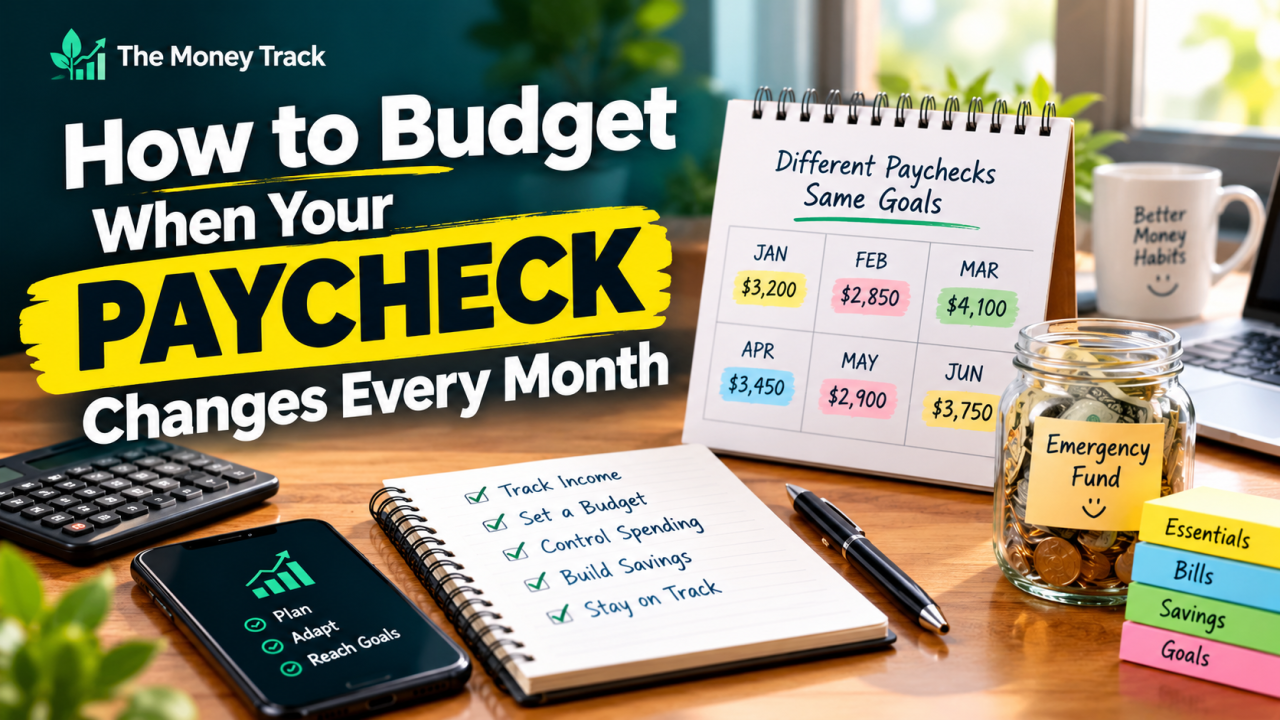
How to Budget When Your Paycheck Changes Every Month
Budgeting is relatively straightforward when you receive the same paycheck every month. You know how much money is coming in, when your bills are due, and how much you can save.
But what happens when your income changes every month?
Maybe you are a freelancer whose projects pay at different times. Perhaps you work in sales and earn commissions, drive for a gig platform, work seasonal jobs, or receive an hourly paycheck that depends on your schedule. One month, you may earn $4,000. The next month, you might bring home only $2,300.
When your income is unpredictable, paying rent, buying groceries, covering utility bills, and saving for emergencies can become stressful.
The good news is that you can learn how to budget when your paycheck changes every month without knowing exactly how much you will earn in advance. The key is to build your budget around a conservative income estimate, prioritise essential expenses, and use higher-income months to prepare for lower-income periods.
This guide explains how to create a flexible monthly budget, handle bills when payments arrive late, build a financial cushion, and avoid common money-management mistakes when your income fluctuates.
Why Budgeting Is Different When Your Income Changes
A traditional monthly budget often assumes that your income is predictable. You receive your paycheck, pay your bills, set aside savings, and spend what remains.
With irregular income, that approach can fail because your earnings and expenses do not always line up.
For example, you might earn more than usual in January but receive fewer payments in February. Meanwhile, your rent, insurance, phone bill, and debt payments may remain the same.
This creates three common challenges.
1. Your Income May Not Match Your Bills
Your essential expenses often follow a schedule, even when your income does not.
Rent may be due on the first of the month, while a client might pay you on the fifteenth or twenty-fifth. Even if you earn enough overall, the timing difference can leave you short of cash when a bill is due.
A good budget needs to account for both the amount of money you earn and when that money becomes available.
2. High-Income Months Can Create a False Sense of Security
When you earn more than expected, it is tempting to increase spending. You might upgrade your phone, book a holiday, or make purchases you have been postponing.
But a high-income month does not guarantee that next month will be equally profitable.
Without a plan, you may spend money that you will need for rent, groceries, or other essentials during a slower period.
3. Saving Can Feel Impossible
When income varies, you may feel that saving is something you can do only when business is good.
However, you can build a savings habit by adjusting your contribution to your actual income. In a difficult month, the contribution may be small or temporarily paused if essential expenses require priority. In a strong month, you can save more.
The objective is not to save the same amount every month. It is to create a system that works across different income levels.
Step 1: Calculate Your Average Monthly Income
Before deciding how much you can spend, understand how much you typically earn.
If your income changes from month to month, looking at just your most recent paycheck may give you a misleading picture.
Instead, review your income history.
Use the Last 6–12 Months of Income
Gather your bank statements, pay records, invoices, commission statements, or gig-work earnings.
Calculate your income for each month and look for patterns.
For example:
| Month | Income received |
|---|---|
| January | $3,200 |
| February | $2,400 |
| March | $3,800 |
| April | $2,700 |
| May | $4,100 |
| June | $2,600 |
| Total | $18,800 |
| Monthly average | $3,133 |
In this example, the average monthly income over six months is approximately $3,133.
To calculate your average, add the income received during the period and divide it by the number of months.
However, do not automatically use your average income as your monthly spending limit. An average can be misleading when your earnings fluctuate significantly or one unusually large payment raises the total.
For a conservative budget, you may want to compare your average with your lower-earning months.
Use Take-Home Income, Not Just Gross Income
If you are an employee, start with the amount deposited into your account after payroll deductions.
If you are self-employed or freelance, distinguish between business revenue and money you can actually spend.
For example, if a client pays you $5,000, you may still need to set aside money for business expenses, taxes, insurance, and other obligations. Your spendable income may be much lower.
Keep business and personal finances separate where practical, and use a conservative estimate of the money available for personal expenses.
For self-employed readers, tax obligations vary by country and situation. Consider a qualified tax professional if you are unsure how much to reserve.
Step 2: Build Your Budget Around a Conservative Income Baseline
One of the most useful strategies for budgeting with irregular income is to choose a baseline that you can reasonably expect to cover your essential expenses.
Instead of budgeting around your best month, use a cautious estimate based on your income history and current work situation.
For example, suppose your recent monthly income has ranged from $2,200 to $4,500.
You might choose $2,400 as an initial planning baseline if that amount is reasonably supported by your recent earnings. This is an example, not a universal formula. If your work has become less reliable, you may need to use a lower figure.
Build your core budget around this baseline.
Separate Essential and Nonessential Expenses
Essential expenses are the costs you need to cover to maintain basic stability and meet important obligations.
Examples include:
- Rent or mortgage payments
- Basic groceries
- Utilities
- Necessary transportation
- Insurance
- Minimum debt payments
- Required medication and healthcare costs
- Childcare or other essential family expenses
Nonessential expenses may include restaurant meals, entertainment subscriptions, optional shopping, and some travel spending.
The distinction is personal. For example, a phone plan may be essential for someone who needs it to earn a living, while an expensive phone upgrade may be optional.
Example of a Conservative Budget
Suppose your planning baseline is $2,400 per month.
| Expense category | Monthly amount |
|---|---|
| Rent | $900 |
| Groceries | $300 |
| Utilities and phone | $150 |
| Transportation | $200 |
| Insurance and healthcare | $150 |
| Minimum debt payments | $150 |
| Essential household expenses | $100 |
| Total essential expenses | $1,950 |
| Remaining amount | $450 |
This example leaves $450 for other priorities, such as savings, irregular bills, additional debt payments, and discretionary spending.
It does not mean that everyone should spend these exact amounts. Housing costs, family size, location, debt, and insurance needs vary widely.
The important question is whether your essential expenses fit within a realistic low-income month.
If your essential expenses consistently exceed your conservative income baseline, you may need a combination of spending adjustments, a larger cash buffer, additional income, or changes to major expenses where feasible.
Step 3: Prioritise Bills Before Discretionary Spending
When your paycheck is unpredictable, it helps to decide in advance which expenses must be funded first.
This prevents a strong income month from disappearing before important bills are covered.
A useful priority order is:
- Essential housing, utilities, food, and necessary transportation.
- Insurance, healthcare, and other critical obligations.
- Minimum payments on debts and other required bills.
- Money reserved for taxes and business expenses, if applicable.
- Emergency savings and upcoming irregular bills.
- Additional debt repayment, long-term savings, and discretionary spending according to your circumstances.
This is a flexible framework, not a rule that overrides every personal situation. If you face a bill you cannot pay, contact the provider or creditor early to discuss available arrangements rather than ignoring the problem.
Create a Bill Calendar
Write down every major bill, its due date, and the amount you expect to pay.
For example:
| Bill | Due date | Amount |
|---|---|---|
| Rent | 1st | $900 |
| Car insurance | 5th | $100 |
| Phone and internet | 10th | $80 |
| Utilities | 15th | $70 |
| Debt minimum payment | 20th | $150 |
Your actual bill schedule may be different, but the exercise helps you see how much money needs to be available at different points in the month.
If your income arrives late or in uneven amounts, consider asking service providers whether a different due date is available. Not every provider offers this option, and changes may take time to arrange.
Avoid Treating Every Deposit as Spendable Money
A payment arriving in your account does not necessarily mean you can spend all of it.
Some of that money may already be needed for rent, next month's groceries, taxes, business costs, or bills that are not due yet.
Give incoming money a purpose as soon as you reasonably can. This is especially important when you receive a large payment after a quiet period.
Part 2: How to Budget When Your Paycheck Changes Every Month
4. Create a System for High-Income and Low-Income Months
When your paycheck changes every month, the biggest budgeting mistake is treating a high-income month as your new normal. A strong month can make you feel financially comfortable, but the next month might bring fewer clients, fewer working hours, or a smaller commission.
Instead, create a system that helps you manage both situations.
What to Do in a Low-Income Month
When your income falls below your usual baseline, focus on protecting your essentials rather than trying to maintain your normal lifestyle.
Follow these steps:
- Cover essential bills first. Prioritize housing, groceries, utilities, transportation, insurance, and minimum debt payments.
- Pause nonessential spending. Temporarily reduce restaurant meals, shopping, entertainment, subscriptions, and other flexible expenses.
- Use your income buffer if necessary. Your buffer exists to help you manage lower-income periods without relying on credit cards or missing essential payments.
- Contact creditors early if you expect trouble. Ask about available payment arrangements before you miss a payment.
- Avoid making long-term financial commitments based on a temporary high-income month.
The goal is not to eliminate every enjoyable expense. It is to keep your finances stable until income improves.
What to Do in a High-Income Month
A larger paycheck gives you an opportunity to prepare for future uncertainty.
Rather than spending the extra money immediately, assign it a purpose.
For example, suppose your normal budgeting baseline is $2,400, but you earn $3,600 this month. That leaves $1,200 above your baseline.
You could allocate the extra income like this:
| Purpose | Amount |
|---|---|
| Build your income buffer | $600 |
| Save for irregular expenses | $250 |
| Pay extra toward high-interest debt | $200 |
| Enjoyment or personal spending | $150 |
| Total | $1,200 |
These amounts are illustrative, not mandatory. Adjust them according to your debt, savings, and upcoming expenses.
The key rule: Give extra income a job before you spend it.
5. Build a Paycheck Buffer to Smooth Out Your Income
One of the most effective ways to budget with an irregular paycheck is to create an income buffer.
An income buffer is money you set aside during stronger months to help cover your expenses during weaker months. It works like a bridge between paychecks of different sizes.
It is different from a general emergency fund, although the two can overlap when you are starting out.
How Much Should You Keep in Your Income Buffer?
Start with a small, achievable target instead of waiting until you can save several months of expenses.
Consider these stages:
| Stage | Suggested target | Purpose |
|---|---|---|
| Stage 1 | $500 | Handle a small income shortfall |
| Stage 2 | One month of essential expenses | Cover a difficult month |
| Stage 3 | Two to three months of essential expenses | Improve stability during repeated fluctuations |
| Stage 4 | Three to six months or more, if appropriate | Prepare for prolonged income disruption |
These are general planning guidelines, not fixed rules. Someone with highly seasonal work, dependents, or limited access to other support may need a larger reserve.
How to Build Your Buffer Step by Step
Step 1: Open a separate savings account.
Choose an account that is accessible when you need the money but separate from your everyday spending account. Check any fees, withdrawal restrictions, and applicable deposit protections.
Step 2: Save a percentage of higher paychecks.
For example, you might direct 30% of the amount above your budget baseline toward the buffer until it reaches your first target.
Step 3: Refill the buffer after using it.
If you use $400 during a slow month, make rebuilding that amount a priority when income improves.
Step 4: Avoid using the buffer for routine lifestyle upgrades.
A new gadget or an expensive weekend trip should not be the reason you empty money reserved for low-income periods.
Example: Using a Buffer During a Slow Month
Imagine that your monthly budgeting baseline is $2,400.
- Month 1 income: $3,500
- Amount above baseline: $1,100
- Amount saved toward buffer: $700
- Month 2 income: $1,900
- Shortfall compared with baseline: $500
If you have enough money available in your buffer, you can transfer $500 to cover the planned budget shortfall. This helps you keep essential bills on track without pretending that the second month was a normal earning month.
Remember to account for when money actually arrives. A budget can look balanced on paper and still fail if a bill is due before your next payment comes in.
6. Plan for Expenses That Do Not Arrive Every Month
Irregular income is not the only challenge. Many expenses are irregular, too.
Annual insurance premiums, car repairs, medical bills, school costs, holiday spending, professional fees, and equipment replacements can disrupt an otherwise sensible budget.
These expenses may be predictable even if their exact dates or amounts are uncertain.
Create a Sinking Fund for Each Major Expense
A sinking fund is money you save gradually for a known future cost.
For example, suppose you expect the following expenses over the next year:
| Expense | Estimated yearly cost | Monthly saving target |
|---|---|---|
| Car maintenance | $600 | $50 |
| Annual insurance bill | $480 | $40 |
| Gifts and holidays | $360 | $30 |
| Medical and dental costs | $300 | $25 |
| Equipment replacement | $240 | $20 |
| Total | $1,980 | $165 |
Instead of facing a $480 insurance bill all at once, you set aside $40 each month.
If your income varies, you do not necessarily have to transfer the same amount every month. You can contribute more during strong months and less during weak ones, as long as you keep upcoming deadlines in view.
Separate Your Savings by Purpose
Consider using separate savings accounts or clearly labeled categories for:
- Income buffer
- Emergency fund
- Annual bills
- Repairs and maintenance
- Taxes, if you are self-employed
- Short-term goals
You do not need a separate bank account for every category. A budgeting app or spreadsheet can track separate balances within one account.
The important thing is to avoid treating every dollar in savings as available spending money.
7. Automate Your Budget Without Overdrafting Your Account
Automation can make budgeting easier, but it needs to be flexible enough for variable income.
If you set up fixed transfers based on your best month, you could accidentally move money needed for rent or groceries.
Instead, automate the parts of your budget that remain reliable.
A Safer Automation Strategy
Automate essential bills when your cash flow allows it. Keep enough money in the payment account to cover upcoming bills and account for payment dates.
Use percentage-based savings rules. For example, you could save 10% of each deposit or direct a larger percentage of income above your baseline toward savings. Choose a percentage that does not put essential bills at risk.
Review automatic transfers monthly. If your income drops sharply, temporarily reduce optional transfers before risking an overdraft or missed essential payment.
Keep a minimum checking-account balance. Choose a realistic amount based on upcoming bills and the timing of your deposits.
Use a Three-Bucket System
A simple way to organize irregular income is to divide your money into three buckets:
  <text color="secondary" size="sm">Housing, groceries, utilities, transportation, insurance, and minimum debt payments. Fund these first.</text>
</box>
  <text color="secondary" size="sm">Income buffer, emergency savings, taxes if applicable, and money for upcoming irregular expenses.</text>
</box>
  <text color="secondary" size="sm">Eating out, hobbies, shopping, entertainment, and other optional purchases.</text>
</box>
Only allocate money to flexible spending after essential obligations and near-term needs are accounted for.
8. Follow a Weekly Budget Check-In
A monthly budget can be too slow for people whose income changes frequently. A short weekly review helps you spot problems before they become expensive.
Set aside 10–15 minutes once a week.
Review these five things:
- Current balance: How much money is actually available?
- Upcoming bills: What must be paid before the next expected deposit?
- Income updates: Have any clients, shifts, commissions, or payments changed?
- Flexible spending: Are you spending faster than your budget allows?
- Savings and shortfalls: Do you need to add to the buffer or temporarily reduce spending?
Do not rely only on your bank balance. Some of that money may already be needed for bills due in the next few days.
A Simple Weekly Review Example
Suppose you have $1,200 in your checking account.
- Rent due next week: $700
- Utilities due soon: $100
- Groceries and transportation needed before payday: $150
Your remaining uncommitted money is:
$1,200 − $700 − $100 − $150 = $250
Although your account shows $1,200, only $250 is available for other spending after accounting for these known needs.
This simple calculation can prevent accidental overspending.
9. Create a Practical Budget for Fluctuating Income
Let's bring the main ideas together with a sample monthly budget.
Assume your income varies, but you decide to plan around a conservative take-home baseline of $2,400.
| Budget category | Monthly amount |
|---|---|
| Rent | $900 |
| Groceries | $300 |
| Utilities and phone | $150 |
| Transportation | $200 |
| Insurance and healthcare | $150 |
| Minimum debt payments | $150 |
| Household essentials | $100 |
| Essential expenses | $1,950 |
| Sinking funds for upcoming expenses | $150 |
| Income-buffer contribution | $100 |
| Flexible spending | $200 |
| Total planned allocation | $2,400 |
This budget gives every dollar a purpose while leaving some room for personal spending.
It is only an example. Your own housing costs, debt, family responsibilities, and local cost of living may require a different allocation.
What Happens When You Earn More Than $2,400?
Suppose you receive $3,200.
Your extra income is $800. You could use it to build the buffer, cover upcoming expenses, reduce high-interest debt, or work toward a specific savings goal.
What Happens When You Earn Less Than $2,400?
Suppose you receive $2,000.
You have a $400 shortfall compared with your baseline. First, review whether you can reduce flexible spending or postpone nonessential purchases. If the remaining shortfall affects essential bills, use your income buffer if available and reassess the budget before the next month.
If low-income months happen repeatedly, do not rely on savings indefinitely. Revisit your baseline, reduce fixed commitments where feasible, look for ways to increase reliable income, and seek assistance or negotiate payment arrangements when needed.
10. Common Budgeting Mistakes to Avoid
Even a well-designed budget can fail if you use unrealistic assumptions.
Mistake 1: Budgeting Based on Your Best Month
A record month is not a reliable estimate of what you can spend every month.
Better approach: Use a conservative income baseline that reflects what you can reasonably expect during slower periods.
Mistake 2: Treating Gross Income as Spendable Money
Freelancers, contractors, and self-employed people may need to account for taxes, business expenses, fees, and delayed payments.
Better approach: Budget using money available for personal expenses after accounting for these obligations.
Mistake 3: Ignoring Payment Timing
A client may owe you money, but that does not mean the money is available to pay today's bills.
Better approach: Track expected payment dates and make plans based on money already received, not just invoices sent.
Mistake 4: Saving Only What Is Left at the End of the Month
When income is unpredictable, optional spending can absorb extra money before you have a chance to save it.
Better approach: Give each deposit a plan as soon as practical, while protecting essential expenses.
Mistake 5: Making Your Budget Too Strict
A budget with no room for occasional enjoyment may be difficult to follow.
Better approach: Include a realistic amount for flexible spending when your essentials and near-term obligations are covered.
Mistake 6: Using Credit Cards to Hide a Persistent Shortfall
Credit can sometimes help manage timing, but repeatedly borrowing to pay ordinary bills can create a debt cycle.
Better approach: If income regularly falls short of essentials, review the underlying numbers, contact creditors early, and explore practical ways to reduce costs or improve income.
11. Useful Tools for Managing Irregular Income
You do not need an expensive budgeting system to manage changing paychecks. Start with a tool you can update consistently.
| Tool | Best for | Main benefit |
|---|---|---|
| Spreadsheet | People who want flexibility | Easy to customize income and expense categories |
| Budgeting app | People who prefer automation | Can simplify transaction tracking and spending reviews |
| Calendar | People with many bill due dates | Helps match payment timing with expected income |
| Separate savings account | People who need a visible buffer | Makes reserved money less tempting to spend |
| Notebook or paper planner | People who prefer a simple method | Encourages regular manual reviews |
Choose a system that fits your habits. A simple spreadsheet reviewed every week is more useful than a sophisticated app you stop using after two days.
When using an app, review its fees, privacy practices, bank connections, and whether its features work with your accounts before linking sensitive financial information.
Conclusion: Take Control of Your Budget, Even When Your Income Changes
Learning how to budget when your paycheck changes every month is about building a flexible financial system, not predicting your income perfectly.
Start by reviewing your past six to twelve months of income and choosing a conservative monthly baseline. Use that amount to plan essential expenses, prioritize bill payments, and limit flexible spending. During higher-income months, build an income buffer and save for expenses that do not occur every month. During lower-income months, focus on necessities and adjust optional spending before reaching for credit.
Remember that consistency matters more than perfection. Your budget will need occasional changes as your income, expenses, and financial goals evolve.
You do not need a complicated app or a large savings balance to begin. Start with your current numbers, review your budget every week, and gradually build a financial cushion that helps you feel more secure.
Your first step today: Calculate your average monthly take-home income, identify your essential expenses, and decide how much you can set aside from your next higher-than-usual paycheck.
Key Takeaways
- Use a conservative income baseline: Base your budget on realistic earnings rather than your best month.
- Prioritize essential expenses: Cover housing, groceries, utilities, transportation, insurance, and minimum debt payments first.
- Build an income buffer: Save money during stronger months to help cover shortfalls during weaker months.
- Prepare for irregular expenses: Use sinking funds for annual bills, repairs, medical costs, and other predictable expenses.
- Review your budget weekly: Track your available balance, upcoming bills, expected income, and flexible spending.
- Automate carefully: Set savings transfers and bill payments that your cash flow can support.
- Avoid lifestyle inflation: Do not increase regular spending simply because you earned more this month.
- Adjust when necessary: If income repeatedly falls below essential expenses, reassess your budget and explore ways to reduce costs or improve income.
A flexible budget gives every dollar a purpose while allowing you to adapt when your paycheck changes.
Start Building a Budget That Works With Your Income
Ready to take control of your changing paycheck? Start by listing your income from the past six months, calculating your essential monthly expenses, and identifying one area where you can save.
Use the simple budgeting steps in this guide to create a plan that works in both high-income and low-income months.
Take action today: Set your monthly baseline, plan your next round of bill payments, and begin building your income buffer—even if you can save only a small amount at first.
Small, consistent steps can help you build better money habits and greater financial stability over time.
Frequently Asked Questions
1. How do I budget when my paycheck changes every month?
Calculate your average take-home income from the past six to twelve months, then choose a conservative monthly baseline. Cover essential expenses first, save extra income during stronger months, and use an income buffer to manage shortfalls.
2. What is the best budgeting method for irregular income?
A zero-based budget combined with a conservative income baseline can work well. Assign your available money to essentials, savings, debt payments, irregular expenses, and flexible spending. Update your plan whenever your actual income changes.
3. Should I budget using my average monthly income?
You can use your average income as a reference, but budgeting strictly around the average may be risky if your income fluctuates significantly. Consider a conservative baseline that reflects what you can reasonably expect during slower months.
4. How much money should I keep in an income buffer?
Start with a small target, such as $500, and work toward at least one month of essential expenses. Depending on your income volatility, responsibilities, and available support, building a reserve covering several months of essential expenses may be appropriate.
5. What should I do when my paycheck is lower than expected?
Prioritize essential bills, reduce nonessential spending, review upcoming payment dates, and use your income buffer if necessary. If you expect to miss a payment, contact the provider or creditor early to discuss possible arrangements.
6. How should I handle extra money in a high-income month?
Assign the extra money a purpose before spending it. Consider building your income buffer, saving for upcoming bills, paying down high-interest debt, contributing to long-term goals, and setting aside a reasonable amount for enjoyment.
7. How can freelancers budget when clients pay at different times?
Track invoices, expected payment dates, business expenses, and personal expenses separately. Budget using money actually available for personal use after accounting for business costs and applicable taxes. Maintain a reserve to manage delayed payments.
8. Should I save money even when my income is low?
First make sure essential expenses and required payments are covered. If money remains, save an affordable amount. During a serious shortfall, it may be more appropriate to protect necessities than to make a savings contribution that forces you to borrow for basic expenses.
9. How often should I review a budget with variable income?
A weekly check-in is a useful starting point. Review your account balances, upcoming bills, income updates, and spending. You can also complete a more detailed review at the end of each month to adjust your baseline and savings targets.
10. Can I use a budgeting app for an irregular paycheck?
Yes. Budgeting apps, spreadsheets, calendars, and paper planners can all work. Choose a tool that lets you track changing income, upcoming bills, savings goals, and spending categories. Consistent use matters more than the tool itself.
Suggested External Links
-
Consumer Financial Protection Bureau (CFPB) — Consumer guidance on budgeting, cash flow, and managing financial challenges: https://www.consumerfinance.gov/
-
Federal Trade Commission (FTC) — Consumer information about credit, debt, and avoiding financial scams: https://consumer.ftc.gov/
-
MyMoney.gov — US government resources on budgeting, saving, and financial planning: https://www.mymoney.gov/
Use external links where they add useful context rather than adding links simply to increase their number.
Audience note: This article uses US-dollar examples. If your target audience is in India, localize the examples to ₹ and review relevant Indian financial education resources before publishing.